Stack up against BuzzFeed

Compare Your Deck

BuzzFeed's 2008 Pitch Deck

Media
Stage: Seed
Raised: $3.5M
Year: 2008
Slides: 21
Outcome: SPAC at $1.5B, later declined

Pitch Deck

1 / 21
Slide 1
Click to expand

Deck Analysis

This 2008 BuzzFeed seed deck presents a crisp product-driven pitch from a team that combined editorial taste with data and distribution technology. Notable for its early articulation of "buzz" detection, distributed widgets, and "ads as content," the deck balances traction, product roadmap, monetization, and a lightweight team slide. It foreshadows how BuzzFeed would grow by blending editorial curation, algorithmic signals, and a platform approach — a combination that later scaled to a large media-technology business and public exit.

Cover & Positioning: Clear brand promise

Cover & Positioning: Clear brand promise

The opening slide (clean red cover with the BuzzFeed name and tagline "What's Buzzing on the Web?") is minimalist and memorable. It establishes an immediate brand identity and a simple thesis: the company is about surfacing what's trending. This kind of clarity helps the audience instantly understand category and purpose without cognitive overload.

Founders can learn from this restraint: a one-sentence positioning on the first slide sets expectations and creates a through-line for the rest of the deck. The slide also projects design confidence — an important signal for consumer-facing products — and prepares investors for a narrative that will connect audience, product, and monetization.

Key Takeaway: Open with a single clear line that states your product's promise and category — simplicity and design confidence set the tone.
Traction & Unit Economics: Quantify early momentum

Traction & Unit Economics: Quantify early momentum

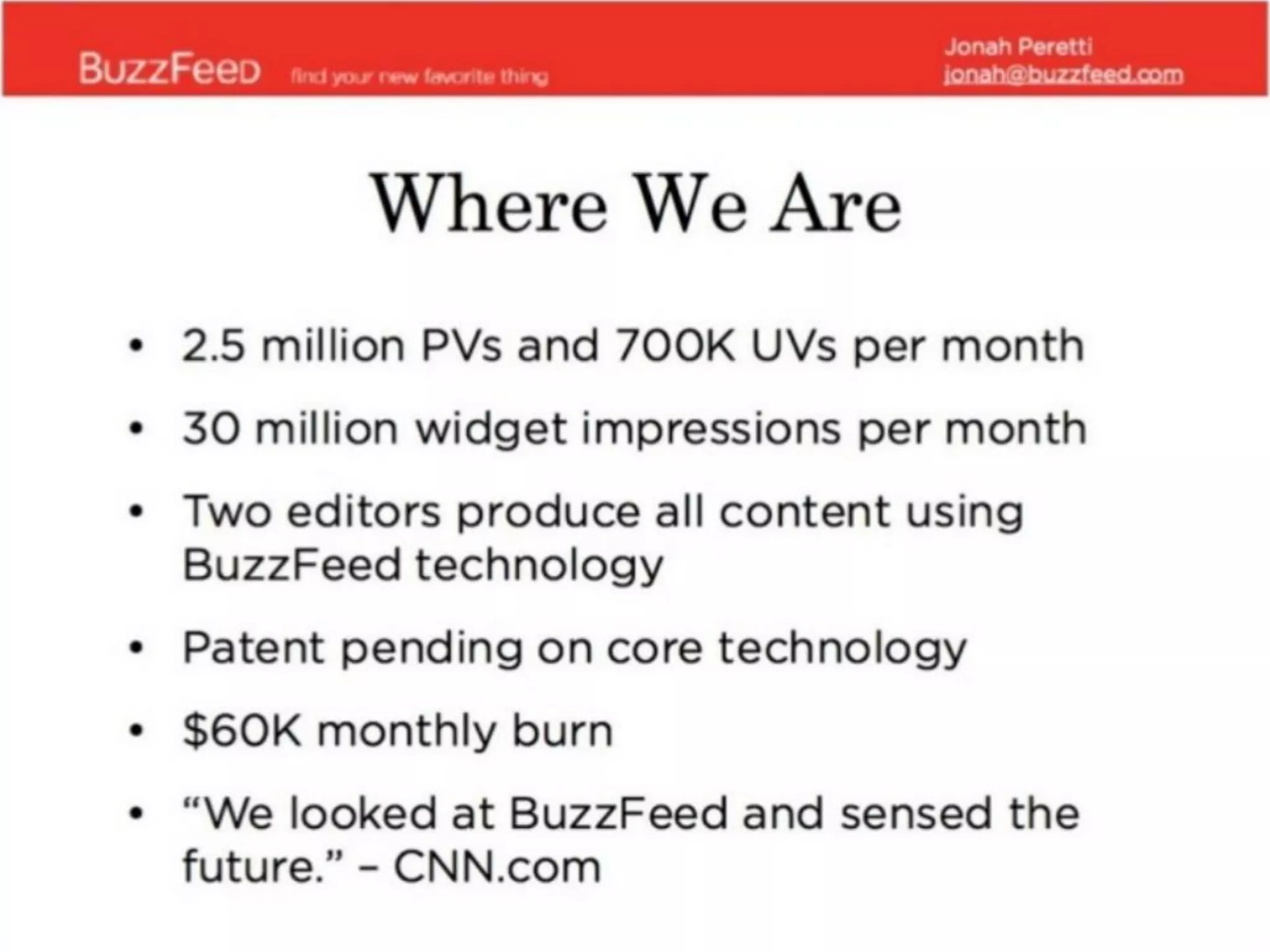
Slide 2 lists concrete metrics: pageviews, unique visitors, 30m widget impressions, two editors producing content, patent pending, and a $60K monthly burn. These specifics give investors fast, actionable signals about traction, operational efficiency, and runway. The mix of audience metrics and operational detail (staffing, burn) shows that the founders understand both growth and unit economics.

The slide also includes a short external quote (CNN) which adds third-party validation — a strong move for early-stage consumer media. For founders, presenting a few high-signal metrics (traffic, engagement/distribution metrics, burn) is more persuasive than overwhelming with vanity stats. This slide balances credibility and realism by showing both upside and costs.

Key Takeaway: Present a concise set of high-signal metrics (audience, distribution, burn) and include third-party validation where possible to build credibility.
Vision & Roadmap: Roadmap tied to scaling leverage

Vision & Roadmap: Roadmap tied to scaling leverage

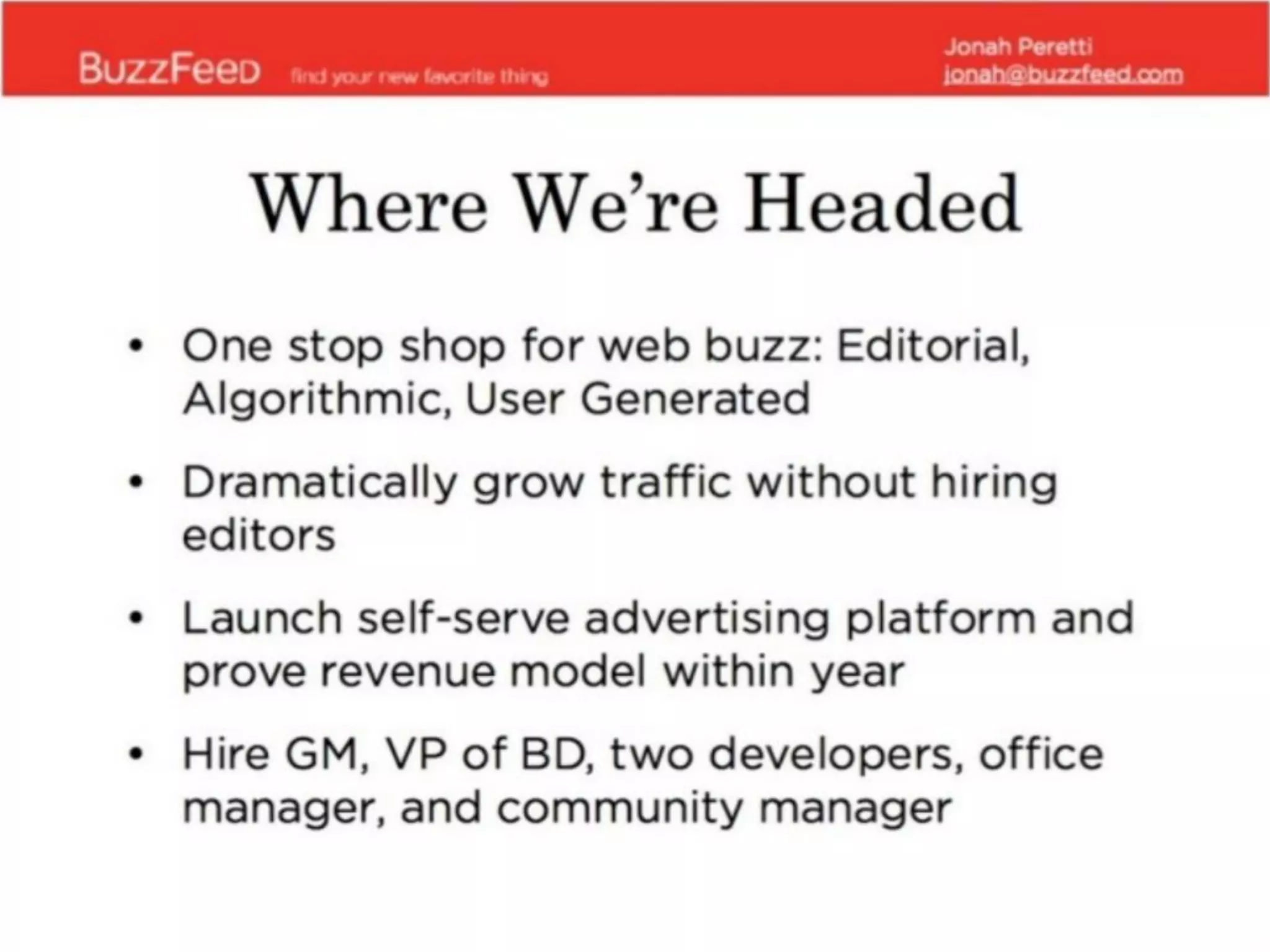
Slide 3 outlines where BuzzFeed is headed — combining editorial, algorithmic detection, and user-generated content; growing traffic without hiring editors; launching a self-serve ad platform; and specific hires. This roadmap communicates a clear lever for fast scaling: shift from editorially intensive content to algorithmic and user-generated models that multiply output without linear editorial headcount growth.

Founders should note how the deck ties product evolution to capital needs and organizational hires. By describing both product features (self-serve ad platform) and immediate personnel needs (GM, BD, developers), the team makes a practical connection between the raise and expected milestones. Investors like to see how funding will be deployed to de-risk scaling plans.

Key Takeaway: Show a product roadmap that explains how growth will become more capital-efficient (e.g., automation, self-serve tools) and link hires to milestones.
Product & Front Page Strategy: Multi-source content funnel

Product & Front Page Strategy: Multi-source content funnel

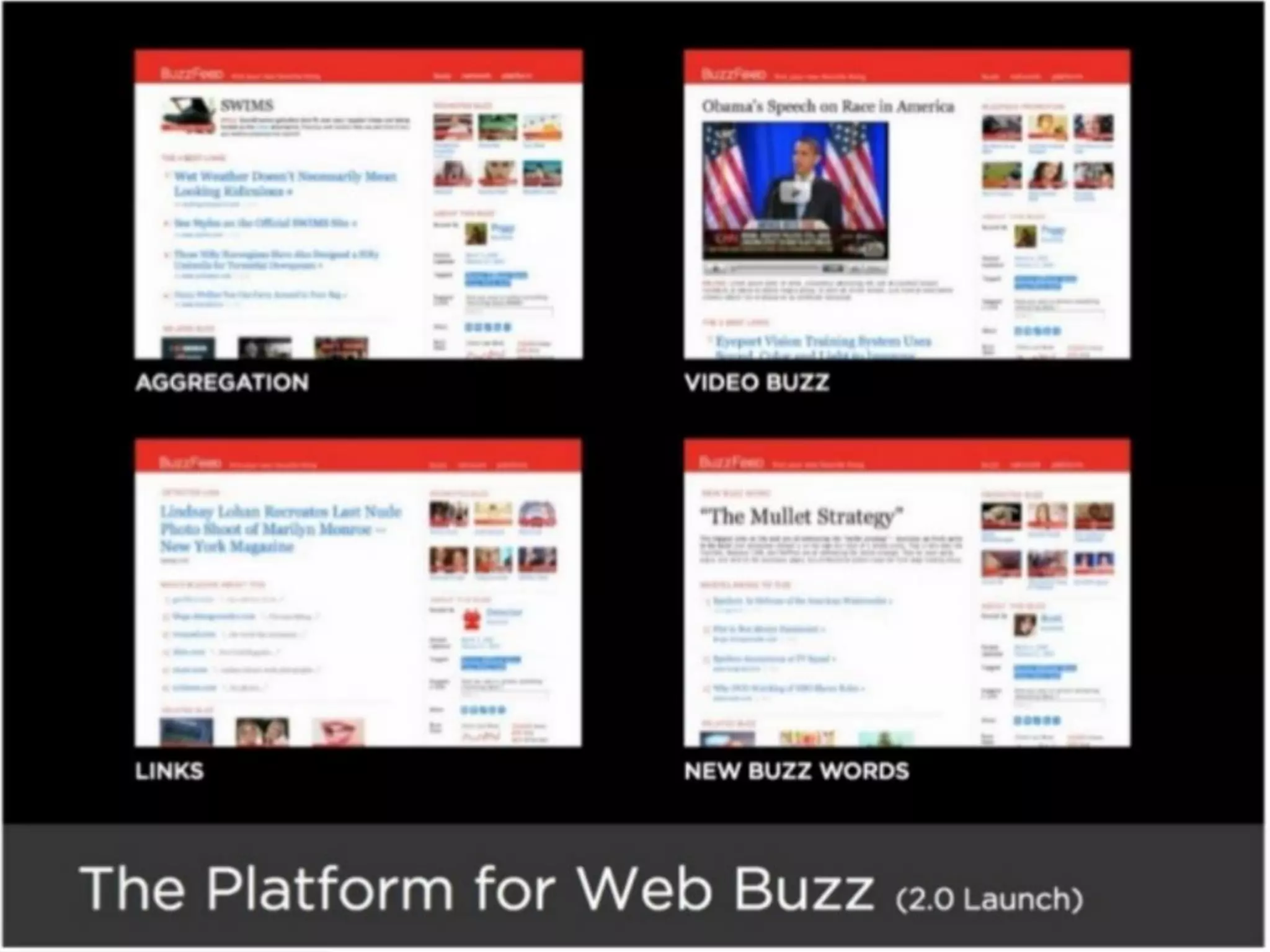
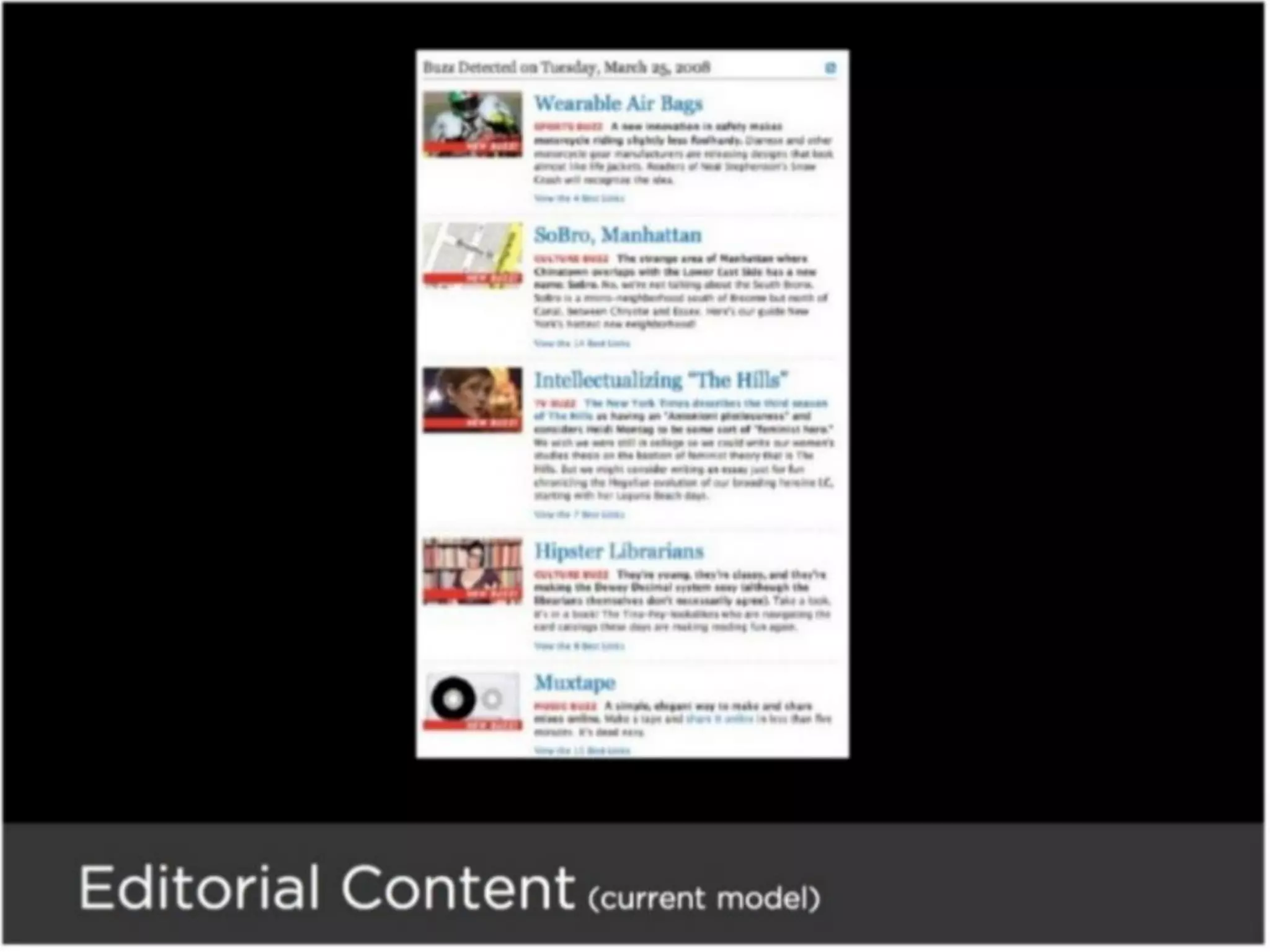
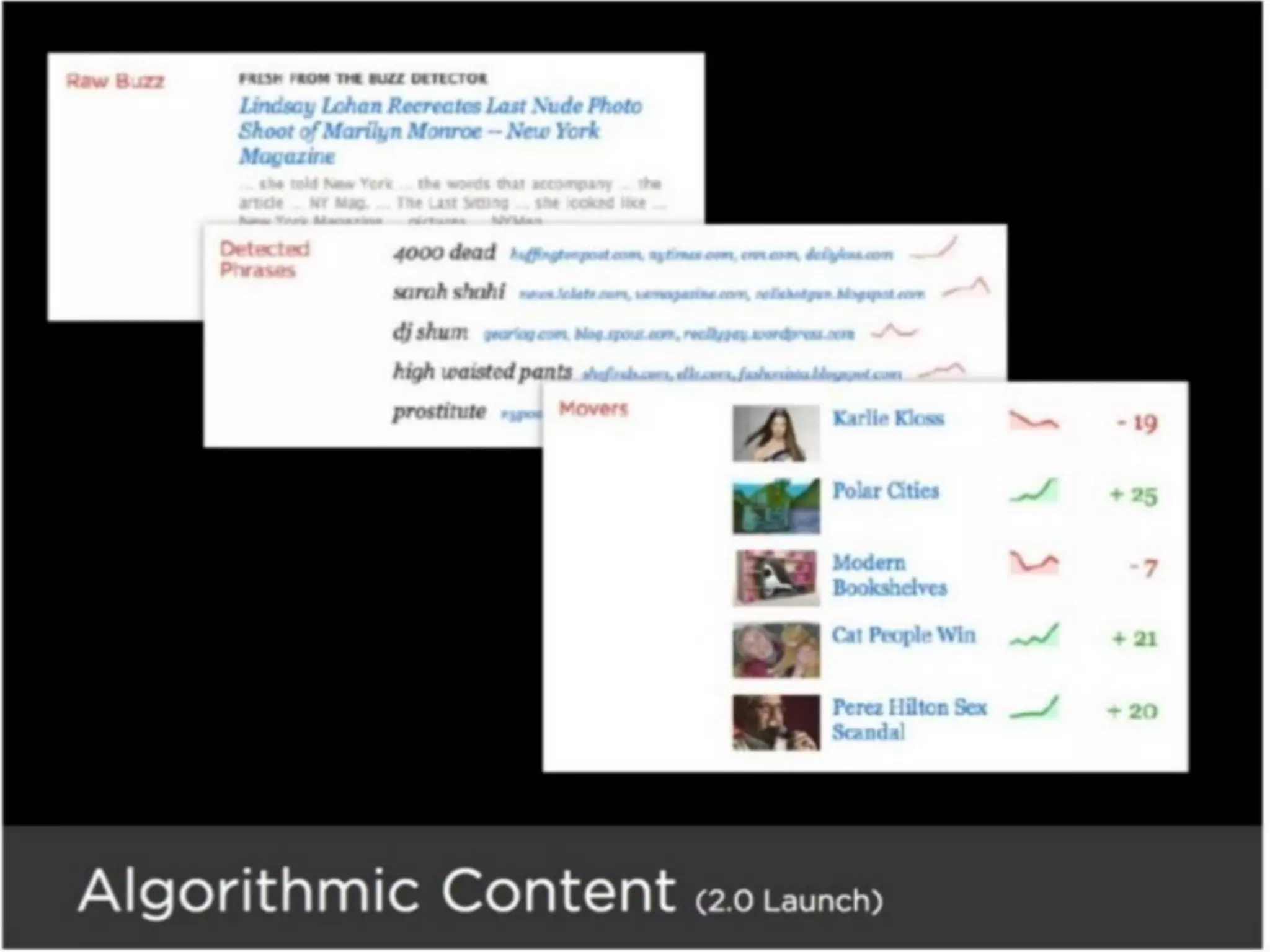
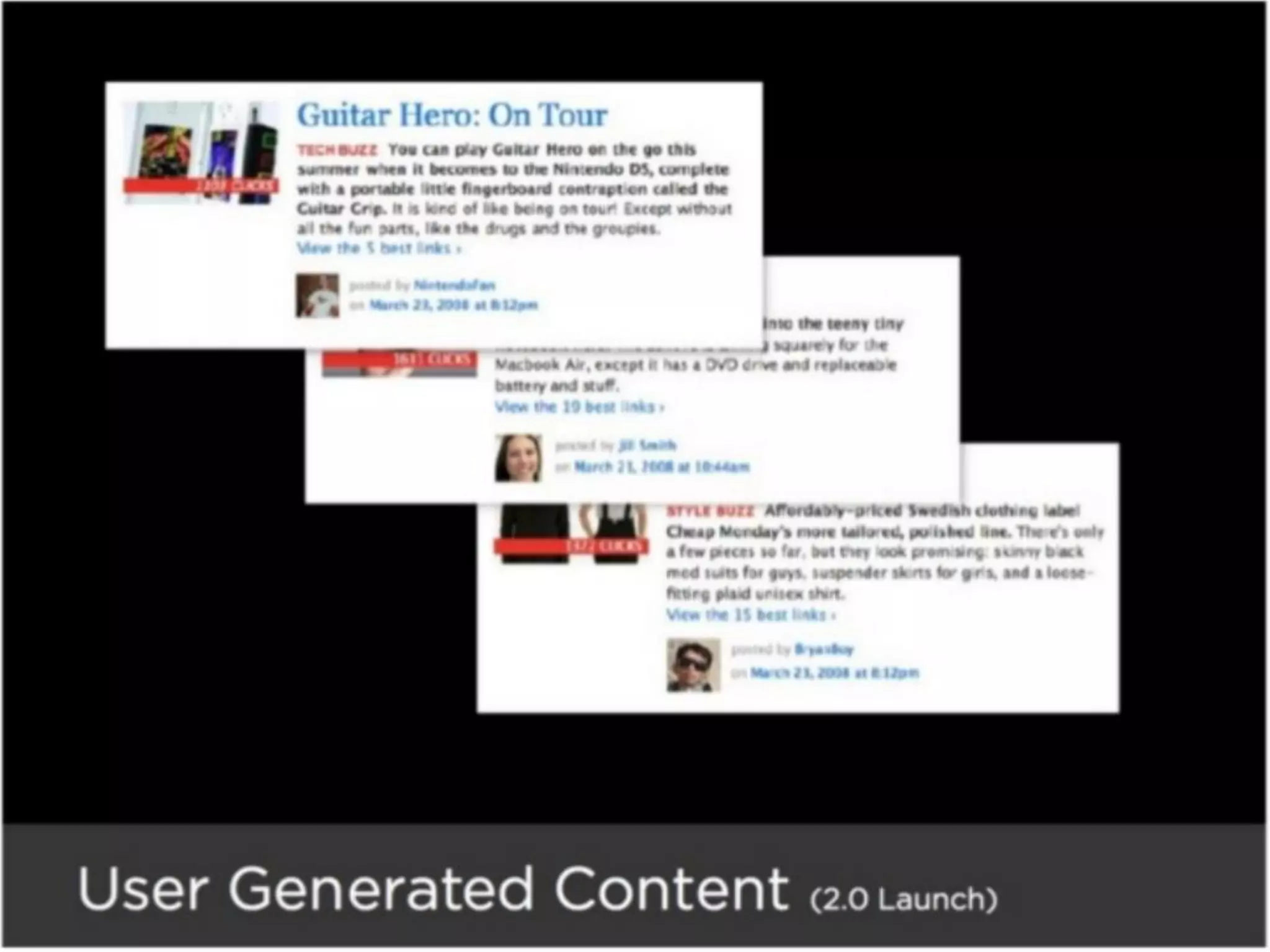
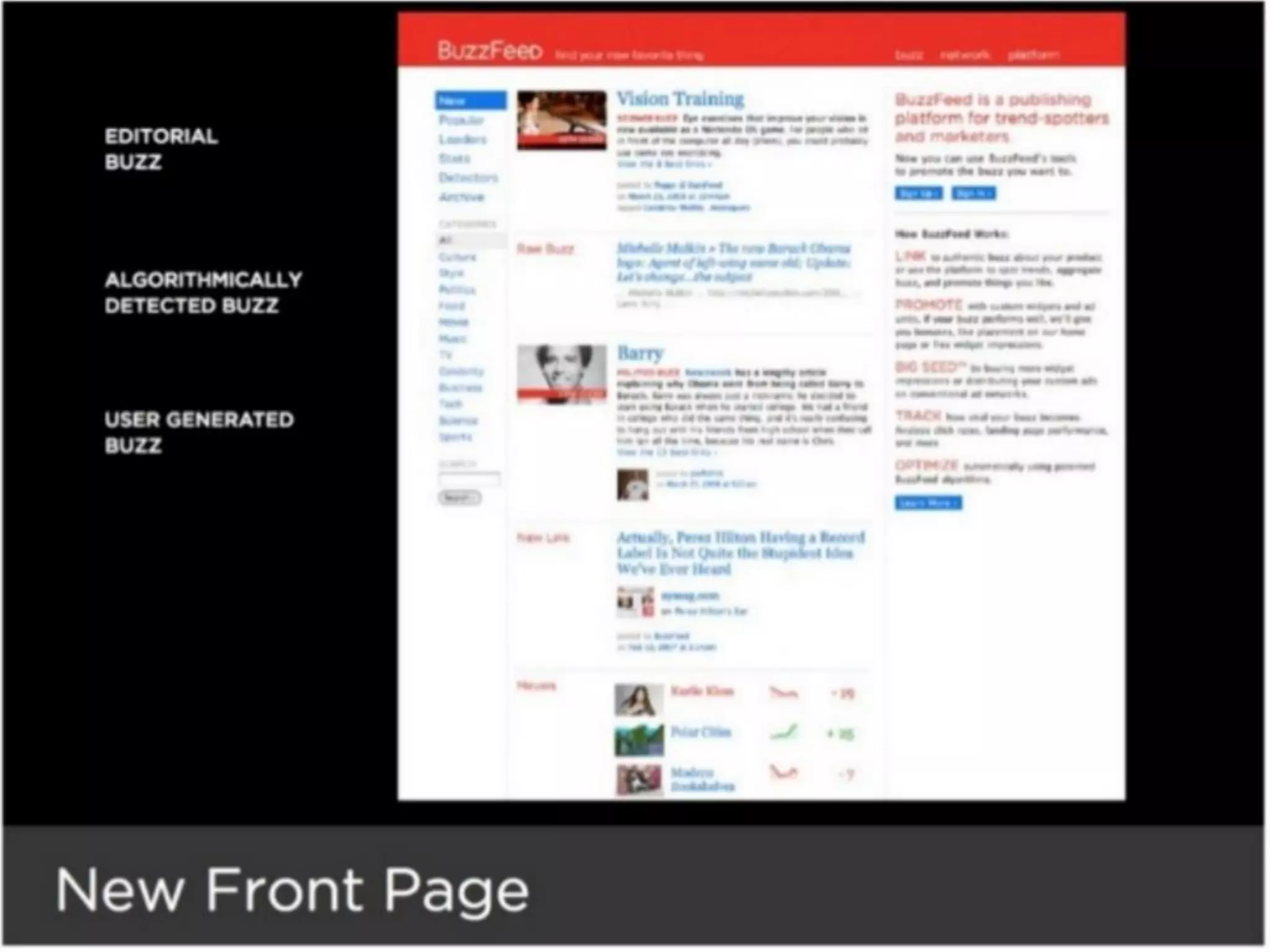
The "New Front Page" slide (slide 8) visualizes how editorial buzz, algorithmically detected buzz, and user-generated buzz coexist on the homepage. This is an important product insight: a mixed feed that leverages multiple content sources reduces single-channel risk and increases content velocity. The interface-level depiction helps investors visualize user experience rather than just abstract concepts.

From a founder perspective, this slide demonstrates the power of a layered content strategy: editorial for quality, algorithms for scale, and users for density. It also implicitly highlights retention and discovery mechanics (fresh, trending, leaderboard-style signals) that make the site sticky. Showing an actual front-page mockup instead of a text-only plan helps translate strategy into tangible product execution.

Key Takeaway: Use mockups to show how different content sources integrate in the product; a layered content feed communicates a scalable editorial strategy.
Monetization: Ads-as-content and premium services

Monetization: Ads-as-content and premium services

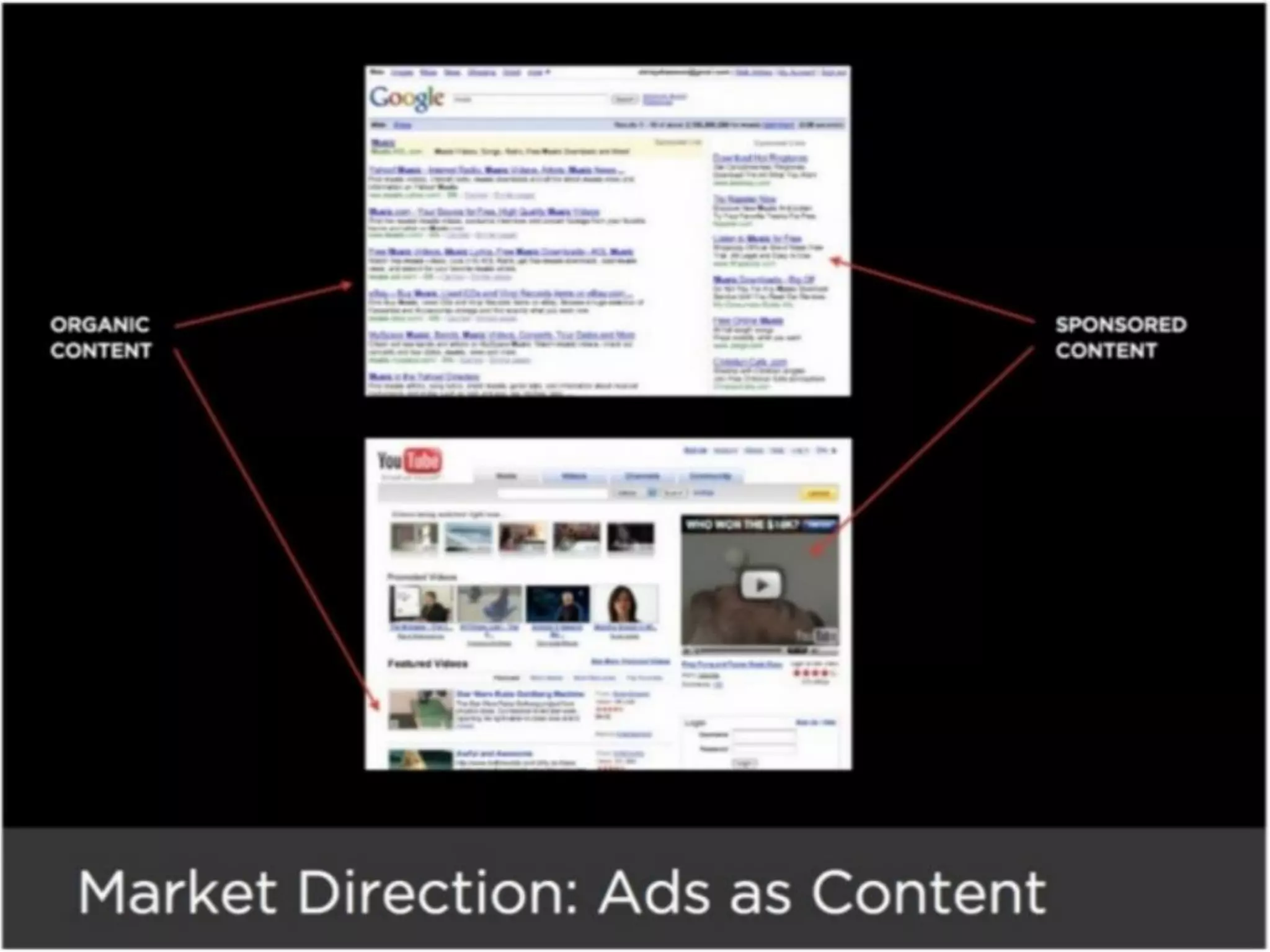
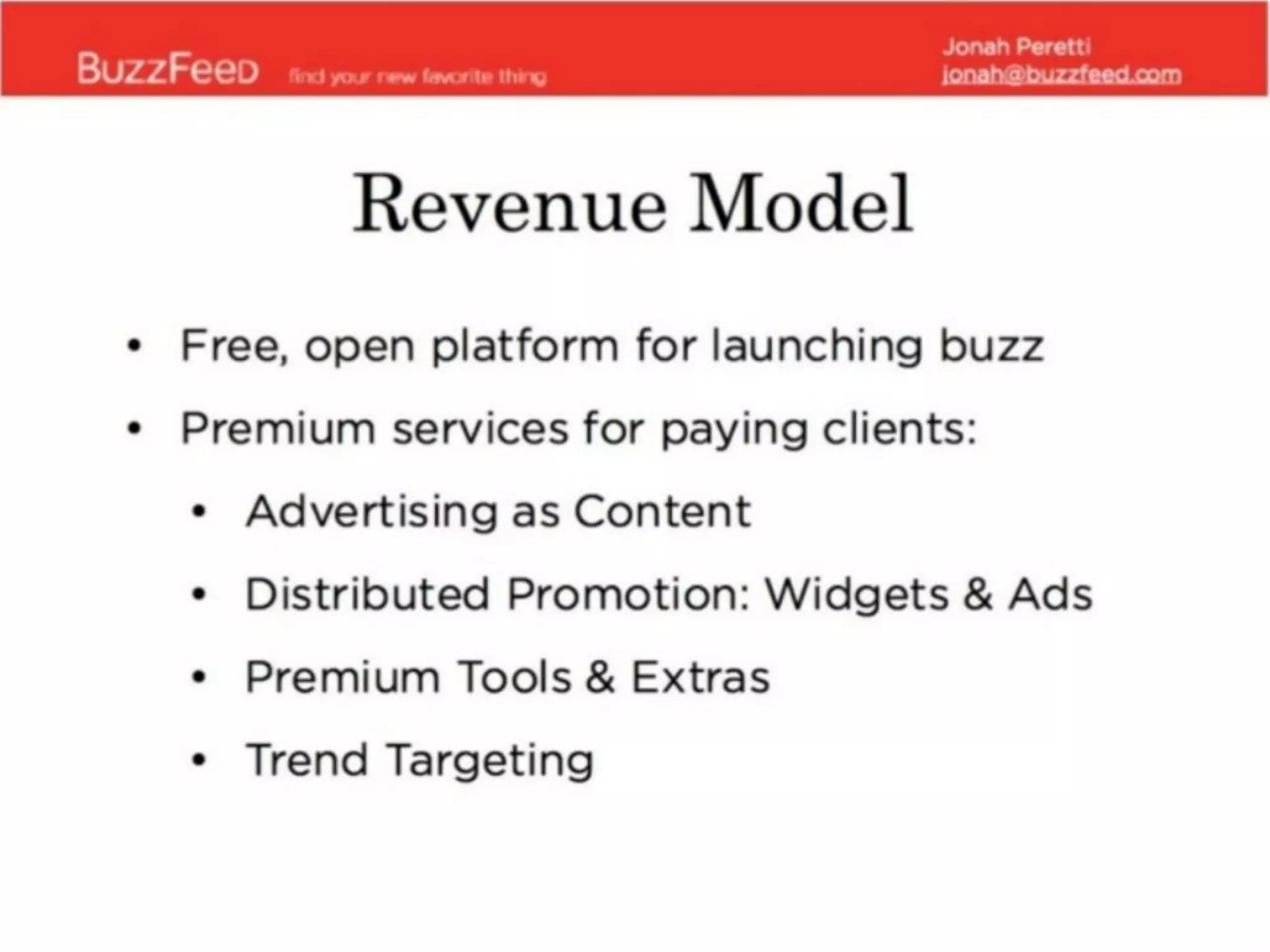
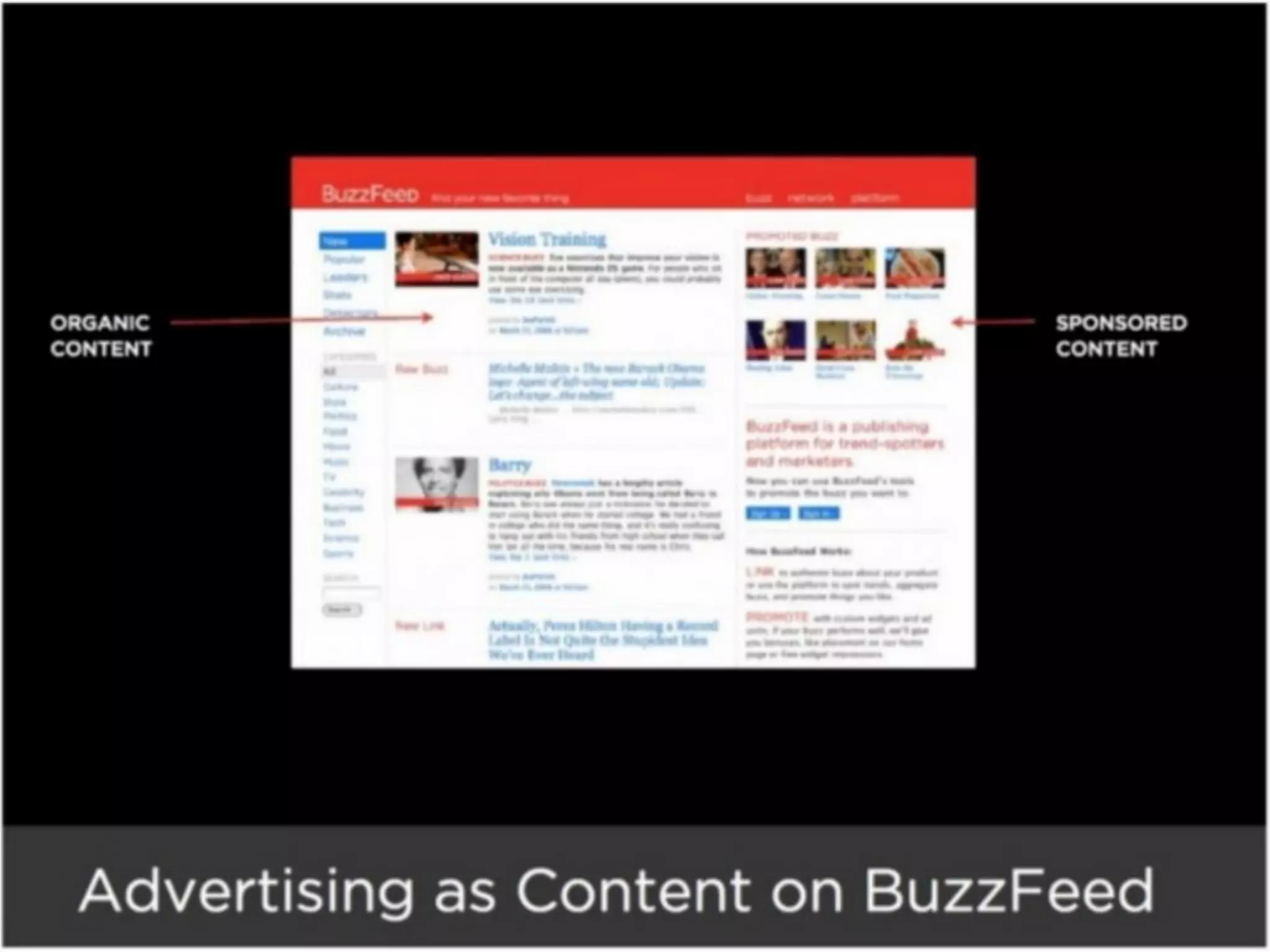
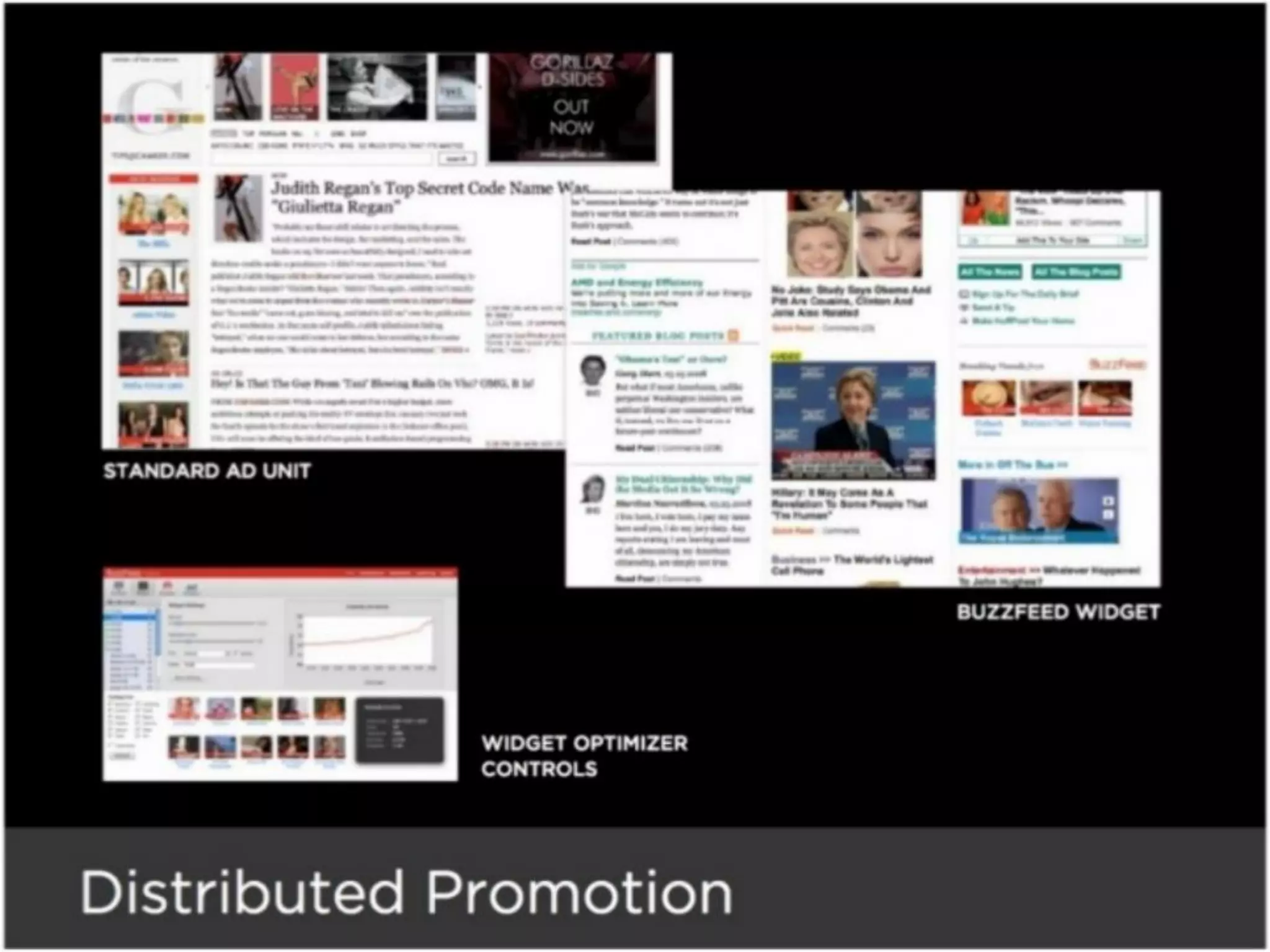
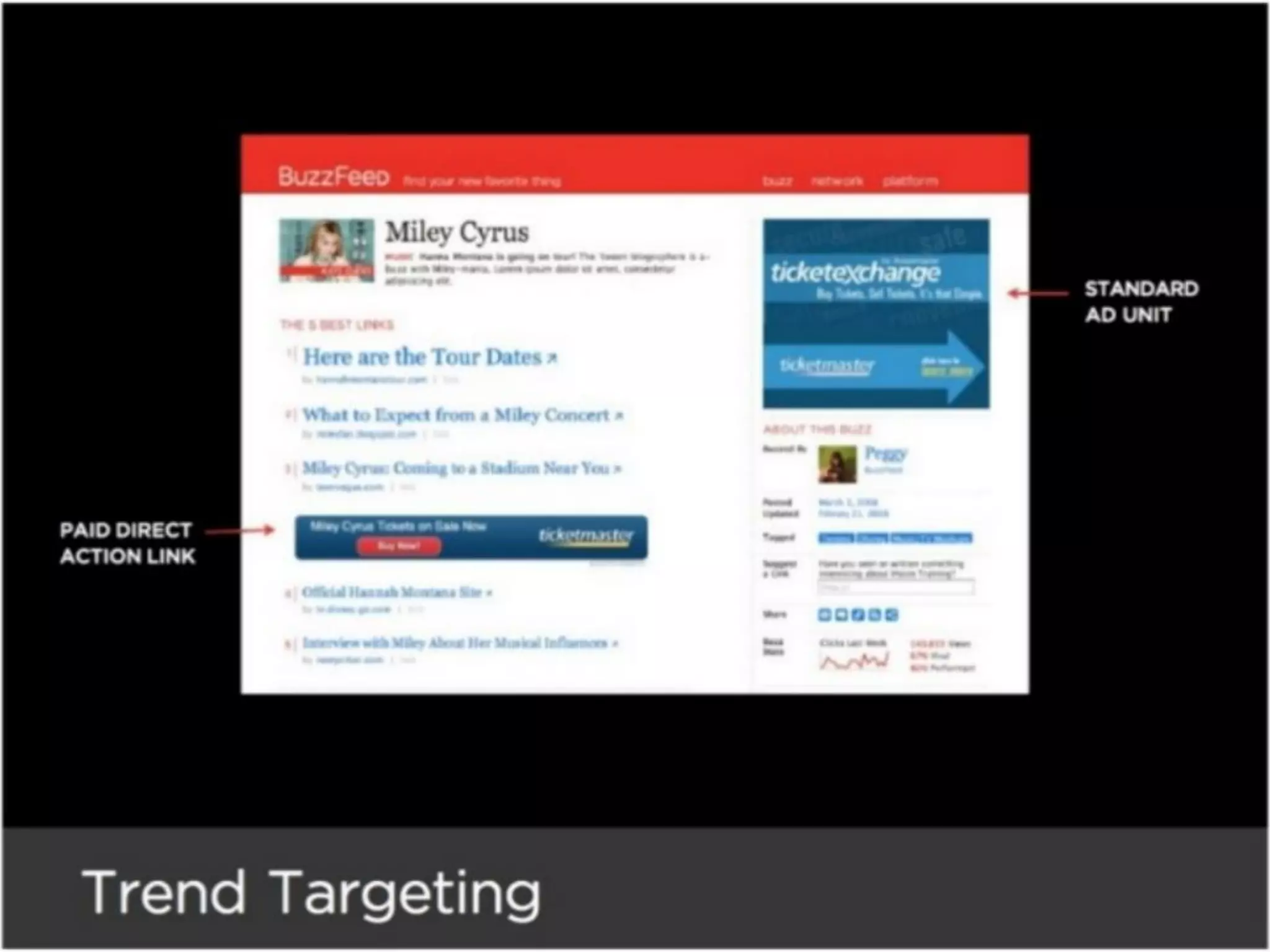
Slide 13 (Revenue Model) lists a free platform plus premium services: advertising as content, distributed promotion (widgets & ads), premium tools/extras, and trend targeting. This demonstrates a multi-pronged revenue approach that fits the product — selling both attention (ad units/widgets) and platform features (tools/trends). The inclusion of both organic and sponsored pathways shows a realistic monetization funnel.

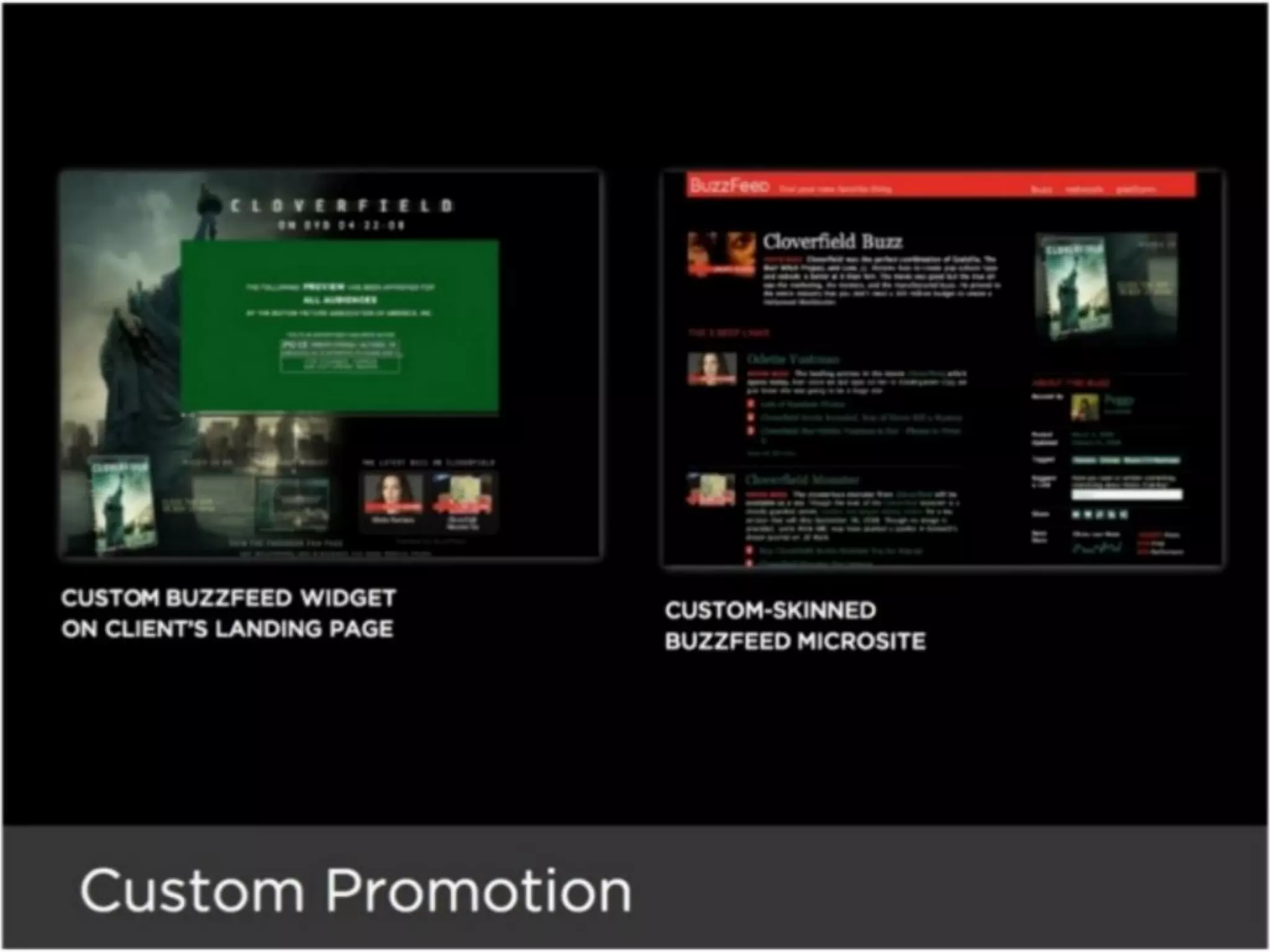
The deck smartly positions monetization as a complement to product features (widgets, trend targeting), not as an afterthought. Founders should emulate this: tie revenue ideas to product hooks and metrics (what drives value for advertisers, how you measure impact). Also, offering both standard ad units and bespoke promotional products (custom widgets/microsites shown later) helps capture both short-term inventory revenue and higher-margin partner work.

Key Takeaway: Tie revenue streams directly to product capabilities — sell both scalable ad inventory and higher-margin platform services that demonstrate measurable impact.
Product Infrastructure: Web app, analytics, and optimization

Product Infrastructure: Web app, analytics, and optimization

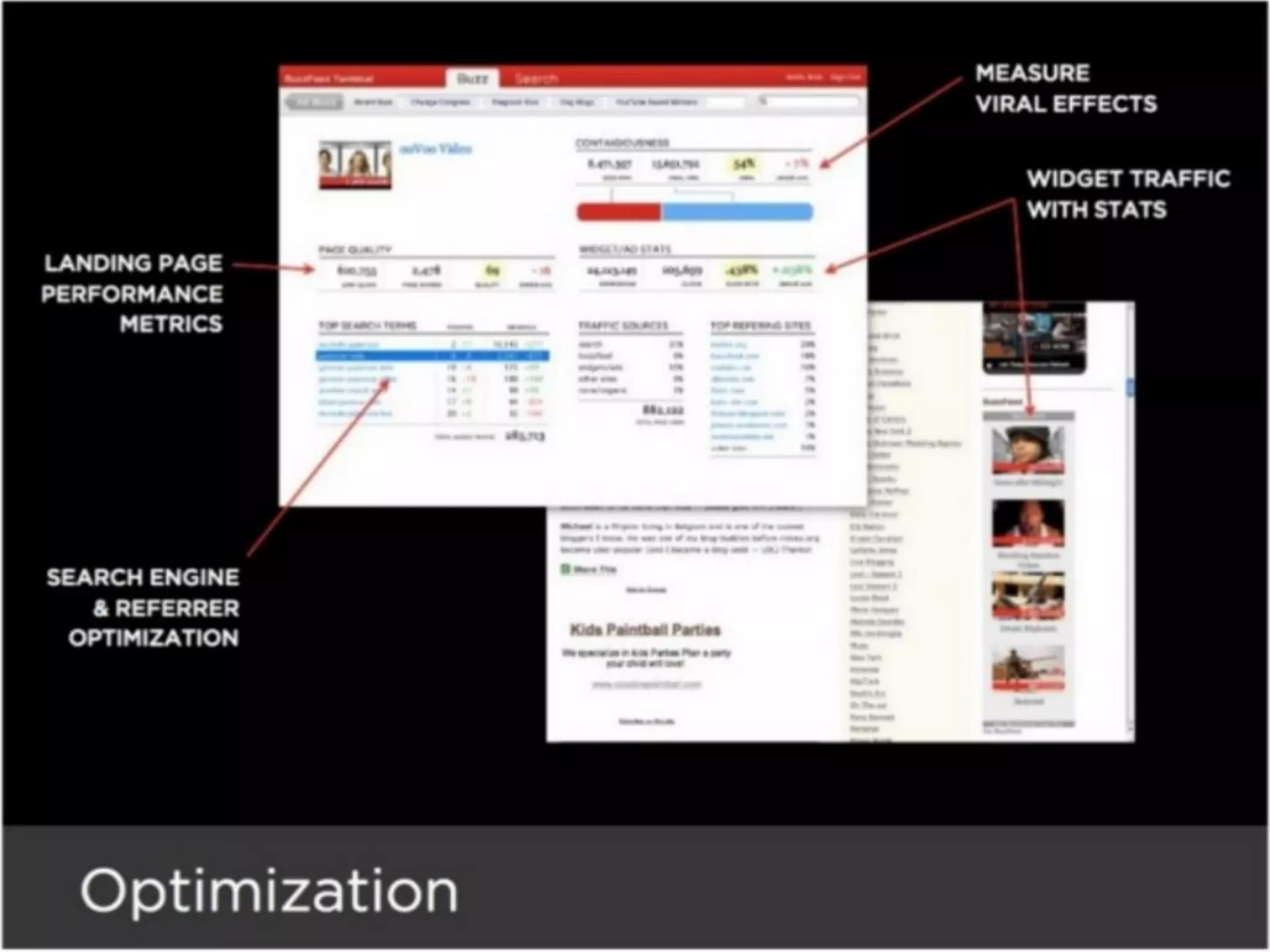
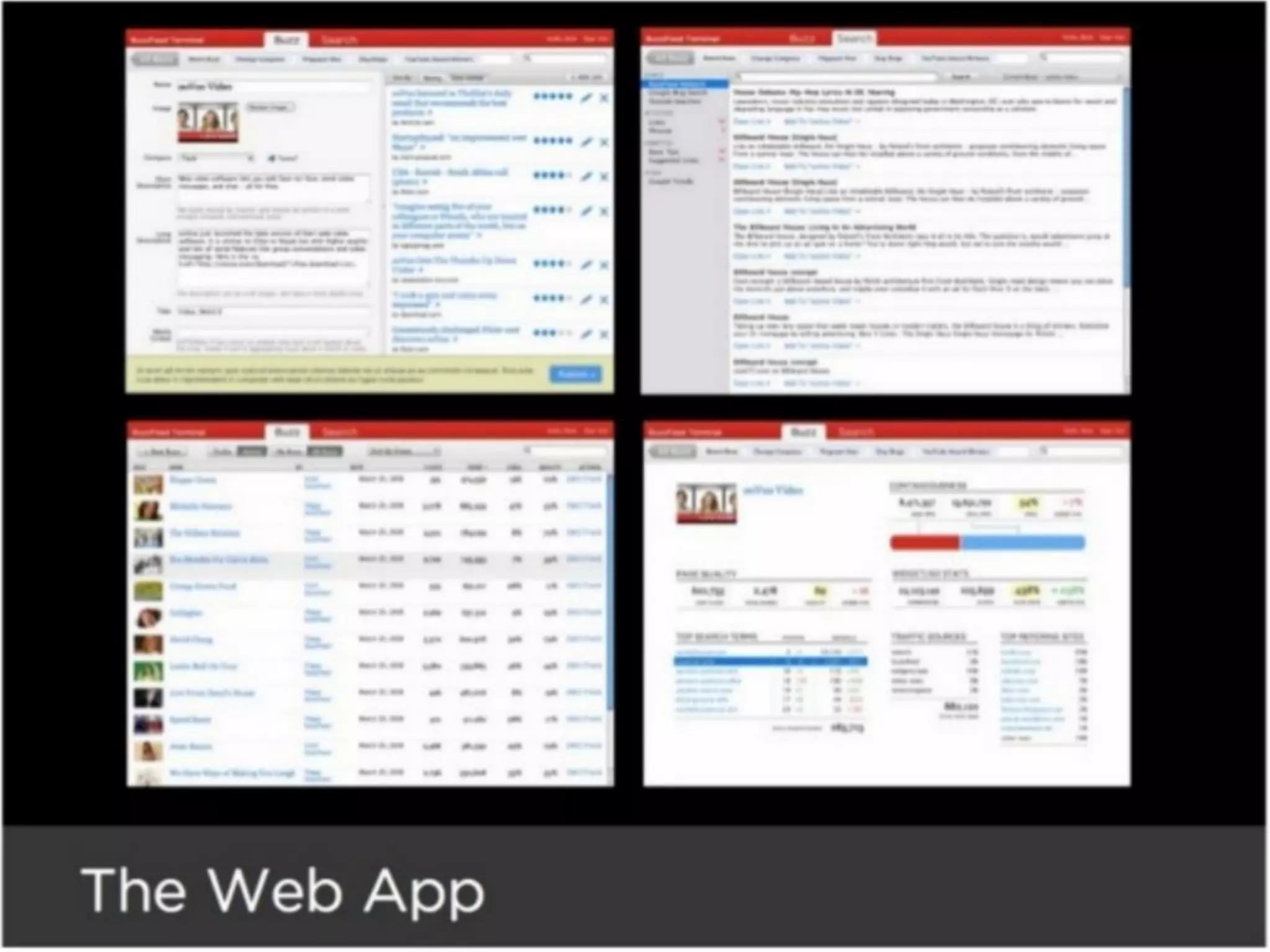
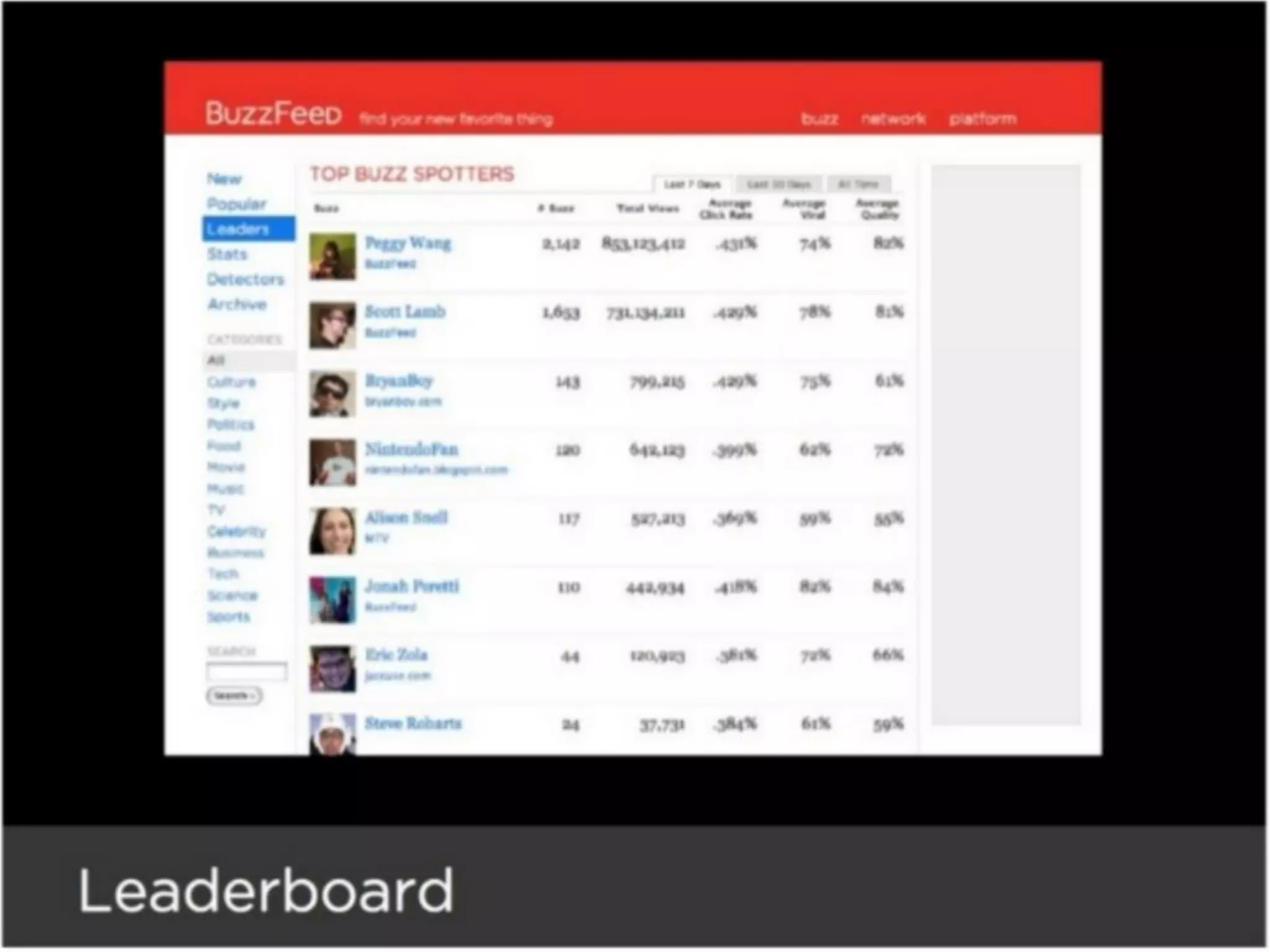
Slide 10 (The Web App) and adjacent optimization slides demonstrate the backend tooling BuzzFeed planned: content management, search/detection, leaderboards, and detailed landing-page metrics. By emphasizing analytics (landing page performance, widget traffic stats, search/referrer optimization), the deck shows how product, editorial, and sales teams can iterate using real performance data.

This is a critical lesson: platforms that succeed at distribution invest early in measurement and tools that turn signals into actions. Founders should prioritize building dashboards and simple optimization tools to prove value to advertisers and to refine content algorithms quickly. Showing internal tooling reassures investors that growth can be scaled and measured rather than left to guesswork.

Key Takeaway: Invest in measurable product infrastructure and dashboards early — metrics-oriented tooling turns experiments into repeatable growth.
Team & Credibility: Complementary skills and advisors

Team & Credibility: Complementary skills and advisors

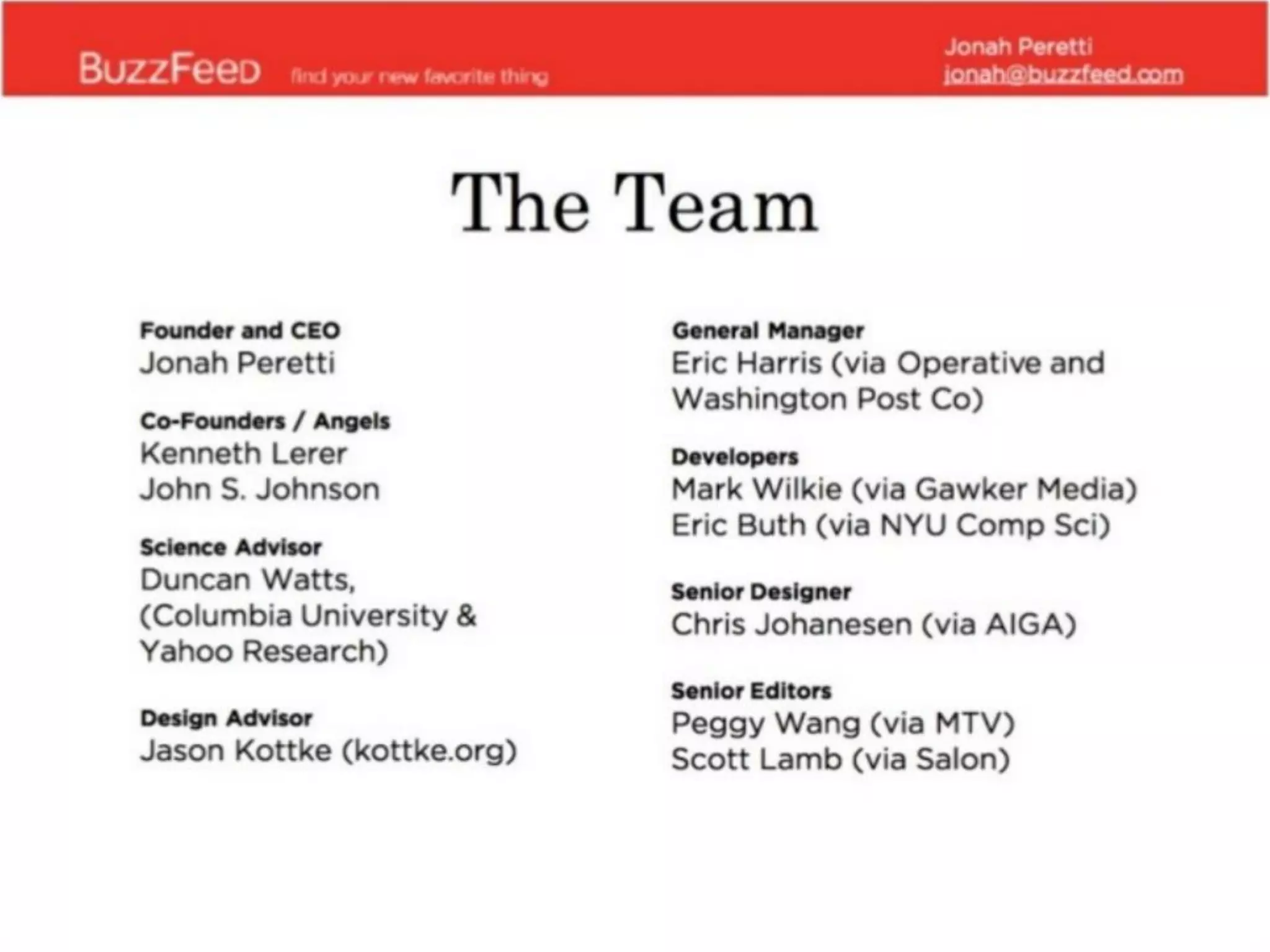
Slide 21 lists the founding team, advisors, and initial hires, mixing editorial backgrounds (senior editors from MTV/Salon), technology talent (NYU comp sci, Gawker), and a science advisor (Duncan Watts). This blend provided credibility across the product, editorial, and data sides — crucial for a media-tech hybrid. The slide is lean but highlights connections to established media and research institutions.

For founders, this demonstrates the importance of assembling a team that covers the core risk areas for your business: content quality, technology, and go-to-market. Inclusion of recognizable advisors (academia and media) can compensate for a small early headcount and reassure investors about execution capability and domain expertise.

Key Takeaway: Build a founding team that covers your core risks (product, content, engineering) and add advisors who bring credibility in research or industry relationships.

Conclusion: Key Lessons

This deck is an instructive early example of a successful product-led pitch: it pairs a simple brand promise with concrete traction, a clear roadmap to scale, product mockups, measurable monetization strategies, and operational tooling. Strengths include crisp positioning, prioritized metrics, product visuals that show execution, and a realistic hiring/use-of-funds roadmap. Actionable advice for founders: lead with one clear thesis, present a small set of high-signal metrics (audience, distribution, burn), tie your roadmap to capital needs and efficiency levers, show product UX or mocks rather than abstract words, and demonstrate how you'll measure and monetize value. Finally, assemble a team that covers the critical execution domains and use advisors to fill credibility gaps.