Stack up against Intercom

Compare Your Deck

Intercom's 2011 Pitch Deck

SaaS
Stage: Seed
Raised: $600K
Year: 2011
Slides: 8
Outcome: Valued at $1.3B

Pitch Deck

1 / 8
Slide 1
Click to expand

Deck Analysis

This seed pitch deck from Intercom (2011) concisely presents a product that reimagines customer communication for SaaS companies. It is notable for clear problem framing, a simple product explanation, a strong founding team slide, and an ask that matches early-stage needs. The deck’s combination of product screenshots, competitive positioning, and early social proof (beta feedback) helped the company secure a $600K seed and ultimately scale to a large outcome — useful as a template for founders who need to tell a focused product-market story quickly.

The Opening: Brand + Simple Identity

The Opening: Brand + Simple Identity

Slide 1 is a minimalist title slide that pairs a distinctive logo with the company name in a clean composition. This simplicity immediately communicates confidence and a clear brand identity without distracting from the pitch. Using whitespace and a single visual makes the deck feel polished and establishes a professional tone before any text-heavy slides appear.

Founders can learn from this restraint: the opening page sets expectations. An effective, uncluttered cover primes investors for a focused narrative and signals that the team understands design and product sensibility — both important for a UX-driven SaaS product.

Key Takeaway: Start with a clean, on-brand cover that communicates product sensibility and sets an expectation of clarity for the rest of the deck.
The Team: Credibility and complementary roles

The Team: Credibility and complementary roles

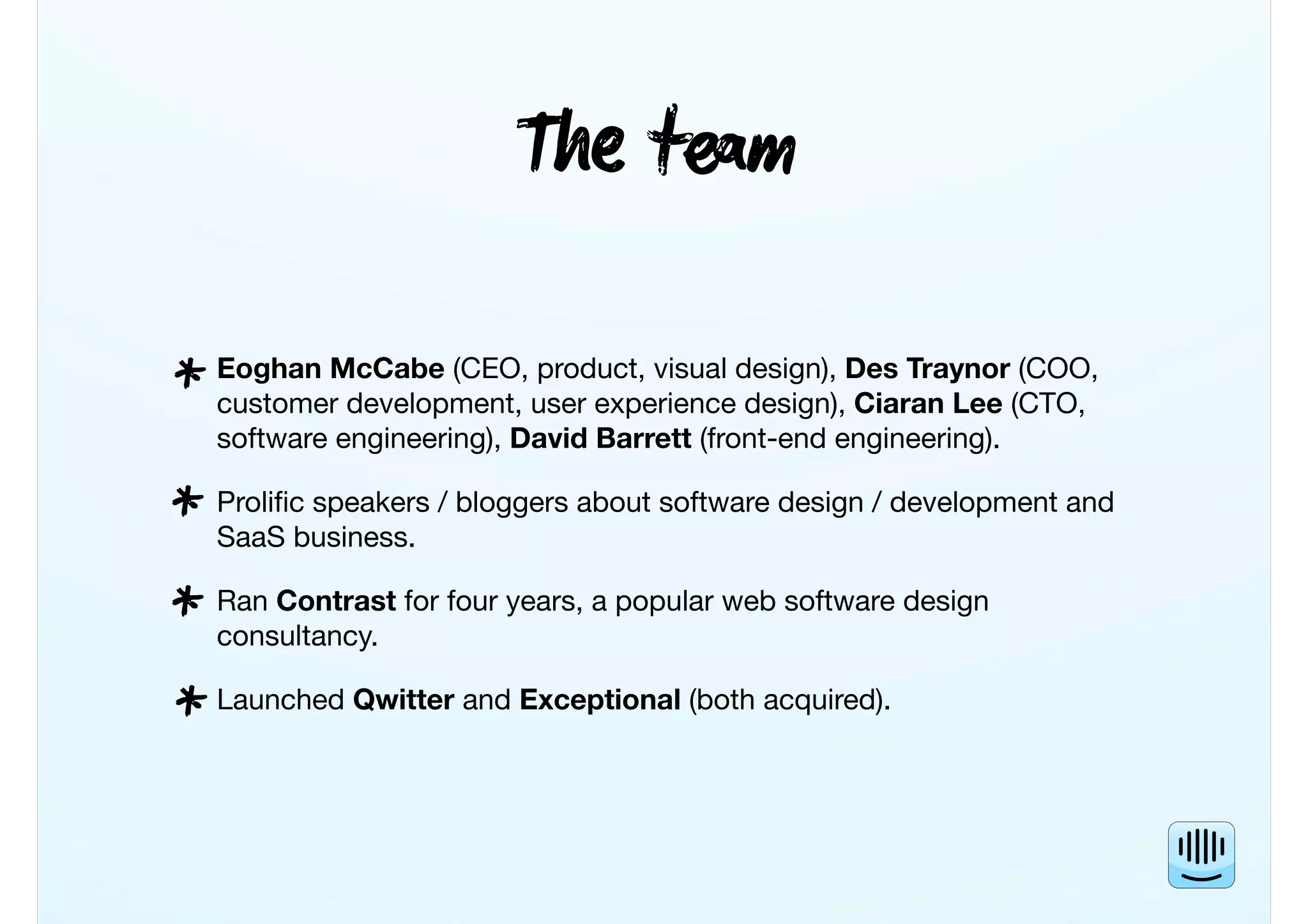
Slide 2 highlights the founding team, listing names, roles, and prior relevant accomplishments (consultancy, prior products). The slide uses bolding to emphasize key names and companies, which helps investors quickly parse who does what and why they matter. It also calls out public-facing credibility (speaking, blogging) and previous exits/acquisitions, which are powerful signals at seed stage.

This slide balances brevity and signal: it doesn’t try to tell every CV detail but focuses on exactly the credentials that matter for trust — product/design strength, engineering chops, and startup experience. For founders, this illustrates how to present a team: show complementary skills, relevant track record, and early signals of domain expertise rather than long bullet lists.

Key Takeaway: Show complementary roles and highlight prior, relevant wins concisely to build early trust with investors.
The Problem: Clear, customer-centric pain

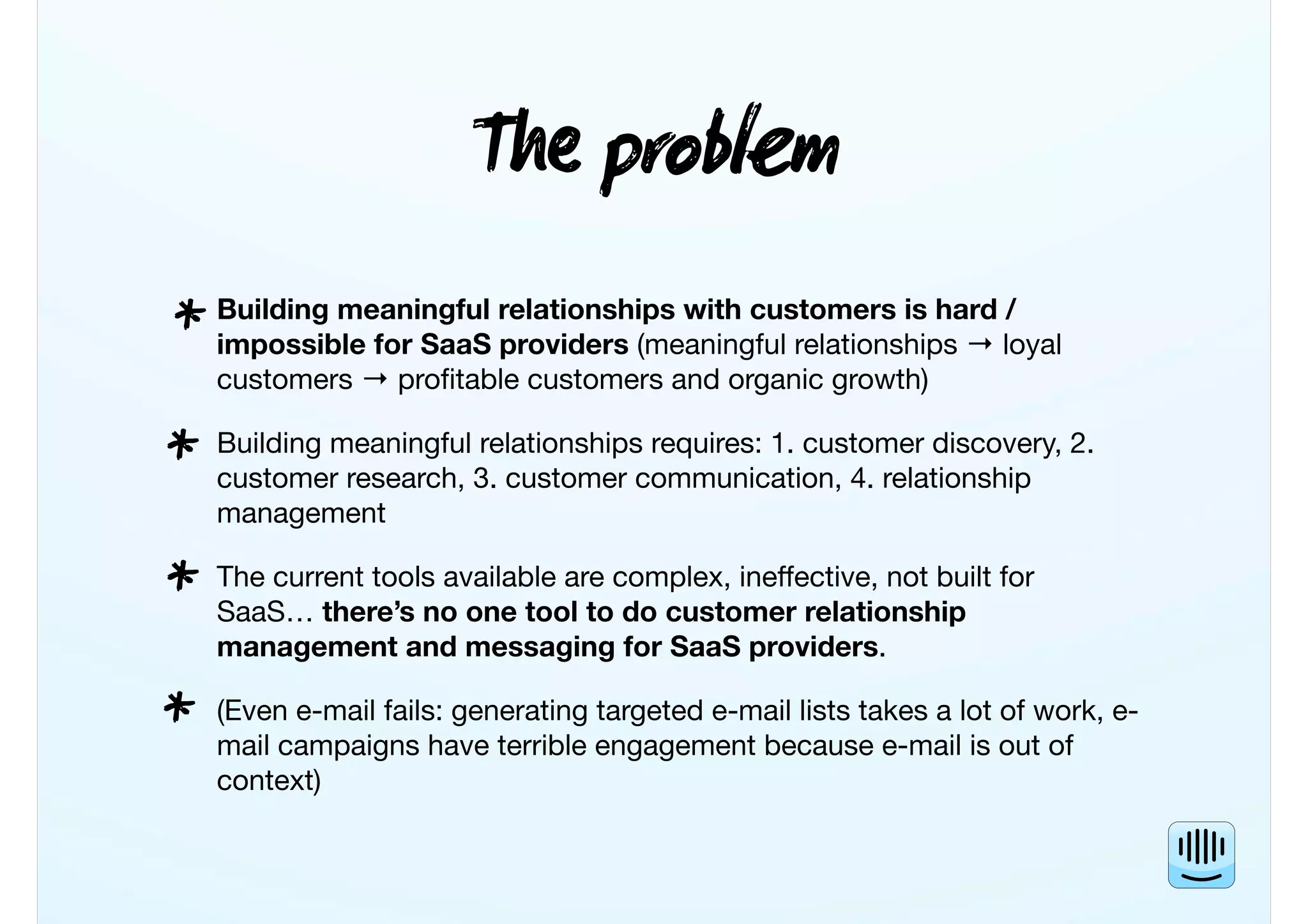
The Problem: Clear, customer-centric pain

Slide 3 frames the problem crisply: SaaS companies struggle to build meaningful customer relationships and existing tools are fragmented or ineffective. The slide breaks the problem into why it matters (loyal, profitable customers) and the tasks required (discovery, research, communication, management), making the scope and complexity of the problem tangible.

The slide also points out a specific shortcoming of common solutions (email, complex tooling), which creates a natural segue to the product. Founders should note how this slide pairs emotional language (“meaningful relationships”) with operational specifics — it shows the pain and explains why current solutions fail, which primes investors to see the product as both necessary and defensible.

Key Takeaway: Define the customer pain in both emotional and operational terms and explicitly explain why existing solutions fail.
The Solution: Product capabilities and simple positioning

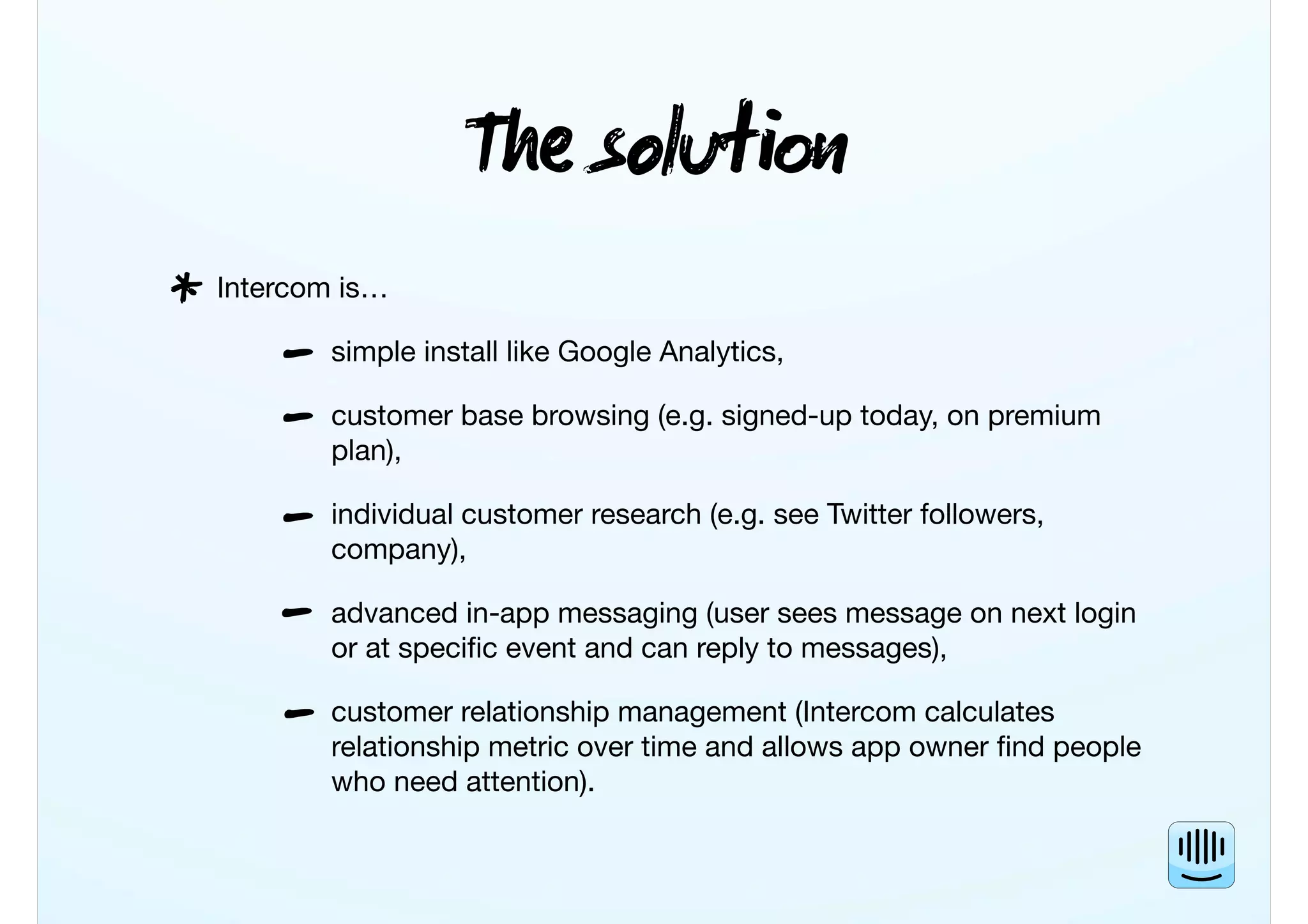
The Solution: Product capabilities and simple positioning

Slide 4 lists Intercom’s core features as the direct answer to the problem: easy install, customer browsing, individual research, in-app messaging, and a relationship metric. The slide uses plain language and short bullets so an investor can immediately map features to the previously stated problems. Positioning the product as a simple install like Google Analytics is an effective analogy that communicates low friction.

This is a good example of product storytelling — each feature is tied to a clear use case (e.g., messaging at specific events, identifying customers who need attention). Founders should aim to show the minimum set of features that deliver core value and use familiar analogies to convey adoption friction and integration simplicity.

Key Takeaway: Describe core features in plain terms tied to specific use cases and use familiar analogies to convey ease of adoption.
Landscape: Competitive map and white space

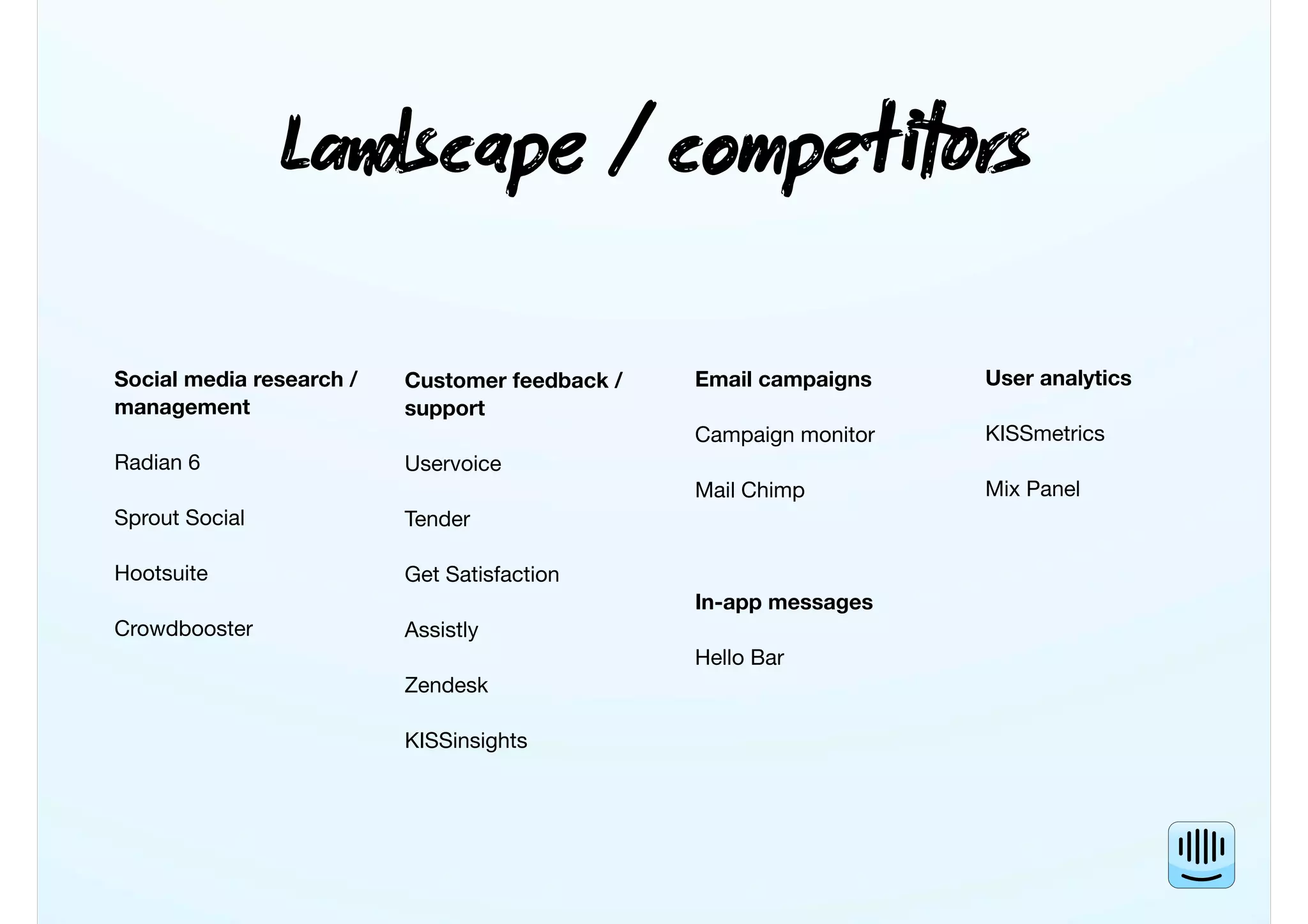
Landscape: Competitive map and white space

Slide 6 lays out the competitive landscape by category (social research, customer feedback/support, email campaigns, in-app messages, user analytics) and lists representative competitors. This categorization makes it easy to see fragmentation — many point solutions exist but none cover the whole problem. By showing players in adjacent categories, the slide implicitly defines Intercom’s positioning as a unifying product.

For founders, this slide demonstrates how to turn a crowded market into an opportunity: instead of claiming a monopoly, show how incumbents are siloed and where your product integrates or replaces multiple tools. The visual organization helps investors quickly grasp both competition and differentiation without deep technical detail.

Key Takeaway: Map competitors by category to show fragmentation and clearly position your product as the integrator or better alternative.
Progress: Traction, beta feedback, and social proof

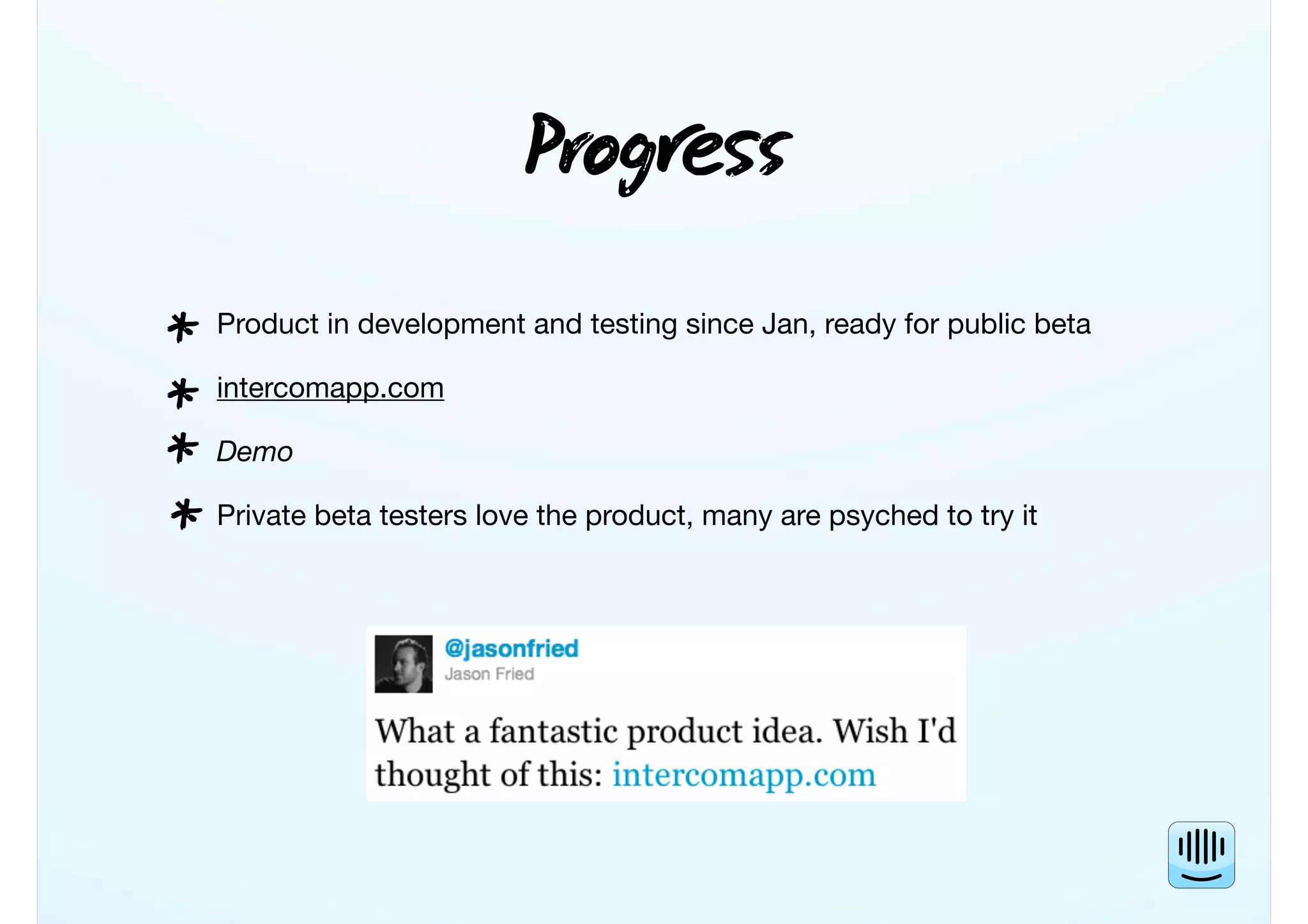
Progress: Traction, beta feedback, and social proof

Slide 7 communicates product progress (in development, heading to public beta), a domain (intercomapp.com), and strong early social proof (a positive tweet screenshot). The combination of roadmap status and third-party praise demonstrates both momentum and market interest. Including a short list of development milestones plus a real quote adds credibility without overclaiming.

Founders should use this pattern to validate early traction: show what’s built, what’s coming, and include one or two pieces of genuine external validation (user quotes, beta testers, press) rather than inflated metrics. Authentic endorsements from respected people or customers can amplify investor confidence at seed stage.

Key Takeaway: Show concrete progress and include authentic social proof to convert product development into perceived traction.
The Ask: Reasonable capital plan and milestone-focused use of funds

The Ask: Reasonable capital plan and milestone-focused use of funds

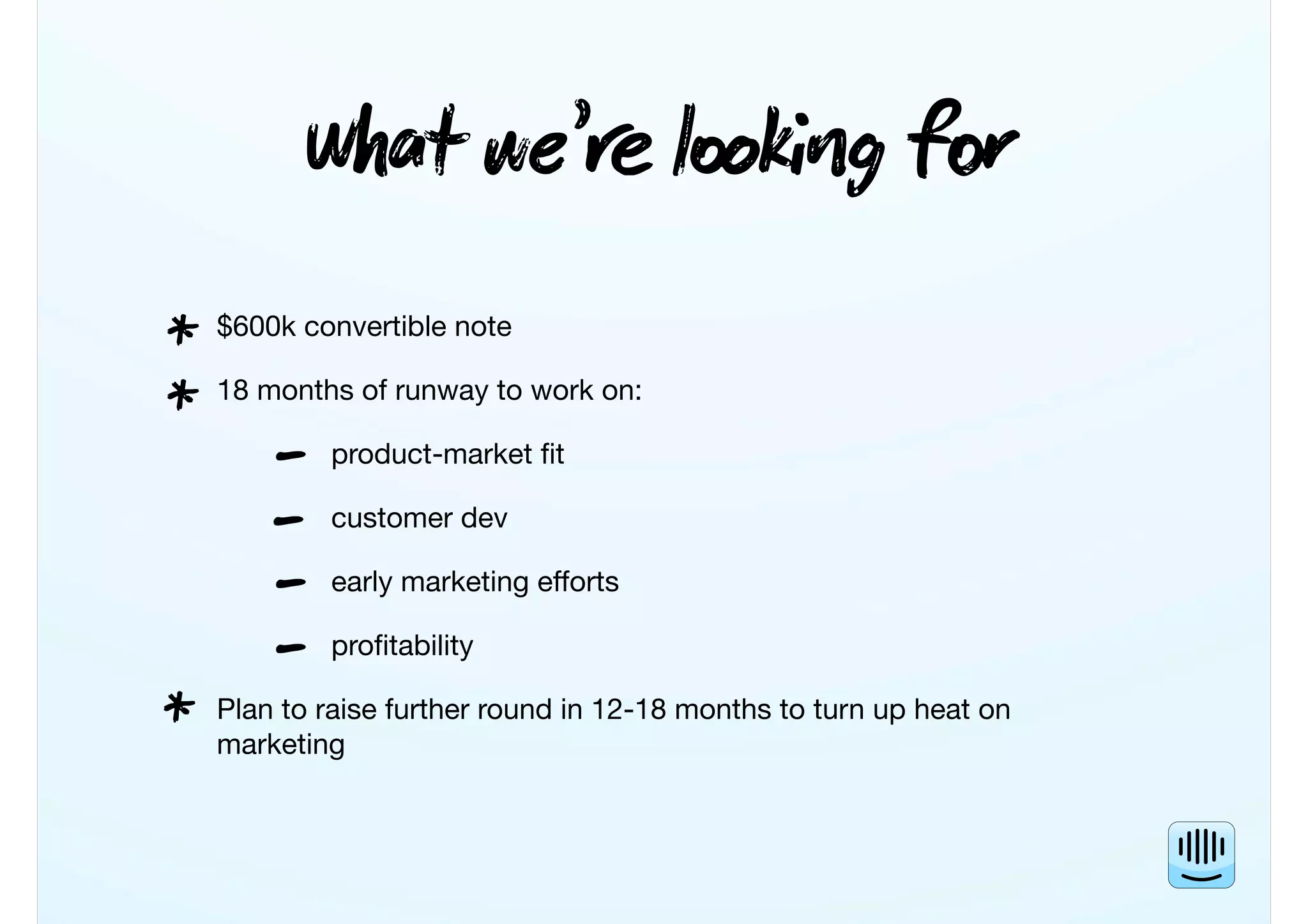
Slide 8 states the ask ($600K convertible note) and explains the runway use: product-market fit, customer development, early marketing, and path to profitability, with a plan to raise later to accelerate growth. This aligns the capital requested with measurable, stage-appropriate objectives and a timeline, which reduces investor uncertainty. It’s candid about next steps and shows fundraising discipline (seeking an amount to reach specific milestones, not to scale prematurely).

Founders can learn to make their asks specific, justified, and milestone-driven. Investors prefer to see how funds will move the company to the next inflection point and what the follow-up plan is — that transparency builds credibility and helps investors evaluate risk and upside.

Key Takeaway: Ask for an amount tied to clear 12–18 month milestones and explain how the capital will de-risk the next stage.

Conclusion: Key Lessons

This deck succeeds through clarity, economy, and direct mapping between problem, solution, team, competition, traction, and ask. Its strengths are a tight narrative (pain → product → differentiation), strong founder credibility, and an ask that is matched to measurable short-term milestones. The visuals are intentionally simple, letting the text-driven story and a single piece of social proof carry the case.

Actionable advice: keep the story focused on a single compelling problem, show how your product uniquely solves it with concrete examples, present a small set of features that deliver disproportionate value, and align your funding ask to explicit milestones. Finally, include credible early validation (beta feedback, customer quotes, or pilots) — it can shift a seed conversation from hypothetical to tangible.