Stack up against Klarna

Compare Your Deck

Klarna's 2012 Pitch Deck

Fintech
Stage: Growth
Raised: Multiple
Year: 2012
Slides: 11
Outcome: Valued at $6.7B (down from $45B)

Pitch Deck

1 / 11
Slide 1
Click to expand

Deck Analysis

This deck from Klarna (2012, growth stage) presents a concise investor-facing story: a clear brand, a well-defined problem in online payments, a simple but defensible product solution (separating buying from paying), and evidence of traction and growth. It’s notable for combining strong visual branding with operational metrics (revenue, payment volume) and an easy-to-understand product flow that ties to consumer preference data — all of which helped Klarna scale in Europe and later become a global fintech leader. The presentation balances emotional appeal (simple buying) with hard numbers and merchant benefits, a model founders can emulate for fintech and payments businesses.

The Opening: Clean brand and one-line value prop

The Opening: Clean brand and one-line value prop

Slide 1 is a classic cover slide: bold logo, strong color, and a single clear value proposition — "Safe and Simple payments online." It establishes brand identity instantly and positions Klarna in the customer’s mind before any details are presented. The slide also lists the founder and role, which subtly signals credibility without distracting from the main message.

This minimal approach is effective because it focuses attention and sets expectations for the deck’s tone: simple, consumer-focused, and trustworthy. Founders should note how a clean opening reinforces brand recall and primes the audience for a product-centric narrative rather than a feature dump.

Key Takeaway: Start with a single, memorable positioning line and strong branding to create immediate clarity and credibility.
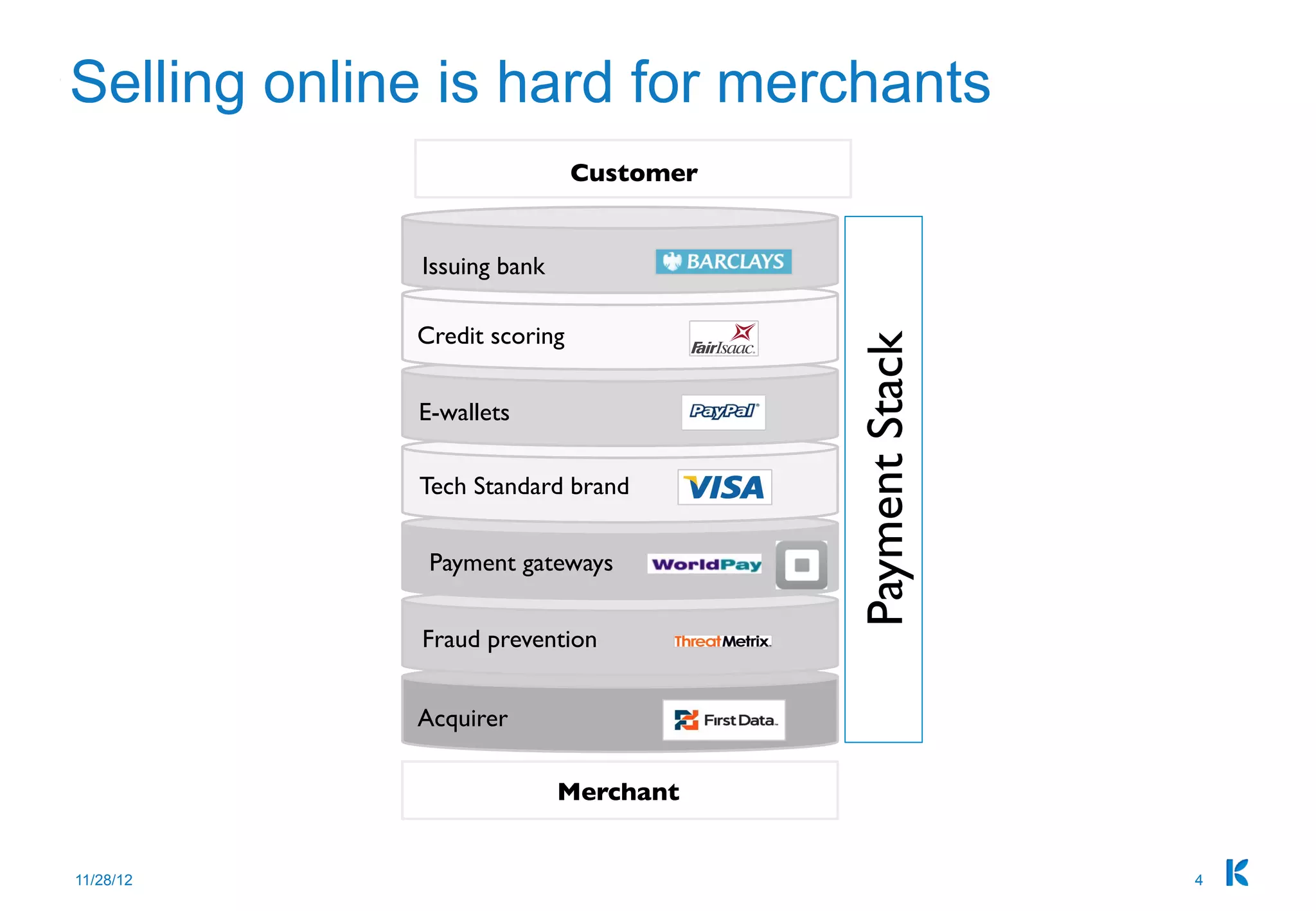
Problem: Checkout is fragmented and painful

Problem: Checkout is fragmented and painful

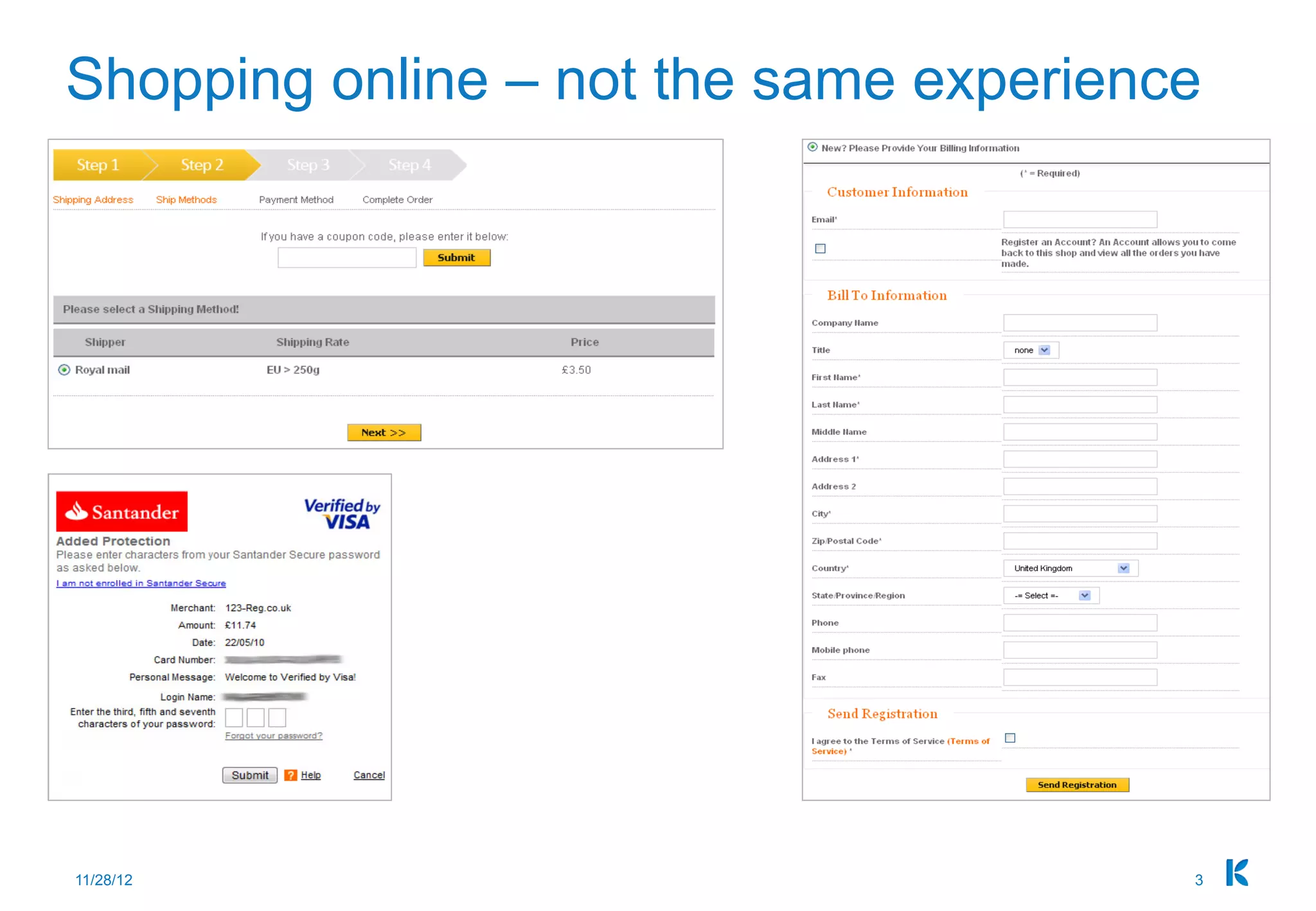
Slide 3 lays out the pain of online shopping with screenshots of long forms, multi-step checkouts, and confusing third-party security flows. The slide communicates the friction points that cause cart abandonment: too many fields, redirects, unfamiliar verifications, and broken user experience across merchants. By using real examples, Klarna makes the problem tangible and relatable to both merchants and investors.

This slide is effective because it doesn’t rely on abstract statements — it shows what customers see. For founders, the lesson is to demonstrate the problem visually and empathetically: investors need to feel the pain users experience to understand why a solution is necessary and valuable.

Key Takeaway: Use concrete, visual examples of user friction to make the problem undeniable and motivate your solution.
Market signal: What customers actually prefer

Market signal: What customers actually prefer

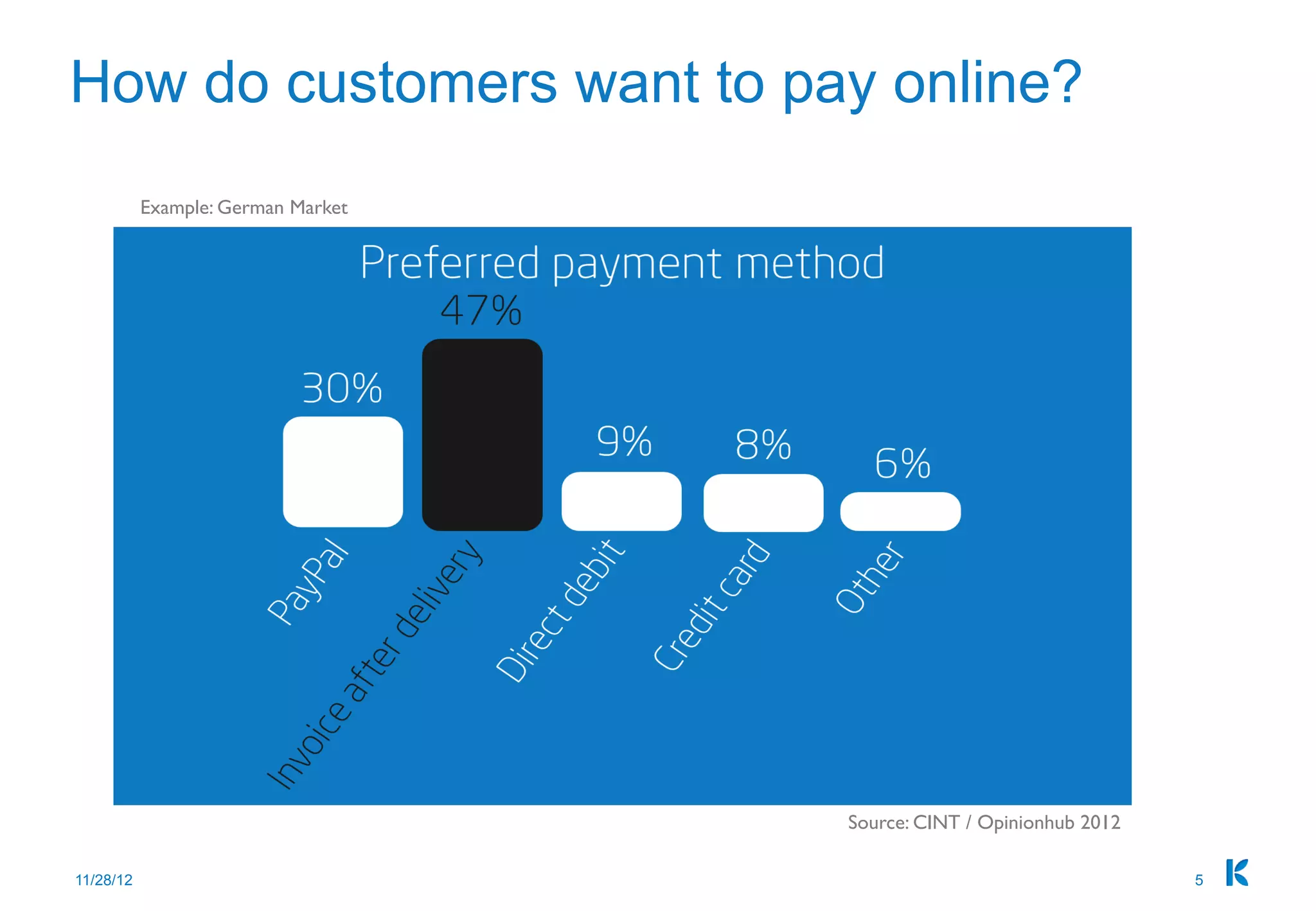
Slide 5 provides market validation via a simple chart (example: German market) showing preferred payment methods. The standout insight — "invoice after delivery" at 47% — demonstrates a strong consumer preference for trust-first payment options over credit cards or e-wallets. This data supports Klarna’s product choice (post-purchase invoicing) and helps justify its go-to-market focus in markets where that behavior is prevalent.

Including third‑party survey data (CINT / Opinionhub) gives the claim credibility and connects product design to measurable user demand. Founders should include regional preference data when their product depends on cultural or market-specific behavior, and be explicit about how those preferences drive product-market fit.

Key Takeaway: Back your product decision with credible, market-specific data showing user preference — it strengthens both product rationale and go-to-market strategy.
The Solution: Separate buying and paying

The Solution: Separate buying and paying

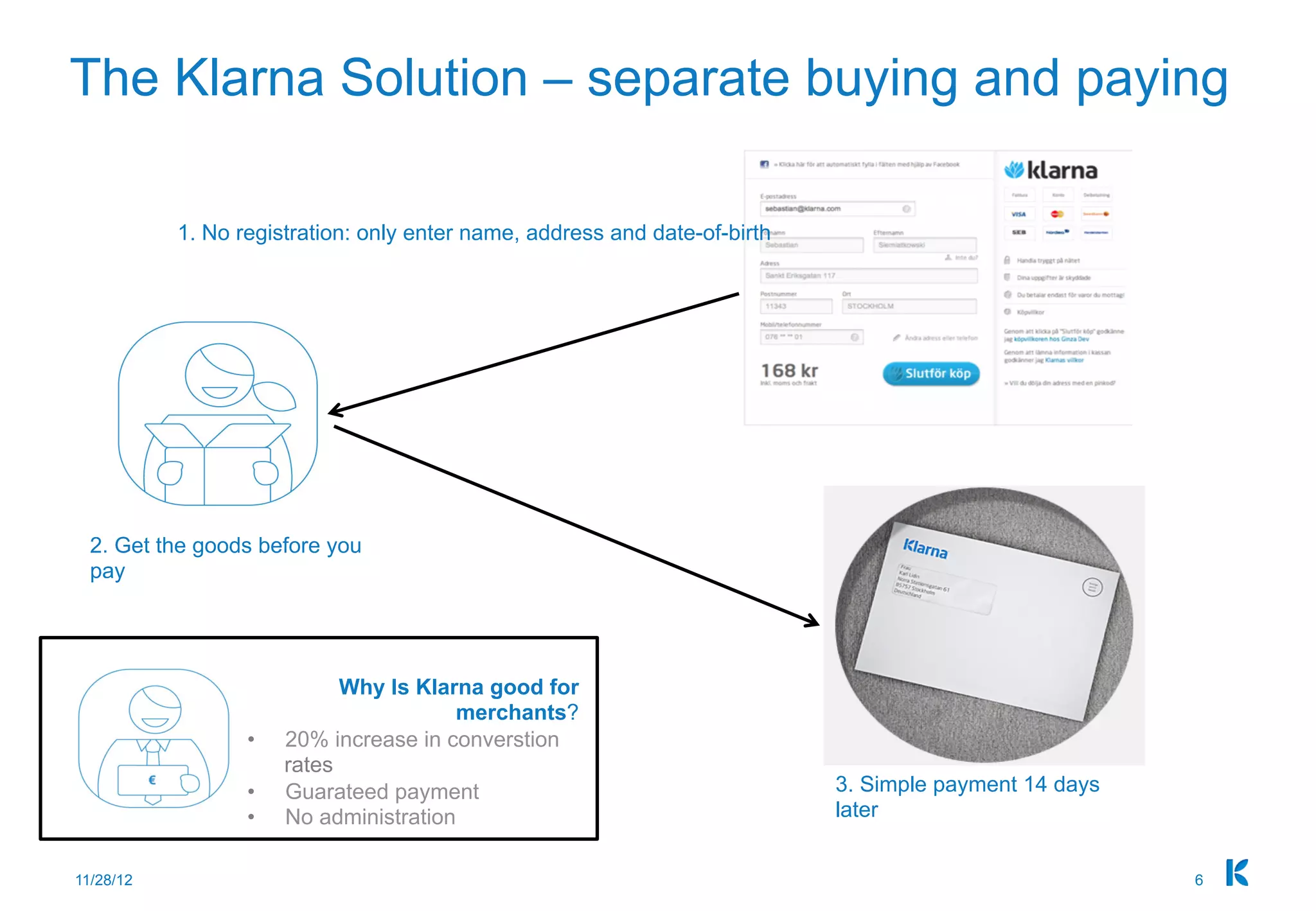
Slide 6 explains Klarna’s core product succinctly: no registration (just name/address/DOB), receive goods before paying, and a simple 14-day invoice. The slide couples a clear user flow with merchant benefits (conversion uplift, guaranteed payment, no administration), which is critical for payments businesses that must serve two customers simultaneously — consumers and merchants. The three-step visual arrows and the boxed merchant benefits help different stakeholders quickly grasp the value exchange.

This section is effective because it aligns UX simplicity for consumers with commercial incentives for merchants (reduced friction, immediate settlement). For founders, the takeaway is to frame solutions around both sides of the marketplace and quantify benefits wherever possible (e.g., conversion uplift), which materially improves the pitch to commercial partners and investors.

Key Takeaway: Explain product flows visually and link consumer simplicity to clear merchant economics and measurable KPIs.
Traction and growth: Timeline + financials

Traction and growth: Timeline + financials

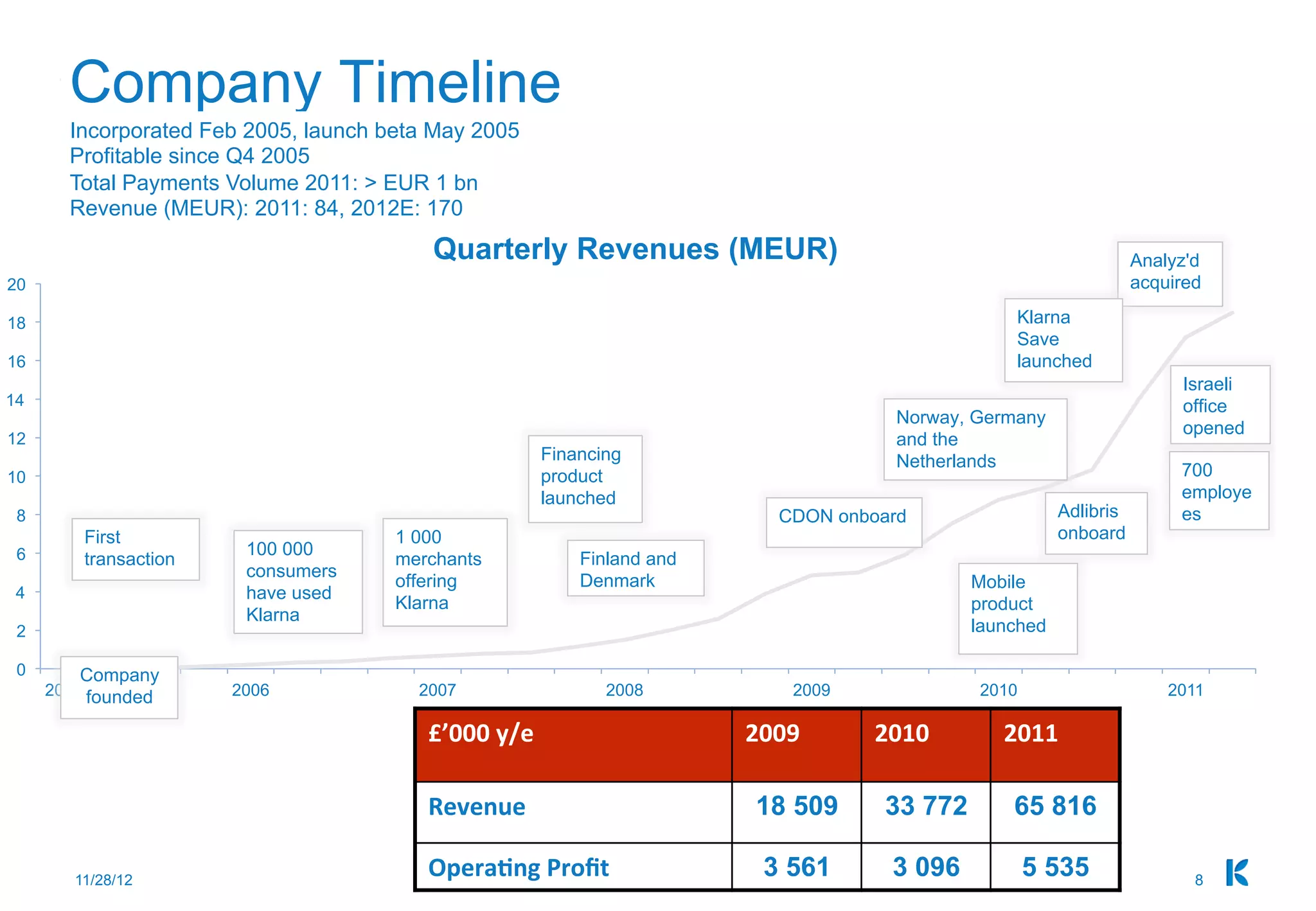
Slide 8 combines a company timeline of product launches and geographic expansion with a simple quarterly revenue chart and a three-year revenue/operating profit table. This juxtaposition of milestones and financials shows investors that product launches translated into measurable commercial growth (e.g., revenue rising from 2009 to 2011). The timeline also highlights strategic events like new market entries and product introductions that explain inflections in growth.

Presenting both narrative milestones and hard numbers is powerful; it demonstrates that strategy and execution produced results. Founders should emulate this by tying product/market expansion decisions to revenue changes and using timelines to explain growth drivers, not just list achievements.

Key Takeaway: Pair a clear milestone timeline with compact financial metrics to show how strategic moves drove revenue and scalability.
Vision / Close: Simple, shareable future vision

Vision / Close: Simple, shareable future vision

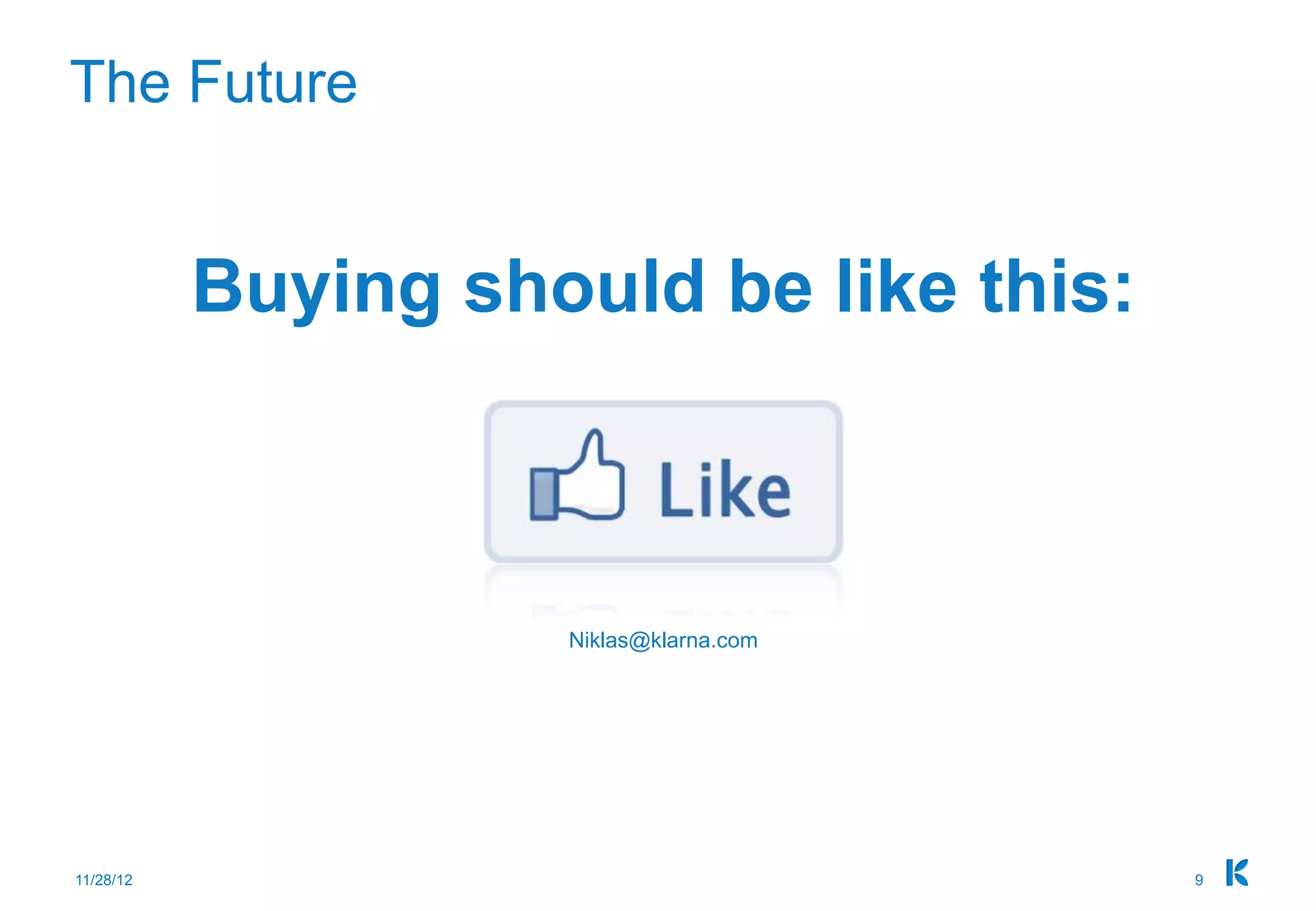
Slide 9 closes with a high-level vision — "Buying should be like this:" accompanied by a Facebook 'Like' button image and a contact email. It’s a memorable, emotionally resonant finish that reiterates simplicity and virality as goals. The slide is minimalist and leaves the investor with a crisp mental image of an ideal end-state: buying that’s as effortless and socially validated as clicking 'Like.'

The close is effective because it reframes the product as a cultural quality (likeability and simplicity), not just a payments utility. Founders should use their final slide to restate the mission in a compact, memorable way and provide a clear next step (contact) — it makes follow-up easier and leaves a lasting impression.

Key Takeaway: End with a short, emotional vision statement and a clear contact — memorable closes drive follow-up conversations.

Conclusion: Key Lessons

Klarna’s 2012 deck succeeds through clarity: a bold brand, a vivid problem demonstration, a simple product flow that ties to concrete merchant benefits, market preference data supporting product choice, and a timeline that links execution to revenue. The deck balances emotion (simplicity, trust) with evidence (metrics, third-party data) and addresses both sides of the marketplace — consumers and merchants — which is essential for fintech platforms.

Actionable advice for founders: open with a single, memorable value proposition; show the user pain visually; validate product choices with market data; present product flows that show how customer benefit converts to partner economics; and close with a succinct vision plus contact. Finally, pair milestones with compact financials to prove your strategy produced growth — investors buy traction that’s explained, not just asserted.