Stack up against N26

Compare Your Deck

N26's 2015 Pitch Deck

Fintech
Stage: Various
Raised: Multiple
Year: 2015
Slides: 22
Outcome: Valued at $9B

Pitch Deck

1 / 22
Slide 1
Click to expand

Deck Analysis

This deck for N26 presents a crisp, design-forward pitch for a mobile-first challenger bank focused on European expansion and fintech platformization. It pairs strong visual storytelling (hero imagery, simple typography) with concrete product highlights, traction metrics, partner integrations, and a clear geographic expansion plan — helping investors quickly understand the market opportunity, product differentiation, and early execution. Notable is how the deck balances brand emotion (lifestyle photography, millennial-oriented messaging) with operational proof points (fast account opening, partner integrations, user growth), making it a useful template for consumer fintech founders.

The Opening: Brand + Problem Framing

The Opening: Brand + Problem Framing

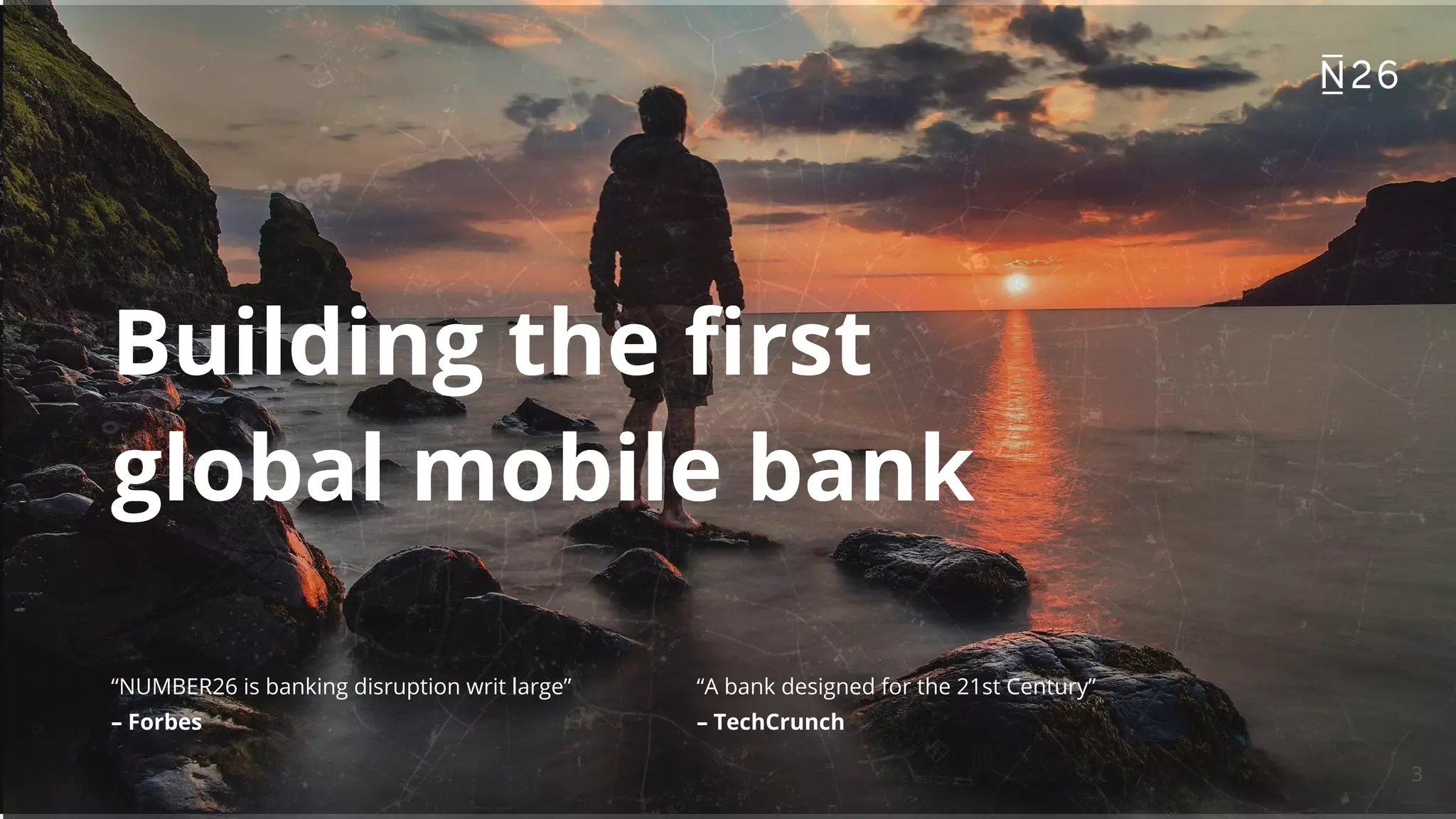
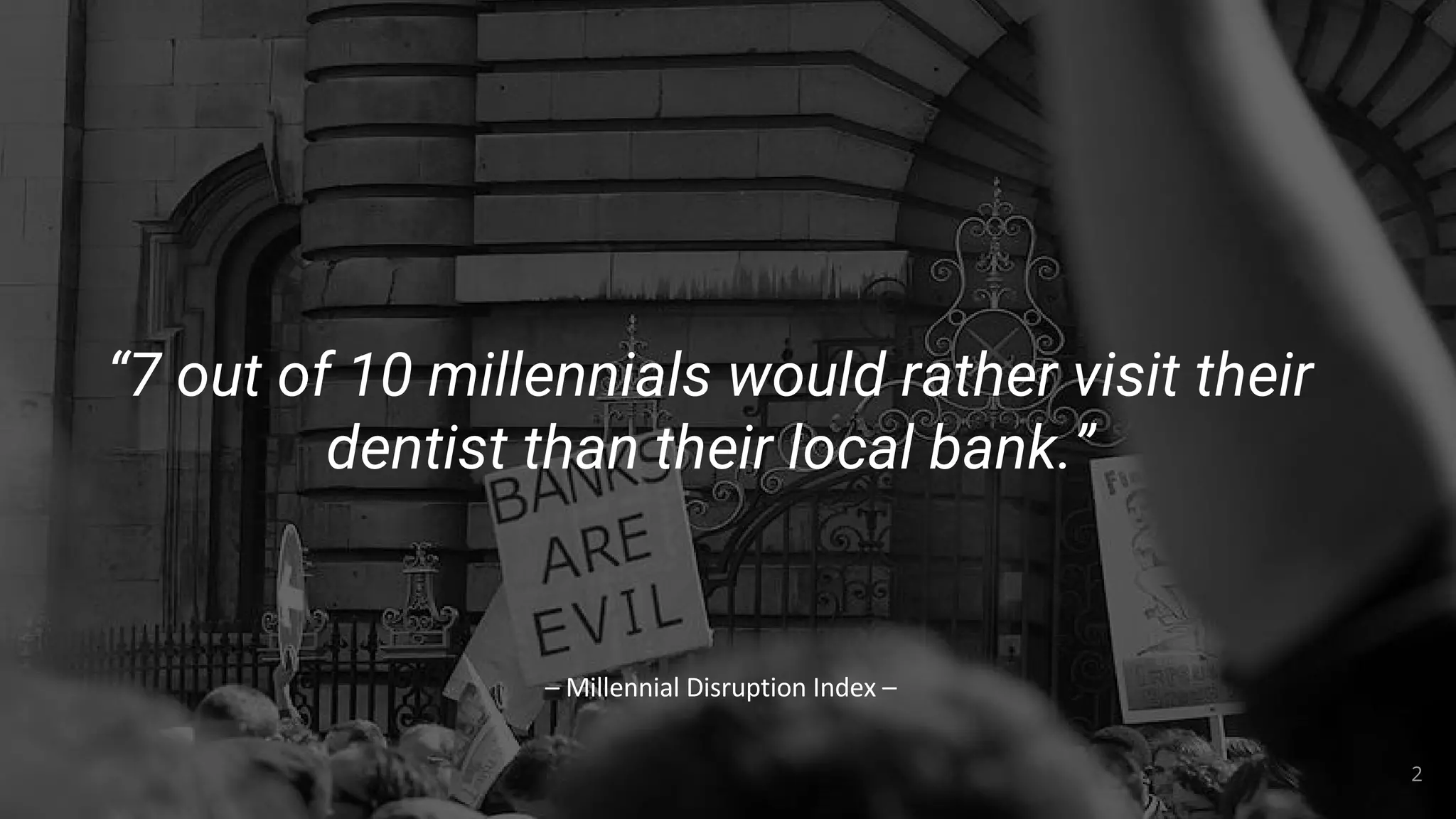
Slide 1 opens with a bold visual and a short, memorable tagline: "The future of banking." The hero image of the mobile login screen immediately communicates the product context (mobile-first banking) while the slide credits and date anchor the pitch historically. This slide is effective because it sets an emotional tone and communicates product-category fit in under five seconds — essential for investor attention in early deck review.

Founders can learn from the economy of this slide: lead with a strong visual that shows the product in-context, pair it with a single declarative line about the company mission, and include minimal logistical details (event, date, presenter) so the audience knows why they should keep watching. The slide signals confidence without overwhelming viewers with data, making it an ideal opener to segue into problem and traction slides.
Key Takeaway: Open with a clean, product-in-context visual plus a single mission line to immediately communicate what you do and who you serve.
Problem Statement: Customer Sentiment & Market Pain

Problem Statement: Customer Sentiment & Market Pain

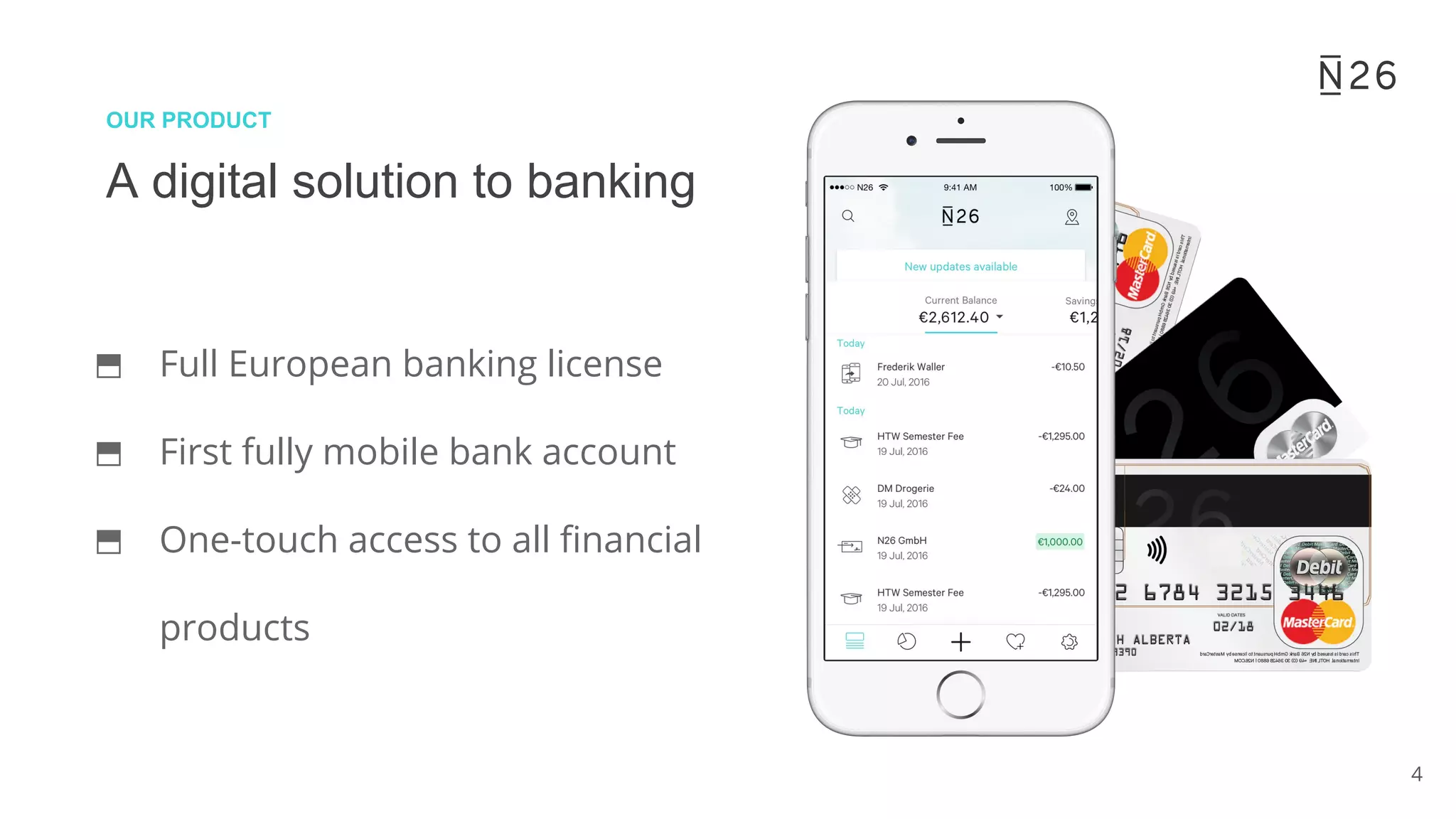
Slide 3 uses a striking statistic — “7 out of 10 millennials would rather visit their dentist than their local bank” — paired with a moody image of protest signage to dramatize distrust in traditional banks. This kind of social-proof-based problem framing is effective because it quantifies dissatisfaction and ties it to a specific demographic segment valuable to fintechs: millennials. The slide sets up a strong why: there is a real behavioral gap that a modern digital bank can address.

For founders, this demonstrates how to present a problem with emotion and scale: show a market sentiment or behavioral stat that resonates and back it with evocative imagery. It’s important, however, to ensure the statistic is credible and sourced in the appendix or pitch notes so investors can validate the claim during diligence.

Key Takeaway: Use a concise, emotionally resonant statistic to make the market problem tangible — but be ready to cite the source in follow-up materials.
Product Overview: Core Capabilities and Differentiators

Product Overview: Core Capabilities and Differentiators

Slide 5 provides a short product summary — "A digital solution to banking" — with three bullet points: full European banking license, fully mobile account, and one-touch access to financial products. The visual of the app and cards reinforces the product experience while the bullets call out regulatory and UX differentiators. This combination of product visuals and succinct feature bullets helps investors quickly understand why N26 is more than just another banking app.

The slide is a good example of balancing product detail with accessibility: it names must-have credentials (banking license) that de-risk the business for investors while highlighting user-facing features that drive adoption. Founders should emulate this mix: present the technical or regulatory credentials that matter to investors alongside the UX benefits that matter to users.

Key Takeaway: Combine regulatory/operational proof points with simple UX benefits to communicate both defensibility and customer value.
Speed & Convenience as a Go-to-Market Lever

Speed & Convenience as a Go-to-Market Lever

Slide 6 focuses on a high-impact product metric: "Paperless account opening in 8 minutes." The slide uses a lifestyle photo and a single large headline to make the speed of onboarding the star. Operational metrics like time-to-activate are powerful because they translate directly into acquisition efficiency, funnel conversion, and CAC. For digital consumer financial products, reducing friction at sign-up is often one of the easiest levers to show measurable improvement in growth metrics.

The lesson for founders is to quantify user experience improvements and call them out as competitive advantages. If you can demonstrate a faster, cheaper, or more secure onboarding journey than incumbents, make that a primary message and be prepared to show the underlying flow and metrics in appendices or demos.

Key Takeaway: Highlight concrete user-experience KPIs (e.g., minutes-to-open) that map to acquisition and activation improvements.
Product Ecosystem: Partnerships and Retail Presence

Product Ecosystem: Partnerships and Retail Presence

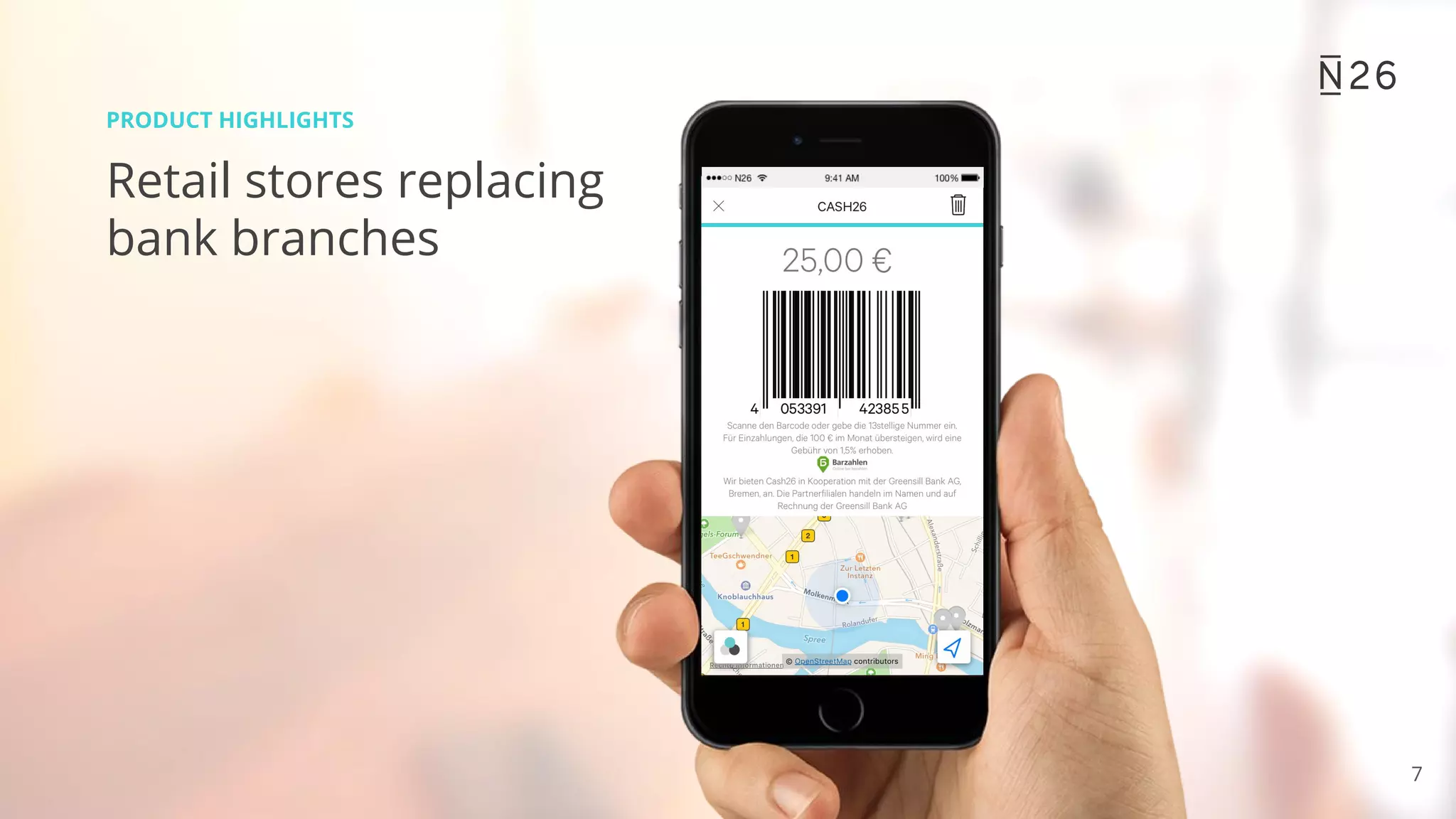
Slide 8 showcases the "retail stores replacing bank branches" value proposition with an example feature (CASH26 barcode) displayed on an in-app screen. This slide communicates a physical-digital hybrid strategy: instead of traditional branches, N26 leverages retail partners to enable cash in/out and broader distribution. It’s an effective way to explain how a mobile-first bank can still deliver essential offline capabilities without the cost of branch networks.

Founders should consider this slide as a template for explaining ecosystem plays: show the feature, explain the partner model, and emphasize the customer benefit. Partnerships that extend product functionality or distribution can be compelling evidence of scalability and unit-economics optimization — include logos, usage metrics, or partner terms in backups to strengthen the claim.

Key Takeaway: Use partner integrations to solve offline needs cost-effectively — show the feature UX plus the partner model to illustrate execution.
Expansion & Monetization Features: Financial Services Stack

Expansion & Monetization Features: Financial Services Stack

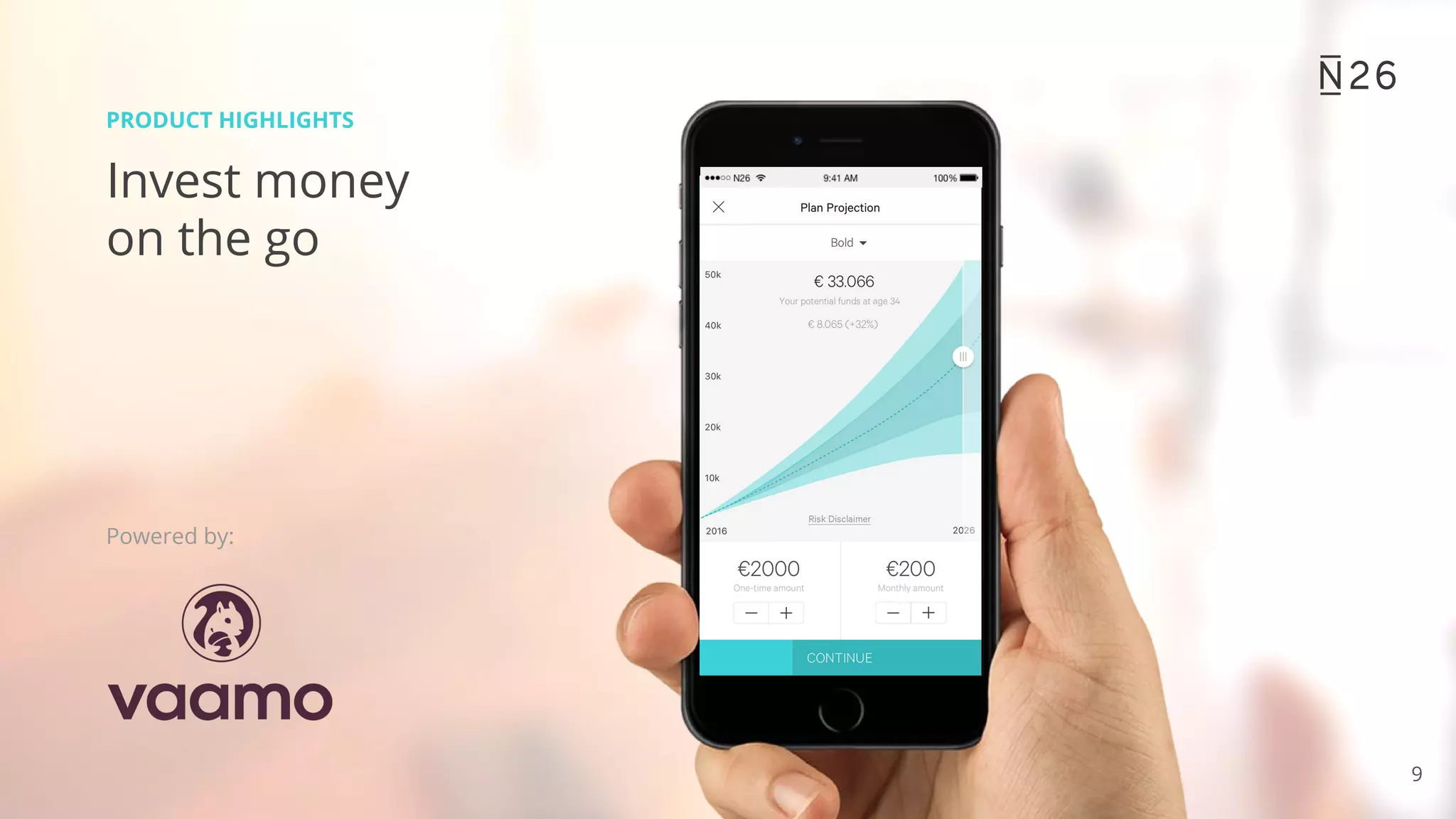
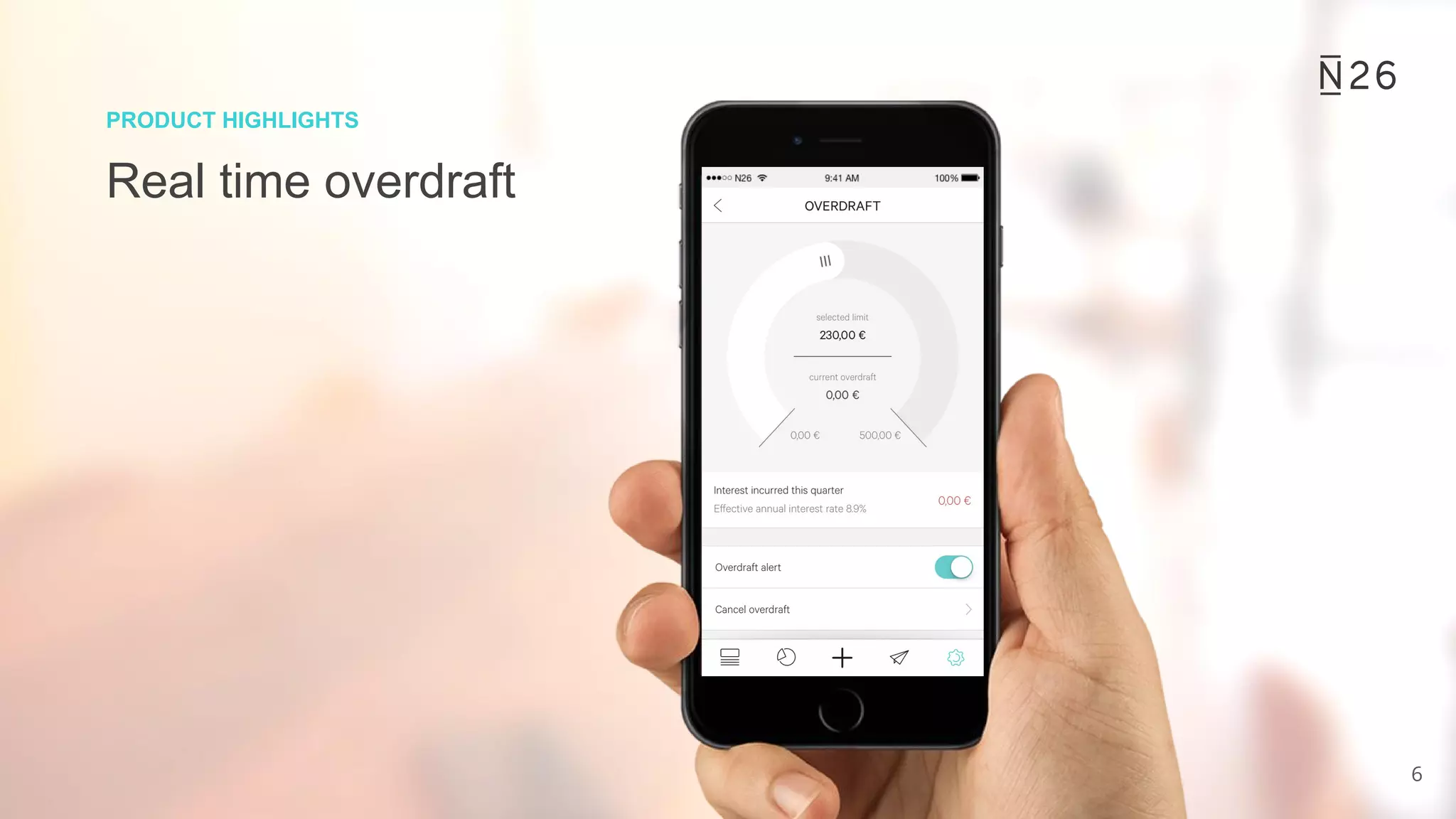
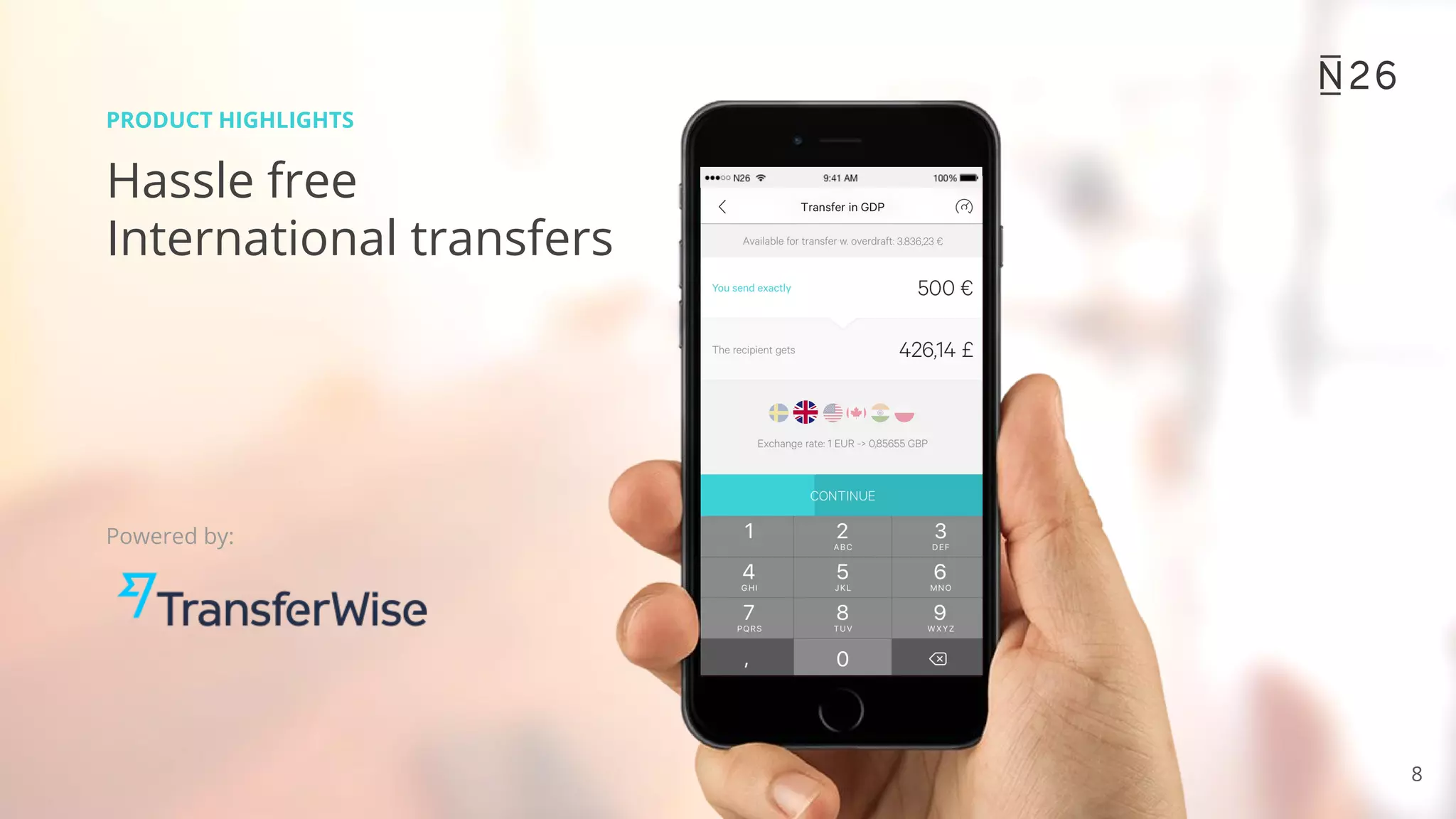
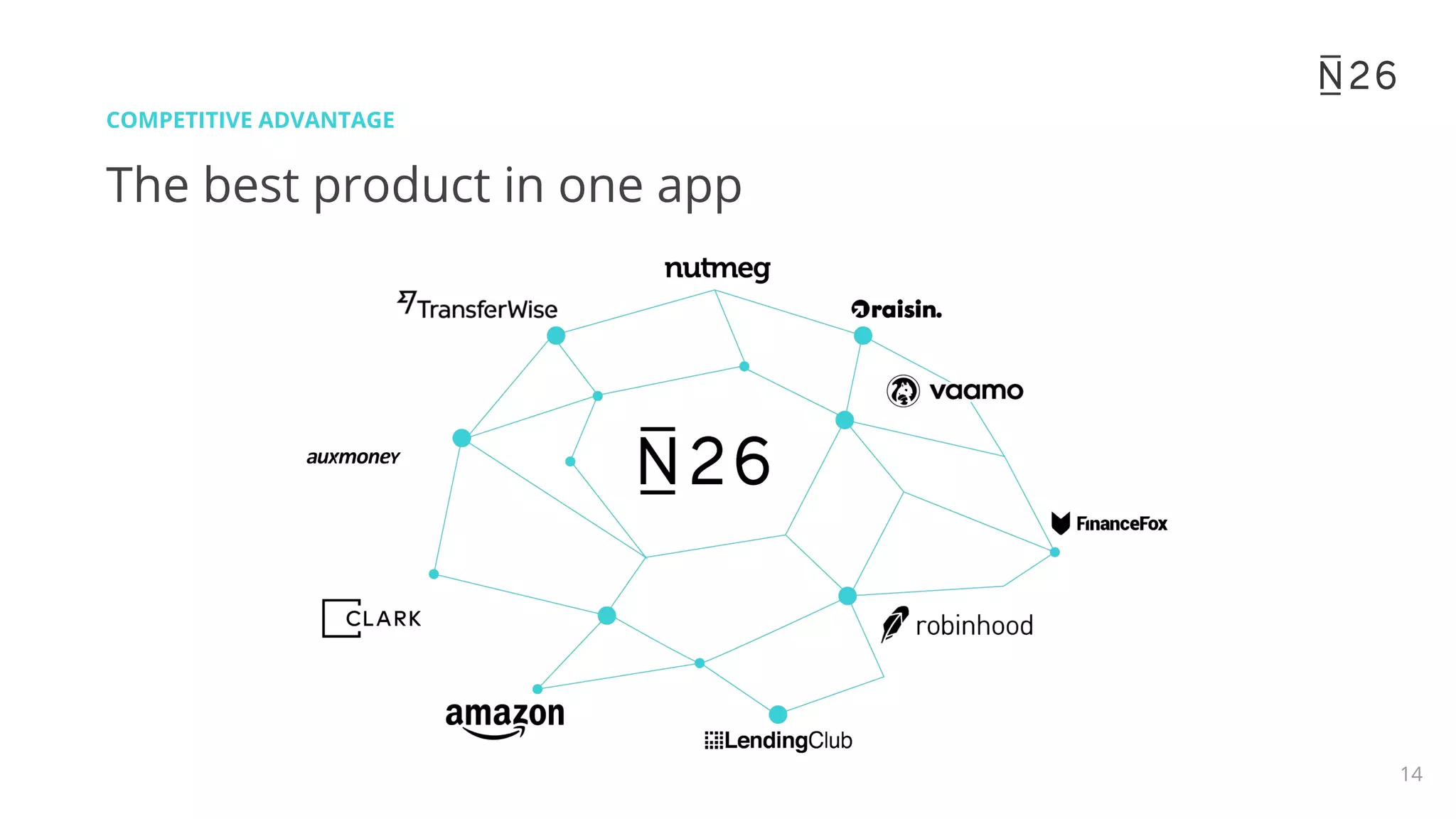
Slide 10 highlights an additional vertical: investment products via a partner (Vaamo) and a clean in-app projection UI. This signals that N26 is positioning as a platform that can aggregate financial services (banking, transfers, investments) rather than a single-product app. The slide illustrates monetization potential through new product lines while keeping the interface and user flow front-and-center, which helps investors picture cross-sell opportunities and lifetime value expansion.

For founders building platforms, showing credible partnerships and in-app UX for new revenue streams is crucial. It reduces risk by demonstrating a go-to-market for additional products and makes the case for higher ARPU; including partner names and sample screens provides tangible evidence rather than abstract claims.

Key Takeaway: Demonstrate platform potential with concrete partner integrations and UI examples that show how new revenue streams will be experienced by users.
Traction & Geographic Strategy

Traction & Geographic Strategy

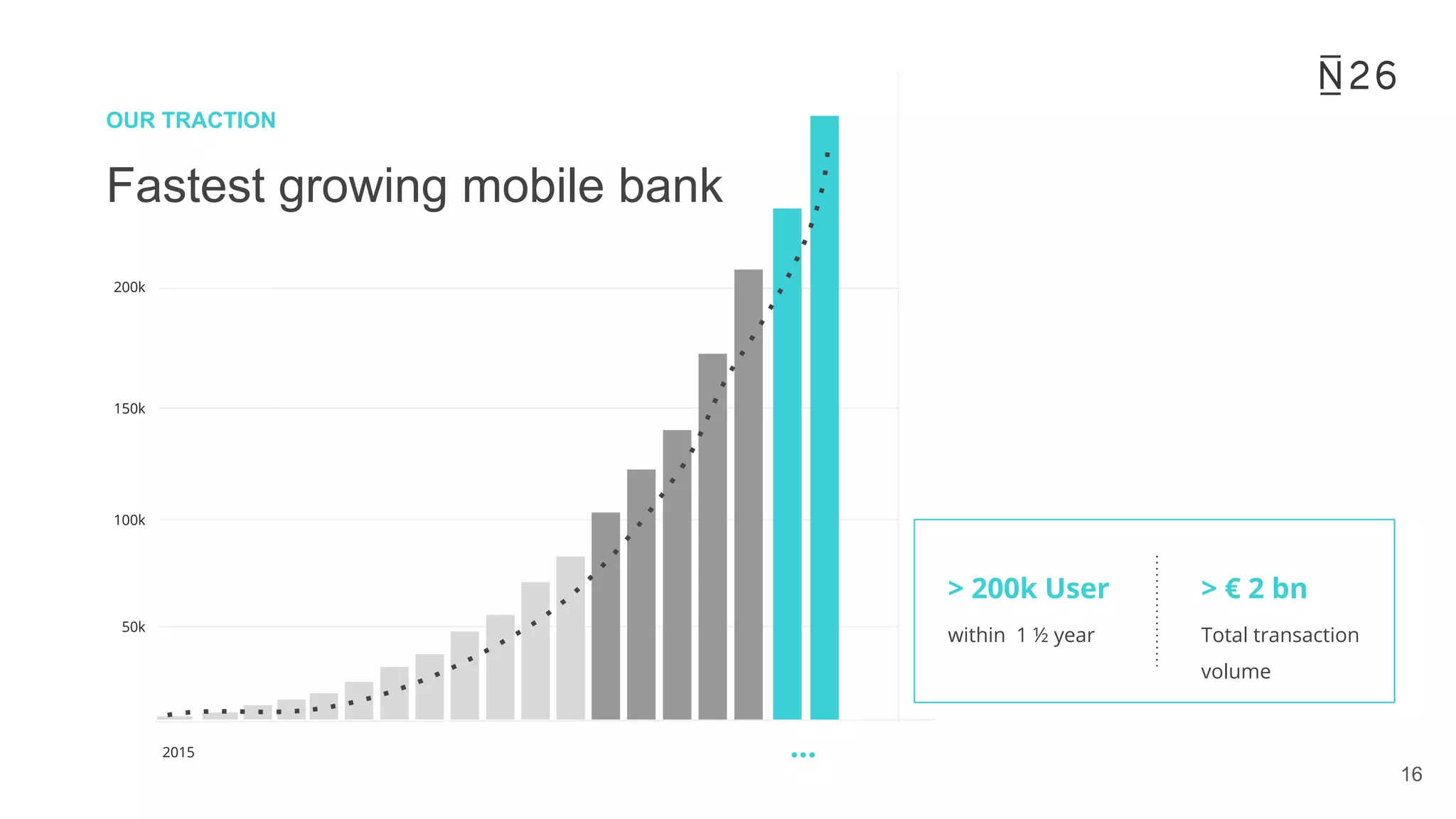
Slide 16 presents growth metrics with a bar chart showing rapid user growth and a callout: "> 200k User within 1 ½ year" and "> €2 bn Total transaction volume." The chart is simple, uses color to highlight recent acceleration, and pairs the visual with clear quantitative milestones. This gives investors substance: traction in user numbers and transaction volume which validates product-market fit and operational scale.

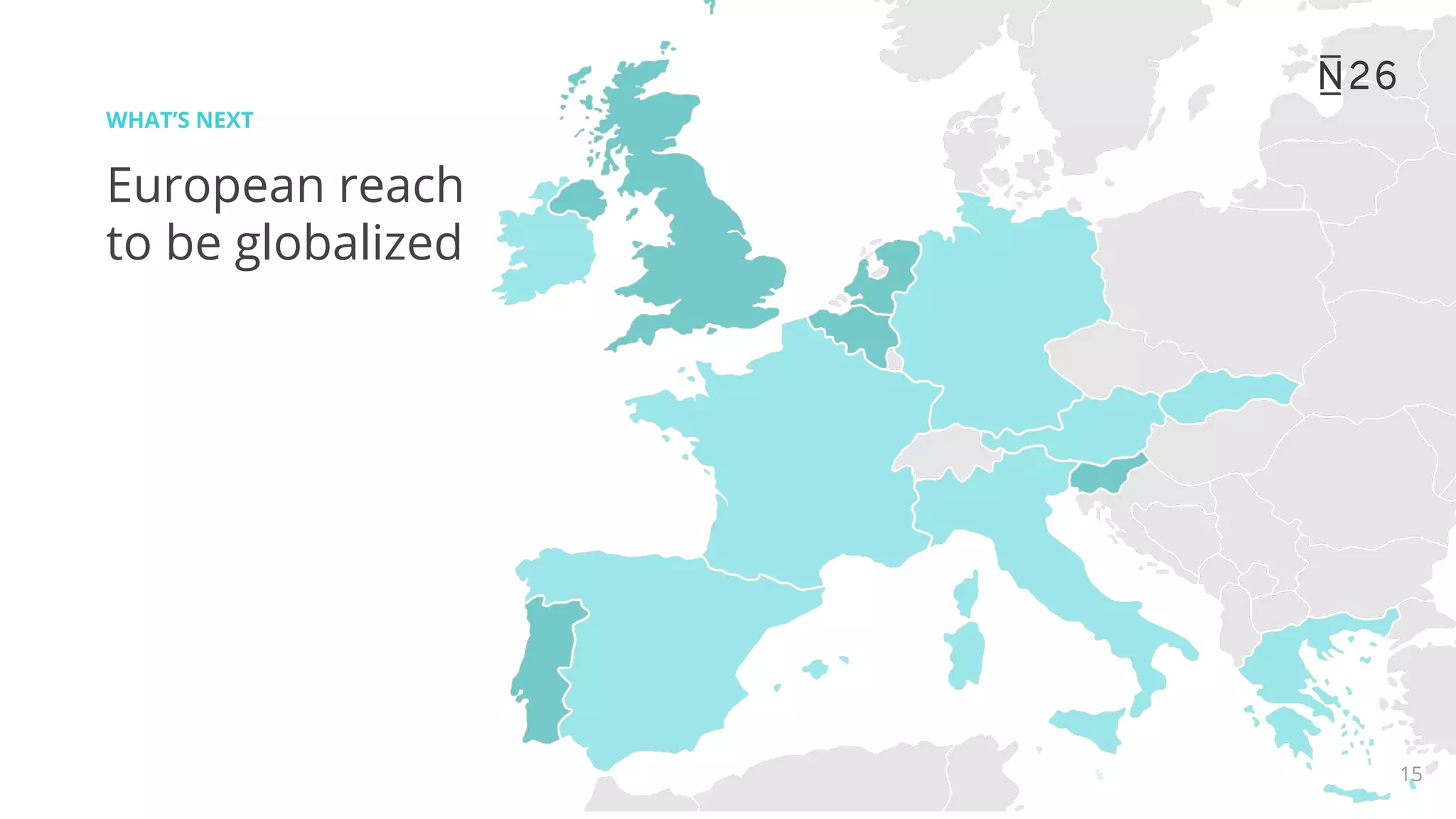
Slide 17 complements this with a European map marking target and operating countries, linking traction to an explicit expansion playbook. Together, these slides show not just growth but an intentional geographic runway. Founders should follow this example by pairing topline growth charts with maps or go-to-market plans that explain where next growth will come from and why those markets are attractive.

Key Takeaway: Pair clear traction charts with a geographic expansion map to show both momentum and a credible plan for scaling.
Team & Culture: Building for Scale

Team & Culture: Building for Scale

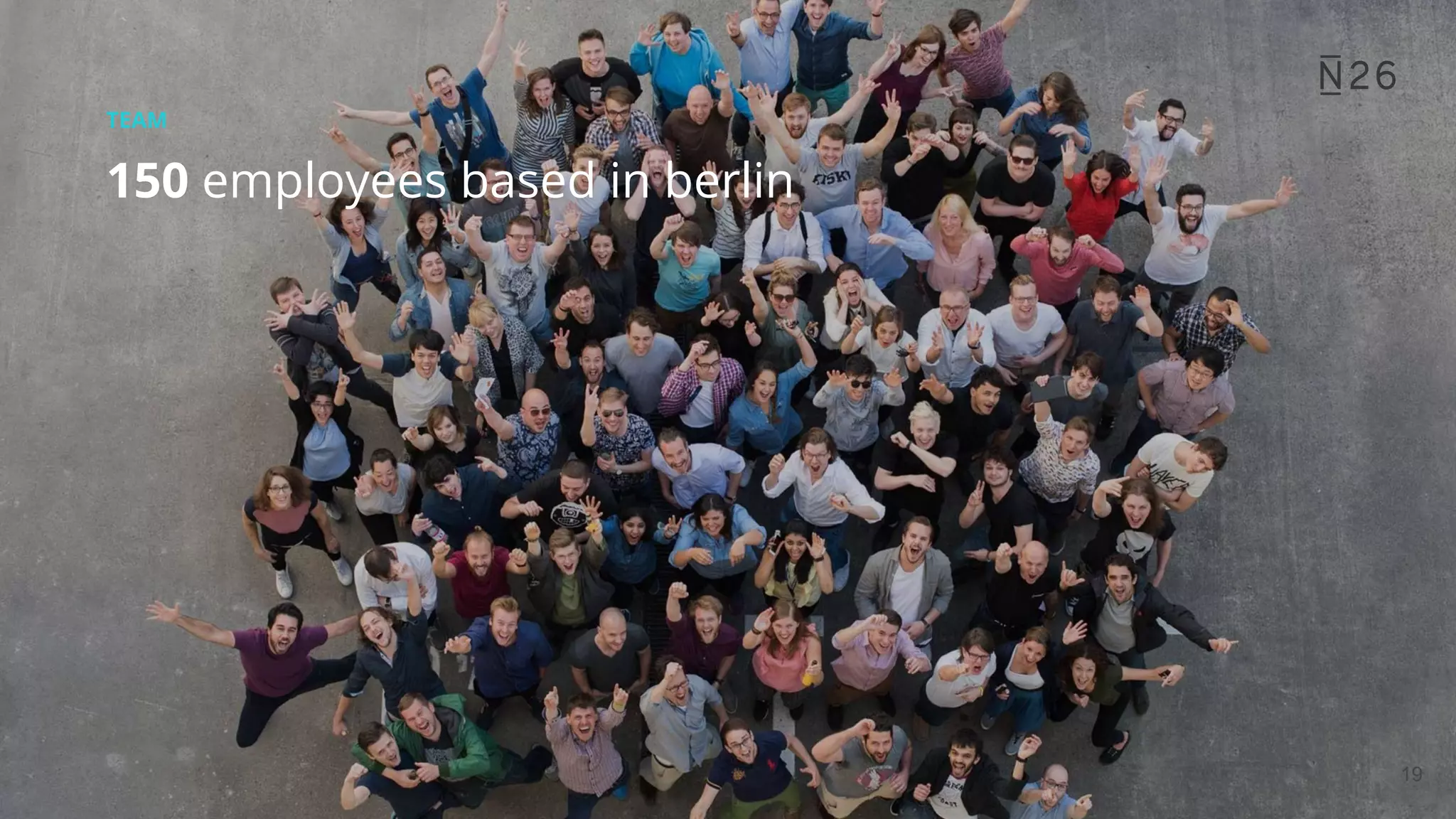
Slide 20 is a large team photo with a headline: "150 employees based in berlin." The visual communicates a sizable, engaged team and emphasizes company culture and operational capability. For investor audiences, a slide like this signals that the company has moved beyond founder-only execution and has built the human capital needed to scale product, operations, and compliance.

Founders should include team slides that convey both headcount and composition: whether you’re hiring for engineering, compliance, or growth matters for investor confidence. A team photo can humanize the company, but it should be supported in backups by org charts and key bios for critical roles to demonstrate depth and domain expertise.

Key Takeaway: Show team scale and culture visually, and support it with backup org details and key bios to prove operational readiness.

Conclusion: Key Lessons

This N26 deck combines strong visual design with tightly curated business proof points: problem framing, product differentiation, partnership-enabled features, actionable traction metrics, and a clear expansion roadmap. Its strengths lie in concise messaging, high-quality product imagery, and the linkage between user experience improvements and measurable business outcomes (activation speed, user growth, transaction volume). For founders, the deck is a useful model for how to present both emotional brand positioning and the hard metrics investors need.

Actionable advice: lead with a striking product-in-context visual and a one-line mission, follow quickly with a concise problem statement and a credible statistic, then show core product differentiators (including regulatory or operational credentials). Pair product UX examples with partner and monetization strategies, and close with clean traction charts plus a geographic expansion plan. Always include backup slides with sources, partner terms, org charts, and unit economics to satisfy diligence after the deck piques interest.