Stack up against Square

Compare Your Deck

Square's 2010 Pitch Deck

Fintech
Stage: Various
Raised: Multiple rounds
Year: 2010
Slides: 20
Outcome: IPO, now Block at $40B+

Pitch Deck

1 / 20
Slide 1
Click to expand

Deck Analysis

This deck is an early-stage investor presentation for Square (2010-era), a fintech startup that turned a simple headphone-jack card reader and intuitive app into a mass-market payments platform. It combines a crisp product demo, market-sizing, founding team credibility, go-to-market strategy and financial projections to make a VC-investable case. The deck is notable because it balances storytelling (simple value prop and vision) with the quantitative elements investors expect (market growth, unit economics, and exit pathways), which helped Square raise follow-on capital and eventually IPO.

The Proposition: Clear, simple value (slide: product & pricing)

The Proposition: Clear, simple value (slide: product & pricing)

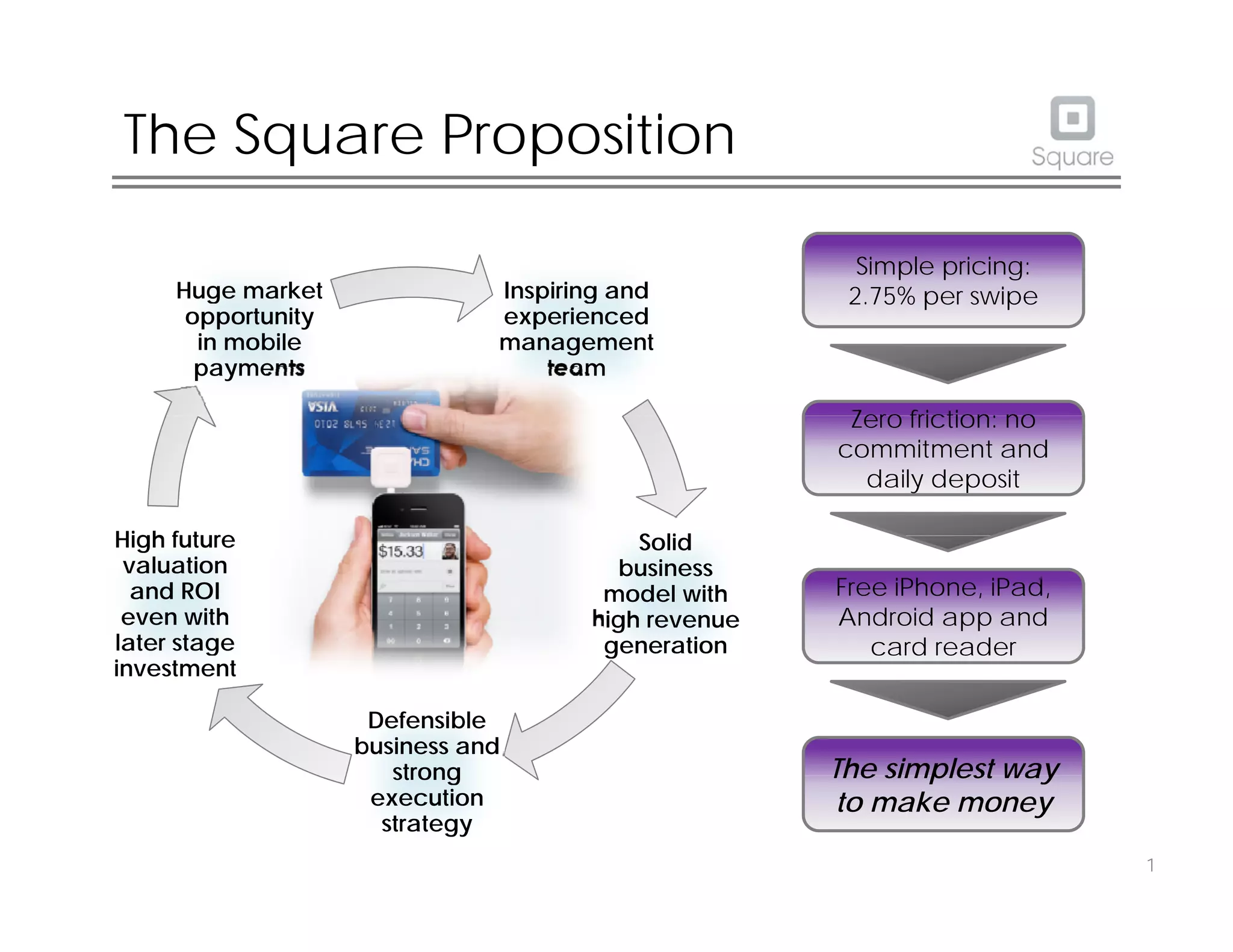
Slide analyzed: The Square Proposition (SLIDE 2) uses a visual center (card reader + phone) surrounded by a concise value-cycle and a right-hand column that reduces the offering to three simple bullets: simple pricing (2.75%), zero friction (no commitments/daily deposits), and free hardware. This layout makes the product both tangible (you can picture the card reader) and immediately attractive to merchants (transparent fees + free device). The circular arrows around the image imply defensibility and compounding value (team → business model → valuation), which frames the product as both practical and investable.

What founders can learn: start with one clean, visual value proposition and lead with the simplest commercial terms your customers care about. The slide is effective because it answers “what is it?”, “how does it make money?”, and “why is it defensible?” in one glance. Use an actual product image, boil pricing and friction down to a few words, and show a concise path from product to return so investors can quickly connect product-market fit to monetization.
Key Takeaway: Lead with a single, visually obvious value prop and highlight the simple customer-facing economics (price, friction, and hardware) to make the business instantly understandable.
Team: high-signal founding roster and social proof

Team: high-signal founding roster and social proof

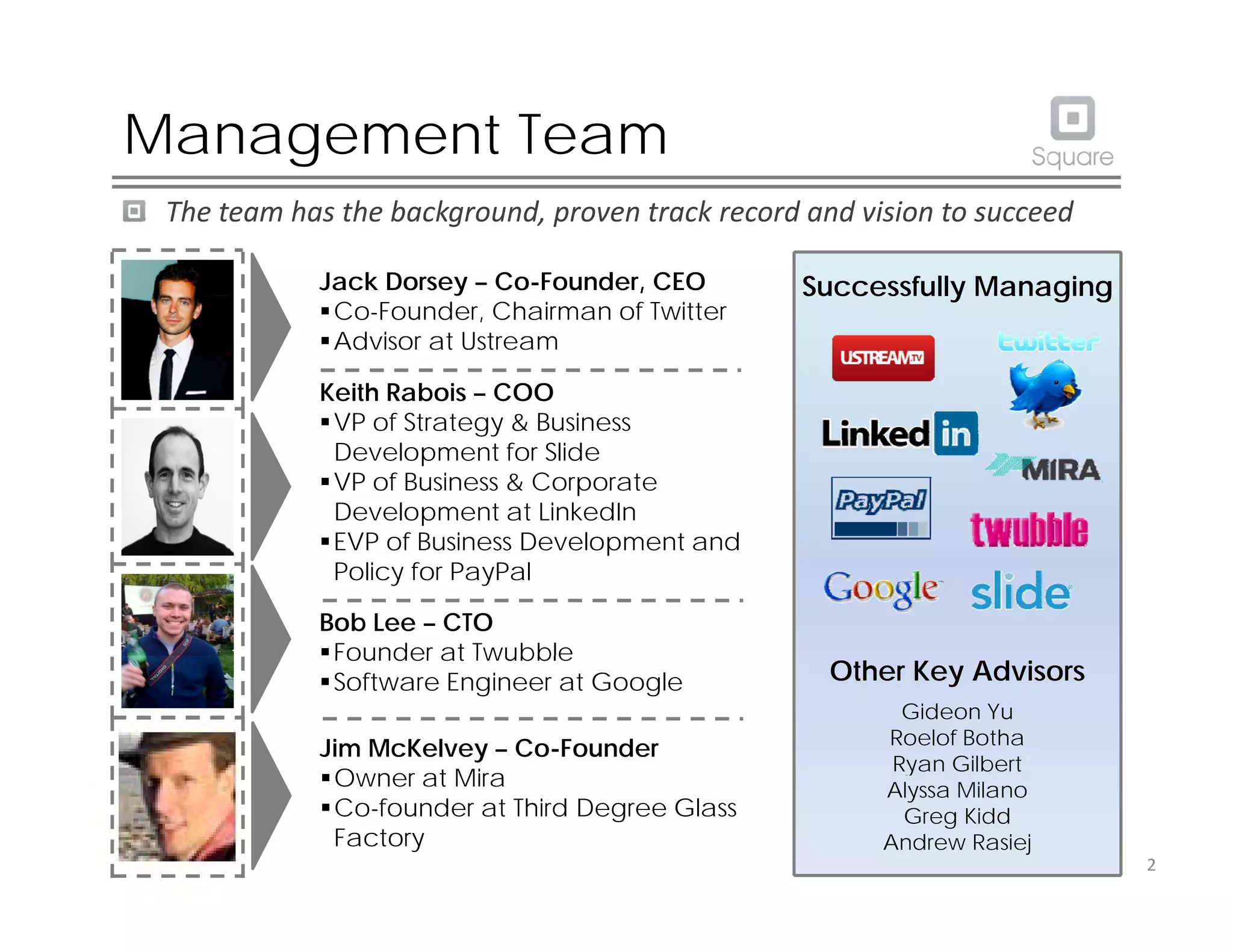
Slide analyzed: The Management Team slide (SLIDE 3) foregrounds well-known, credible founders (Jack Dorsey, Keith Rabois, Bob Lee, Jim McKelvey) with photos, short bios, and recognizable logos of companies they’ve been associated with. On the right it groups logos of companies the team has successfully managed at, which acts as quick social proof and reduces perceived execution risk. This slide trades density for clarity: short bullets for each founder plus visual endorsements (logos) that resonate with investors.

What founders can learn: when you have high-signal team members, make the slide about credibility and execution capacity—use photos, one-line relevant experience, and familiar brand logos to convey network and track record. If your team is less famous, prioritize specific, measurable accomplishments (revenue built, customers acquired, product launches) that show execution capability in the same compact format.

Key Takeaway: Use photos, one-line bios and credible partner logos to turn team resumes into a rapid trust-builder for investors.
Market: large, fast-growing TAM with simple slices

Market: large, fast-growing TAM with simple slices

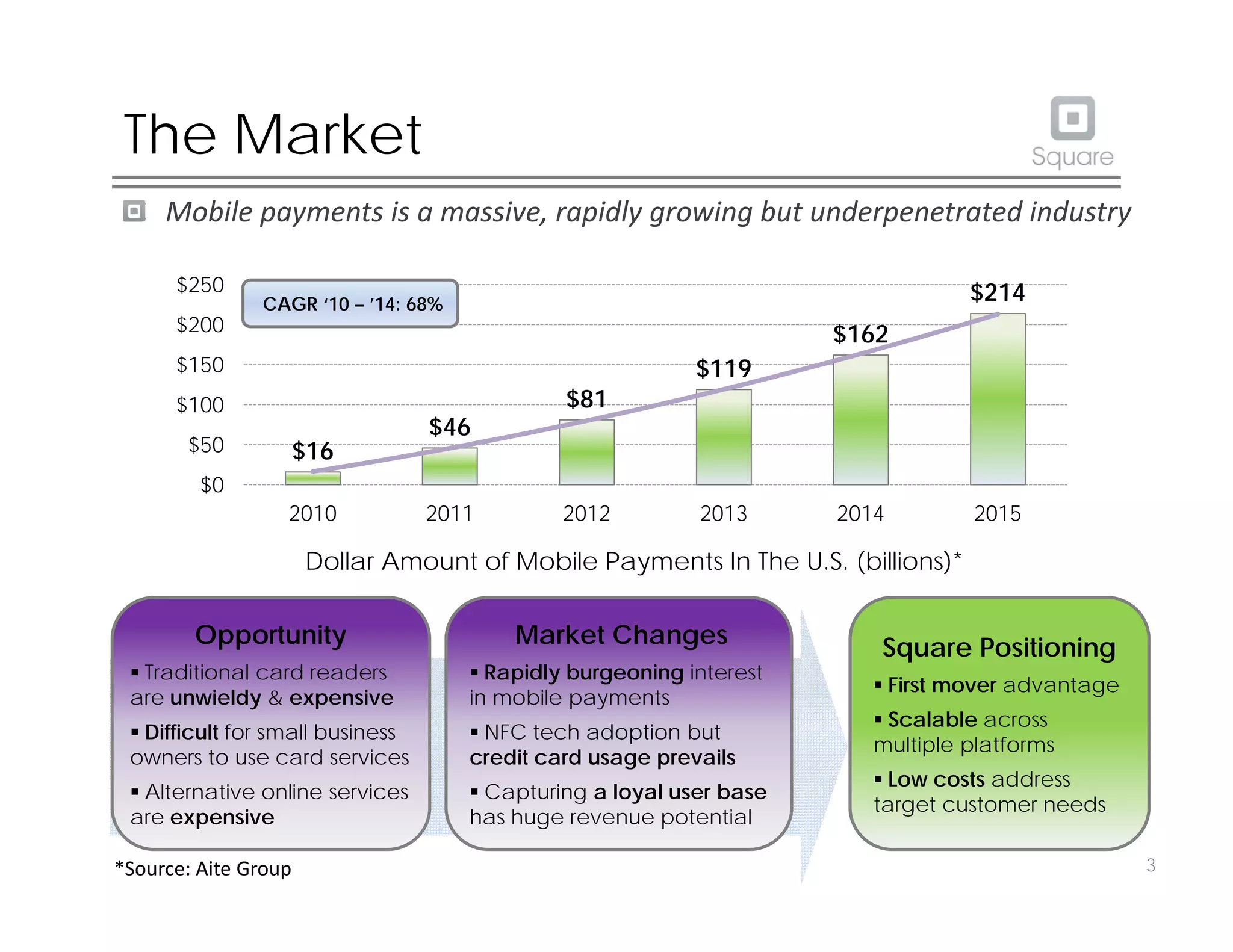
Slide analyzed: The Market slide (SLIDE 4) pairs a clear bar/line chart of rapid growth in US mobile payments (2010–2015) with three boxes that spell opportunity, market changes and positioning. The chart quantifies the addressable market (from $16B to $214B by 2015) and cites a CAGR figure, while the boxes translate that growth into actionable reasons Square can win: traditional readers are unwieldy/expensive, NFC adoption lags, and capturing loyal users creates recurring revenue. This combination ties macro opportunity to product-specific advantages.

What founders can learn: investors want both macro context and direct reasons your product is positioned to capture that market—show a credible growth chart and pair it with 2–3 focused bullets that map market dynamics (pain points, tech adoption gaps, customer economics) to your positioning. Cite sources for market numbers and keep the narrative focused on how market forces amplify your go-to-market.

Key Takeaway: Frame TAM with credible numbers and immediately map market trends to specific product advantages; show why the timing favors you.
Product & Technology: demo-first with concise tech assurances

Product & Technology: demo-first with concise tech assurances

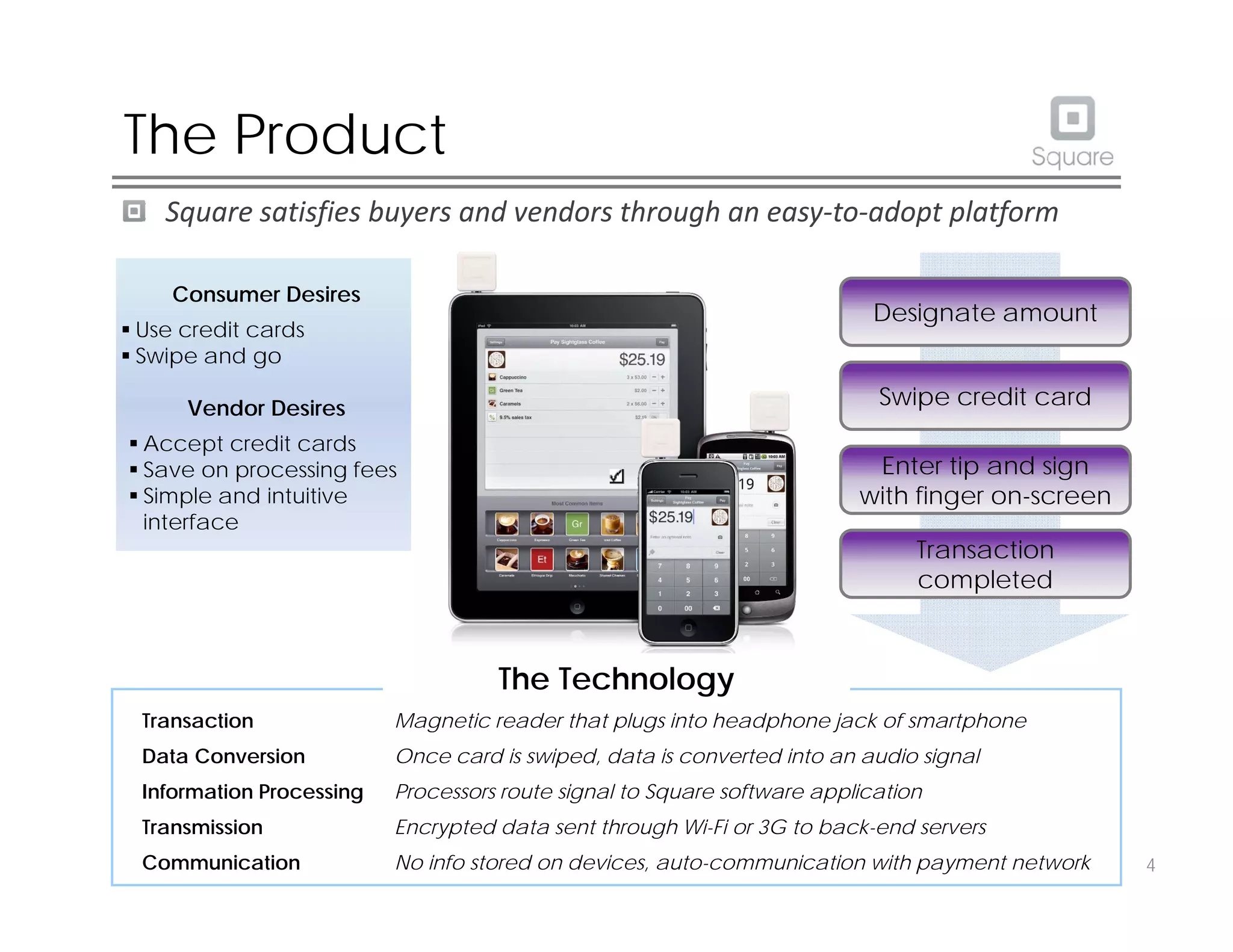
Slide analyzed: The Product slide (SLIDE 5) centers on an image of devices running the Square app and a step-by-step right column showing the seller flow (designate amount → swipe → sign → complete). The left column contrasts consumer and vendor desires while a bottom box succinctly describes the technology (magnetic reader → audio signal → encrypted transmission; no data stored on device). That combination does three things: demonstrates UX simplicity, reassures about security/architecture, and aligns both sides of the marketplace (buyers and sellers).

What founders can learn: show the user flow visually and then back it up with a brief technical explanation that addresses the top investor concerns (security, data flow, compatibility). A product-first slide that demonstrates an elegant UX plus a single-paragraph technical assurance can reduce friction in follow-up conversations and preempt basic diligence questions.

Key Takeaway: Lead with a short visual demo of the core user flow and add a compact technical note addressing security and data handling to preempt early concerns.
Customer Acquisition & Growth: distribution clarity and credible traction

Customer Acquisition & Growth: distribution clarity and credible traction

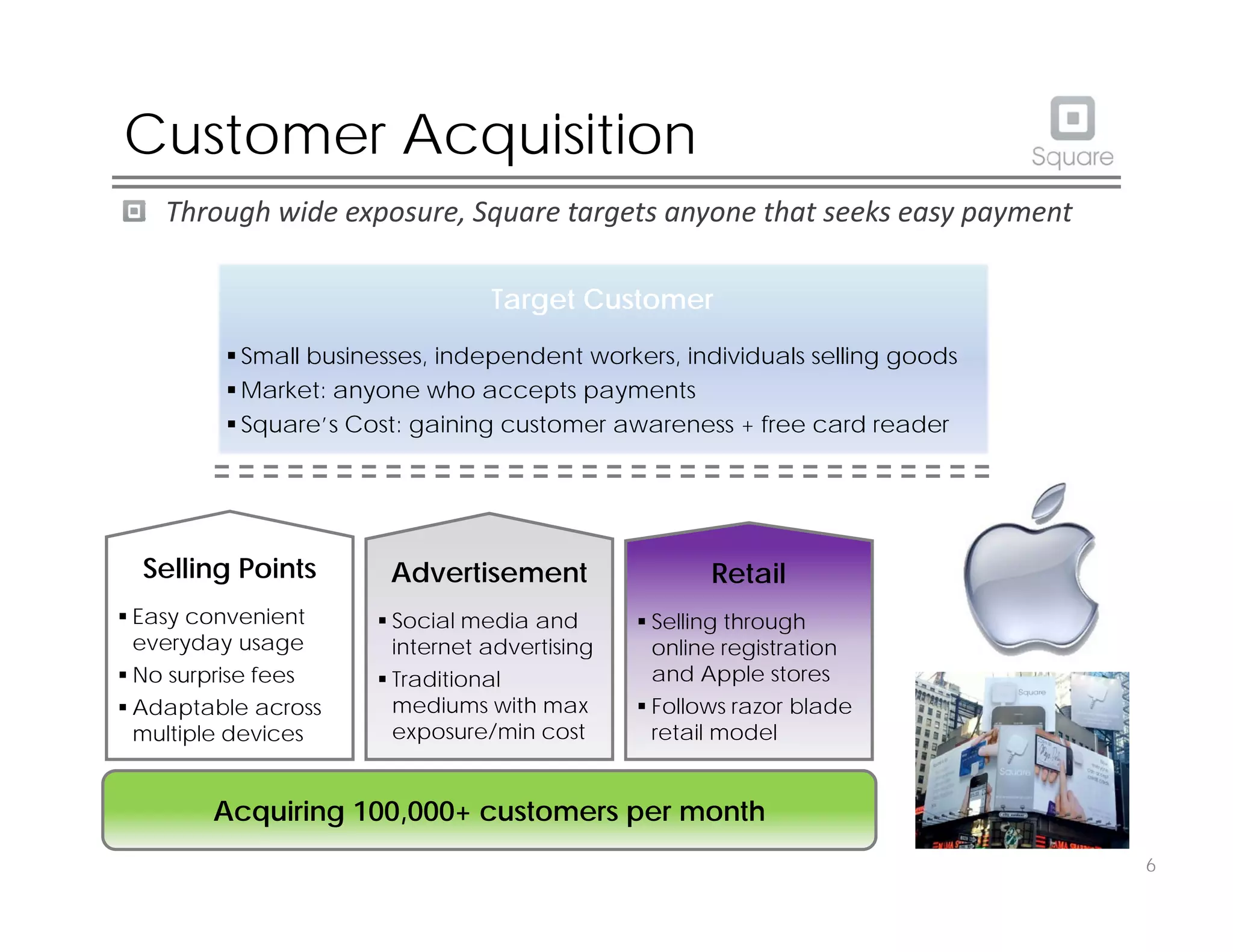
Slide analyzed: The Customer Acquisition slide (SLIDE 7) spells out target segments (small businesses, individuals), selling points, advertising channels (social media, traditional) and a retail/Apple-store play—concluding with a bold claim: acquiring 100,000+ customers per month. The slide pairs qualitative GTM tactics with a quantitative traction statement, signaling that the product-market fit is already turning into growth. The presence of Apple logos and retail references also imply channel partnerships and credibility.

What founders can learn: investors look for both how you will reach customers and evidence it’s working; present a multi-channel acquisition plan (organic, paid, retail, partnerships) and follow it with a traction metric that’s easy to verify or explain. Be specific about costs and unit economics if possible (e.g., cost to acquire, conversion rates) to make the growth claim investable rather than aspirational.

Key Takeaway: Combine a clear, multi-channel GTM plan with a concrete, verifiable growth metric to turn storytelling into investable traction.
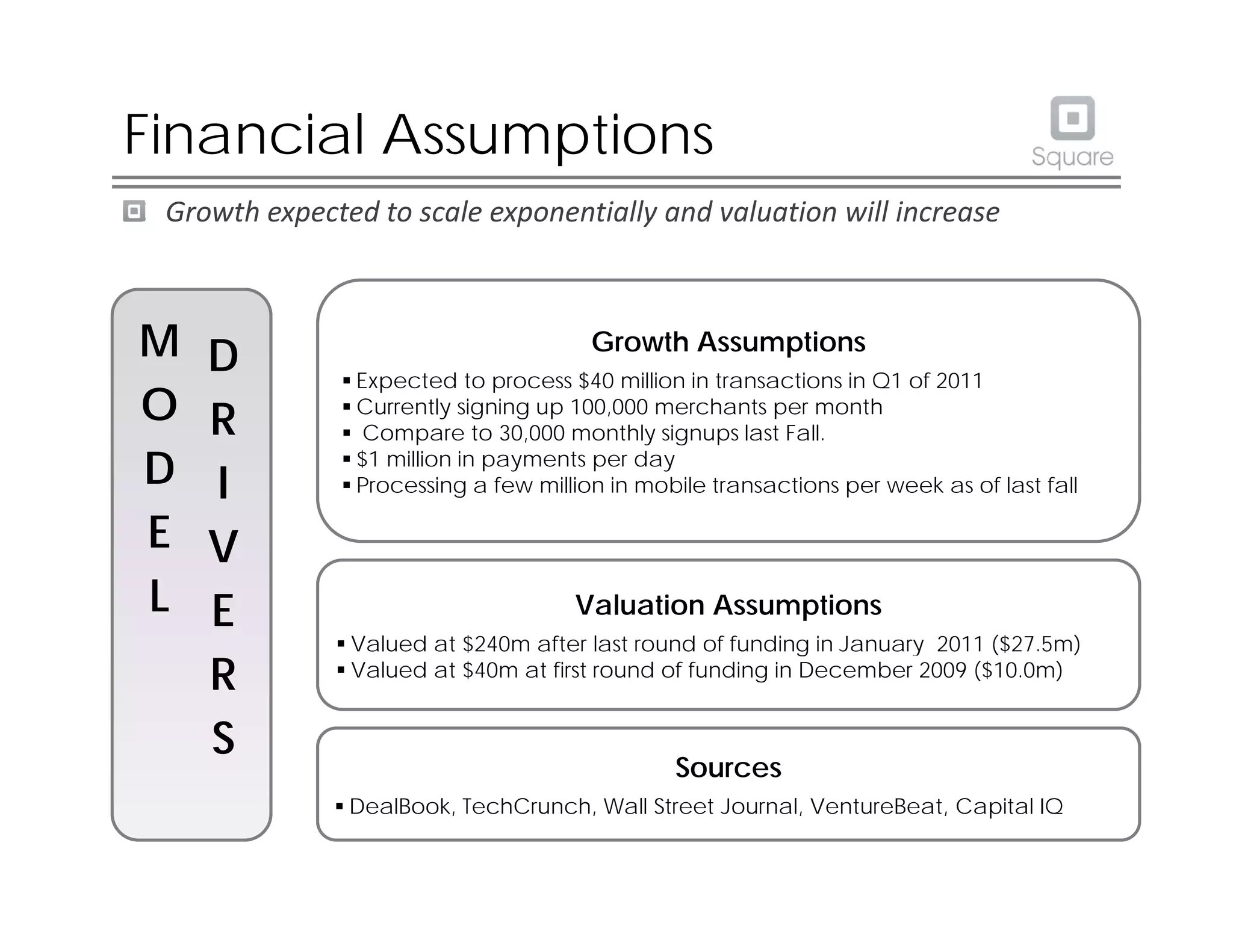
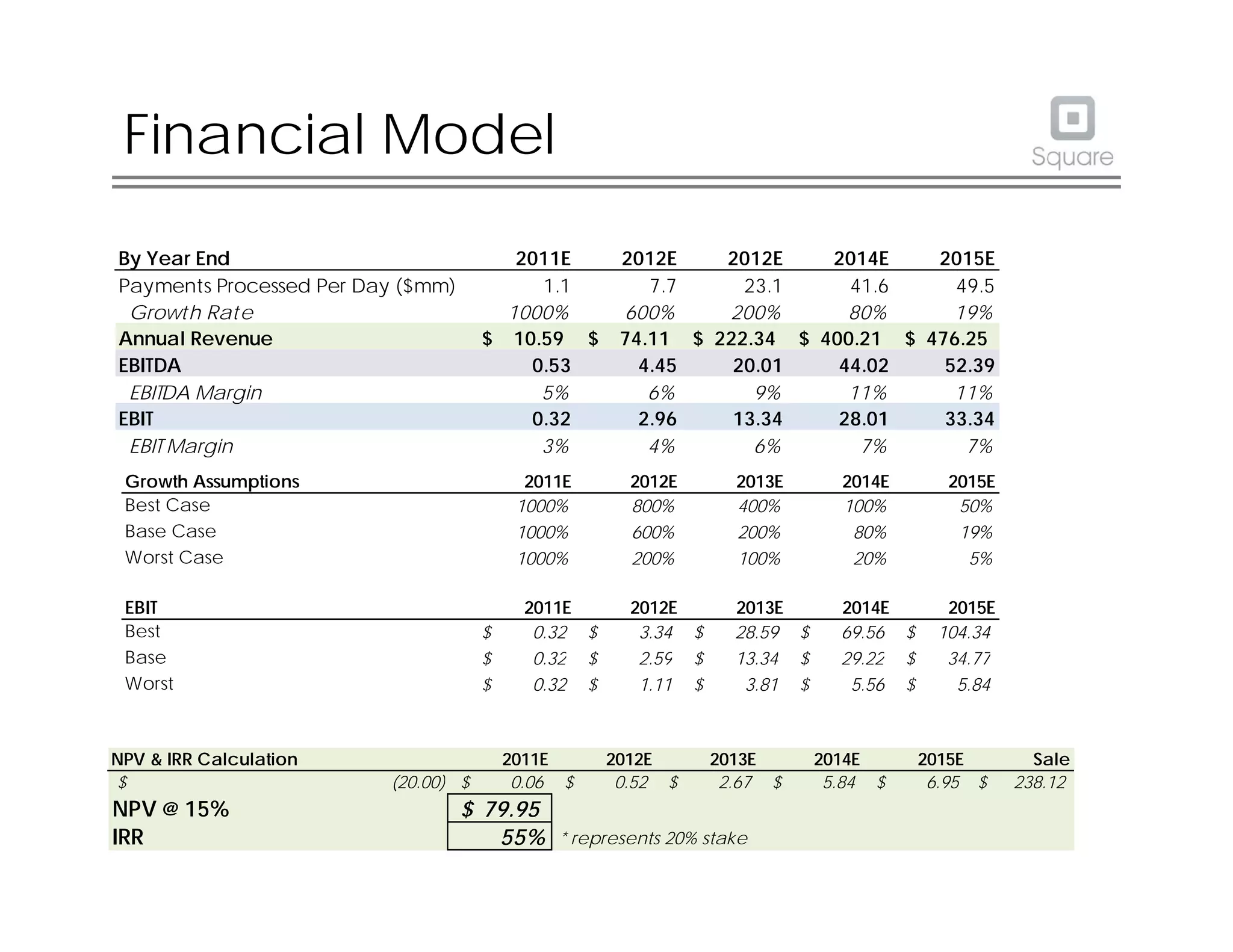
Financials & Ask: aggressive but transparent projections

Financials & Ask: aggressive but transparent projections

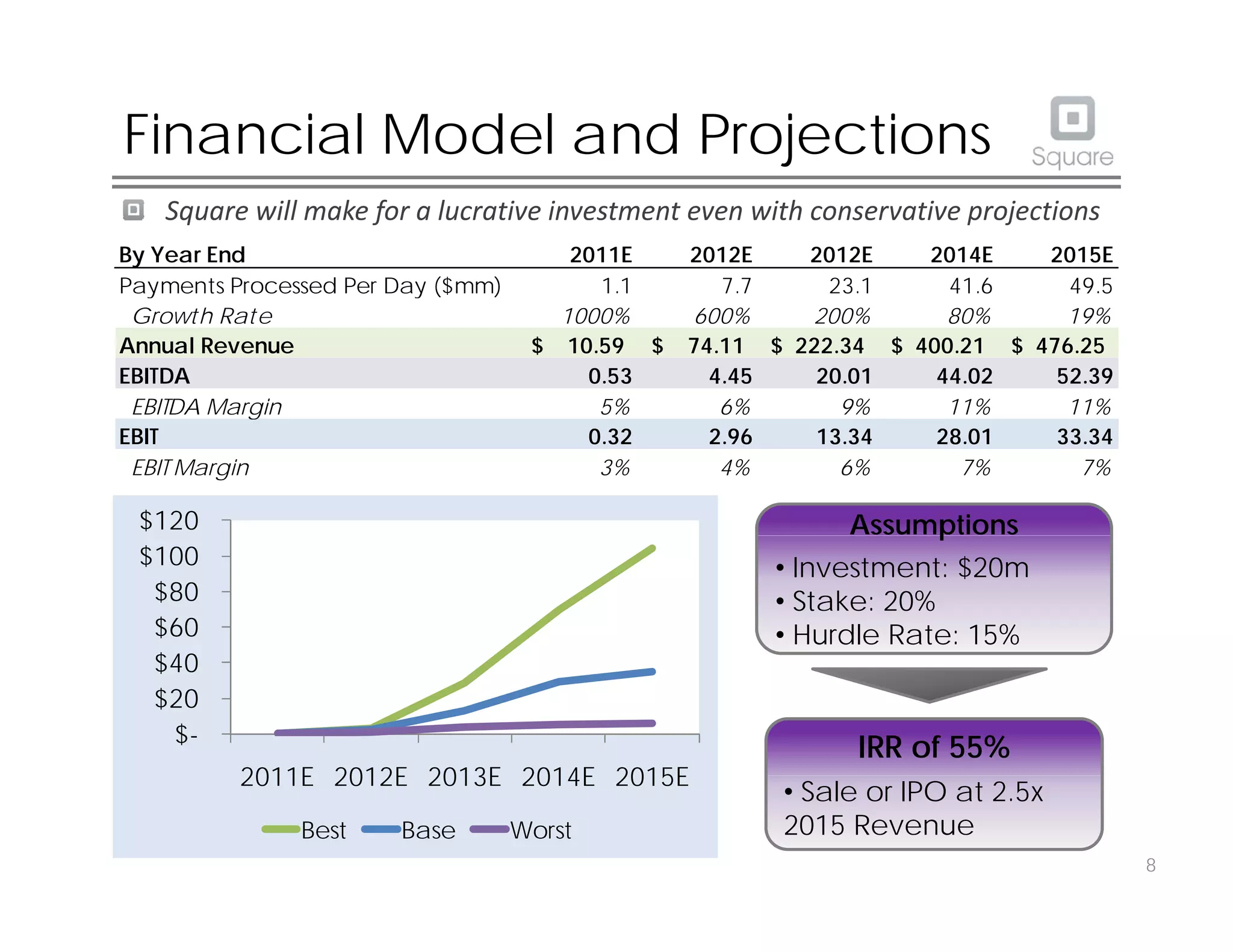
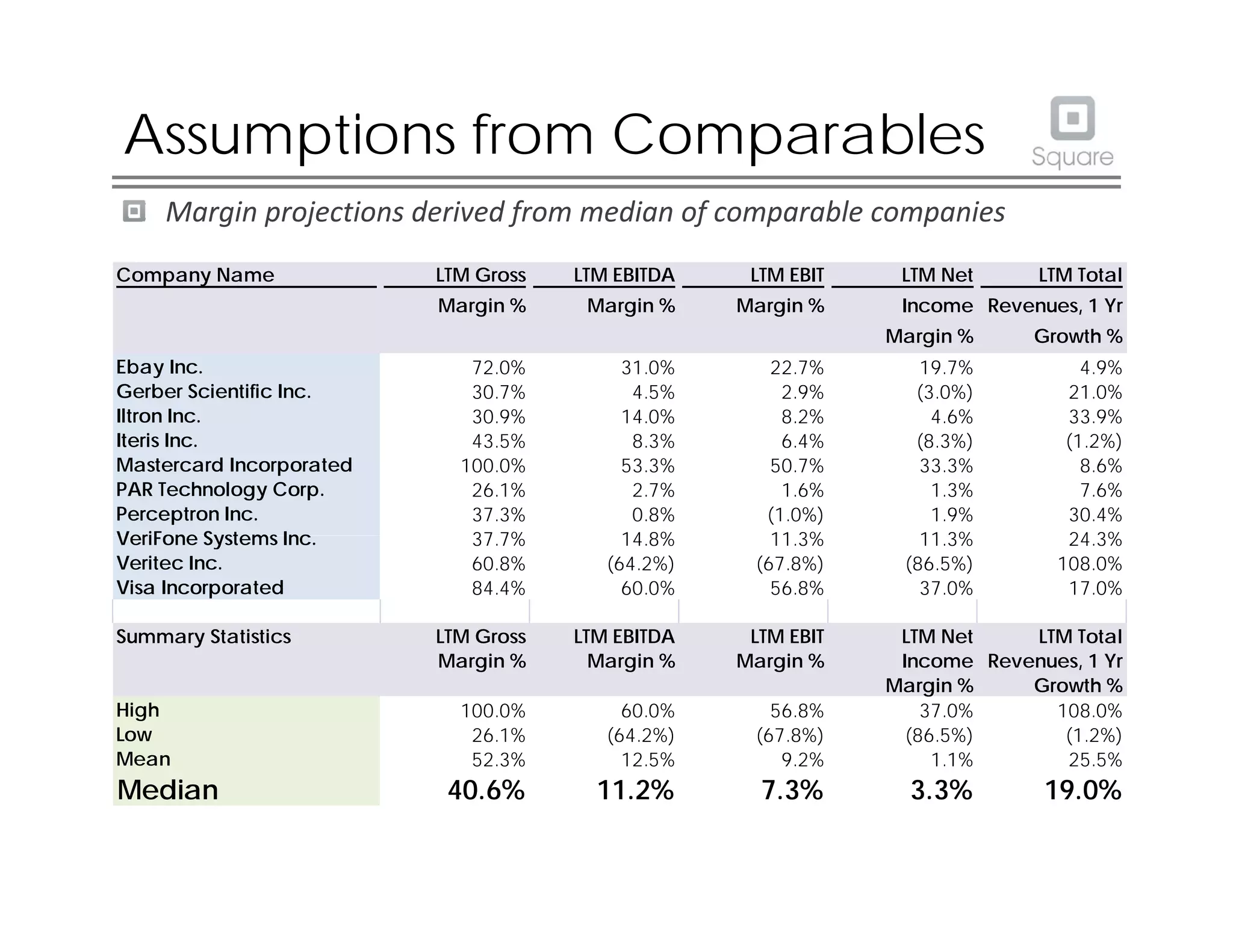
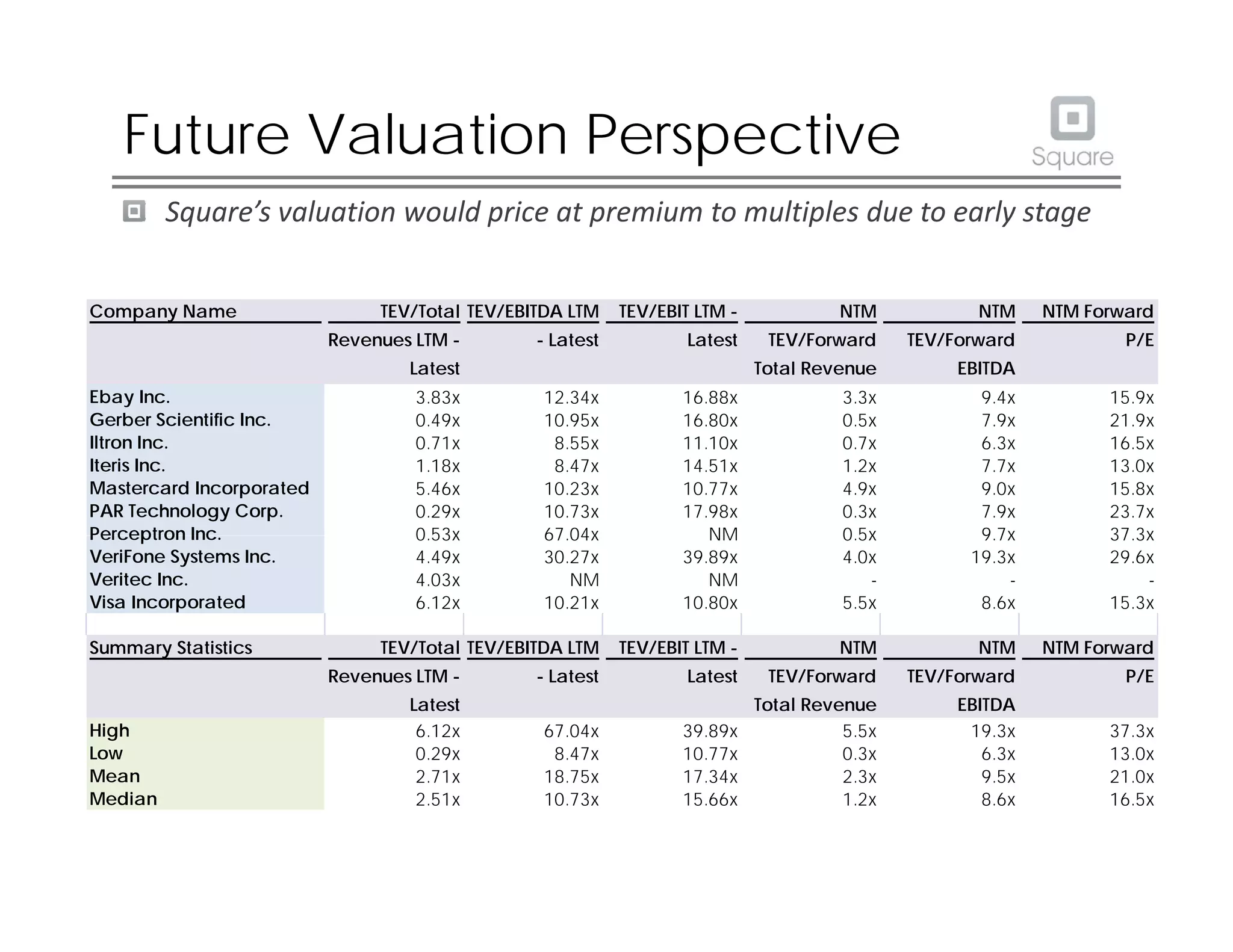
Slide analyzed: The Financial Model and Projections slide (SLIDE 9) lays out payments processed per day, revenue, EBITDA, EBIT, margin progression, and scenario curves (best/base/worst) across 2011–2015. It includes assumptions (investment $20m, stake 20%, hurdle rate 15%) and claims an IRR of 55% with a sale/IPO exit multiple. The slide is dense but gives investors the key inputs and outputs and ties them to exit scenarios—showing upside and the capital ask/return expectations.

What founders can learn: provide a readable financial summary with clear drivers (payments processed, take rate), multiple scenarios, and explicit assumptions that lead to investor outcomes (IRR, exit multiple). Avoid unsupported optimism—label assumptions and show sensitivity. Investors prize transparency: show how much capital you need, what stake it buys, and the implied return under credible exit assumptions.

Key Takeaway: Present a driven financial model with clear unit economics, labeled assumptions and scenario outcomes so investors can see the path to returns and the capital required.

Conclusion: Key Lessons

This deck succeeds because it pairs a simple, visual product story with market evidence, credible team social proof, a tangible go-to-market plan and concrete financials. Each slide anticipates investor questions—what is the product, why now, who’s running it, how will customers be acquired, and what are the returns—and answers them succinctly. The result is a cohesive narrative that turns a small hardware add-on and app into a scalable payments business.

Actionable advice for founders: prioritize clarity and verification—lead with a one-sentence value prop and a product image, quantify market size and traction, showcase team credibility in one glance, map GTM channels to real metrics, and provide a financial model with labeled assumptions and exit math. Anticipate the top investor concerns (security, defensibility, CAC, unit economics) and address them directly with short, evidence-backed bullets so your deck invites follow-up diligence rather than more questions.