Stack up against Buffer

Compare Your Deck

Buffer's 2011 Pitch Deck

SaaS
Stage: Seed
Raised: $500K
Year: 2011
Slides: 13
Outcome: Bootstrapped, $20M ARR

Pitch Deck

1 / 13
Slide 1
Click to expand

Deck Analysis

This seed pitch deck from Buffer (2011) is a concise, design-forward presentation that quickly establishes a large market trend (social sharing), explains a simple product value (scheduled sharing), and backs it with concrete traction and financial reasoning. Notable for its visual clarity and metrics-first approach, the deck leans heavily on a few big ideas: social is growing fast, scheduling improves engagement, and a freemium model with predictable unit economics can scale. Founders can learn how to communicate product simplicity, early momentum, and path-to-revenue in a compact, investor-friendly format.

Opening: Strong Brand and Visual Identity

Opening: Strong Brand and Visual Identity

The first slide is a full-bleed logo that establishes an immediate visual identity. Starting with the brand alone communicates confidence and helps the audience remember the company name before any details are presented. The minimal design also sets the tone for the rest of the deck: clean, focused, and product-driven.

By opening with a simple, polished logo slide the founders remove noise and let subsequent slides carry the narrative. Founders should recognize the value of a strong visual anchor — it primes investors and creates cohesion across later slides that emphasize growth and product. A clear brand-first opening also signals design and product sensibility, which is especially important for B2C/SaaS products where UX matters.

Key Takeaway: Lead with a strong visual identity to set the tone and build memorability before diving into data.
Market Context: Establishing a Trend (Zuckerberg's Law)

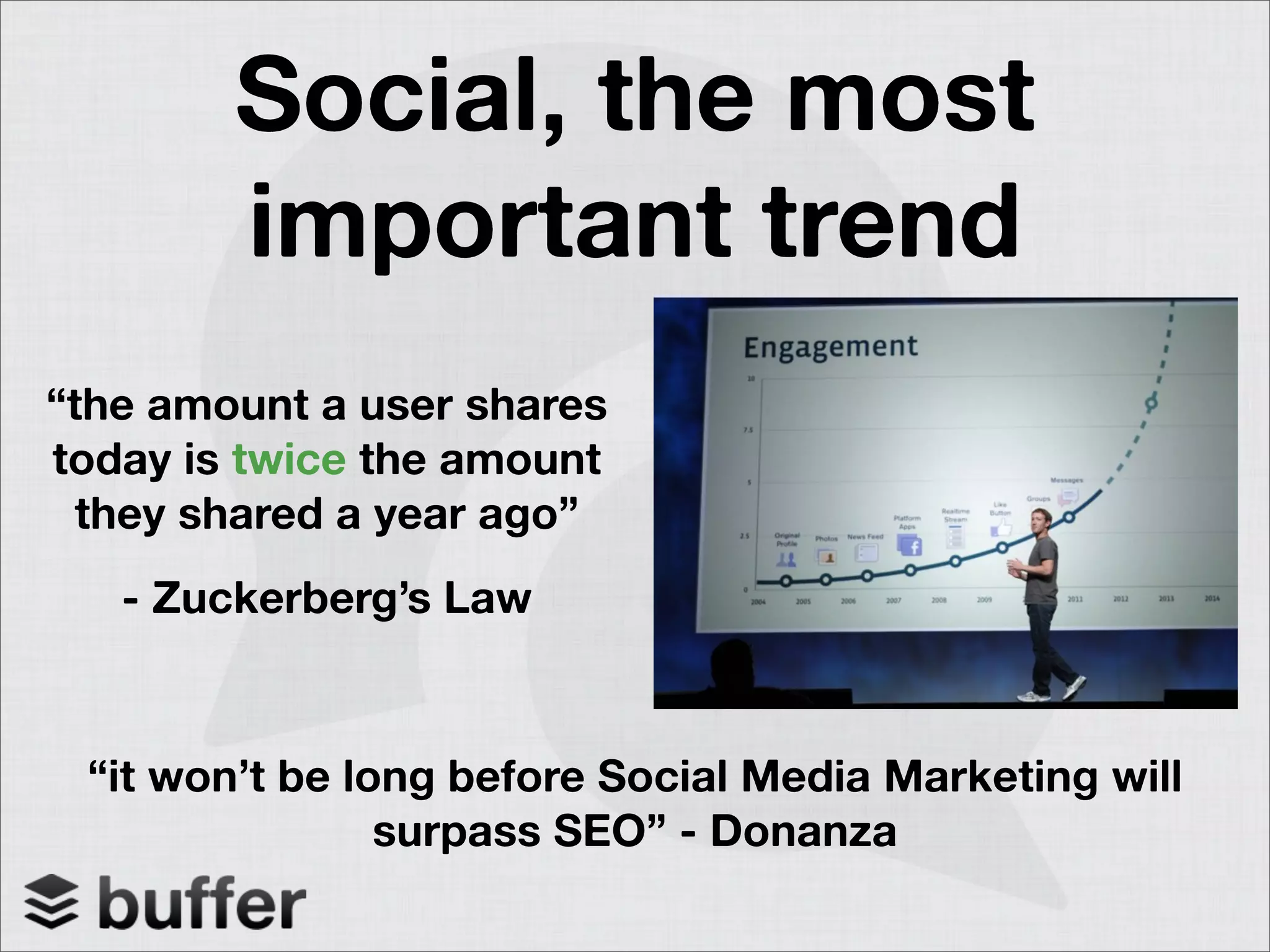
Market Context: Establishing a Trend (Zuckerberg's Law)

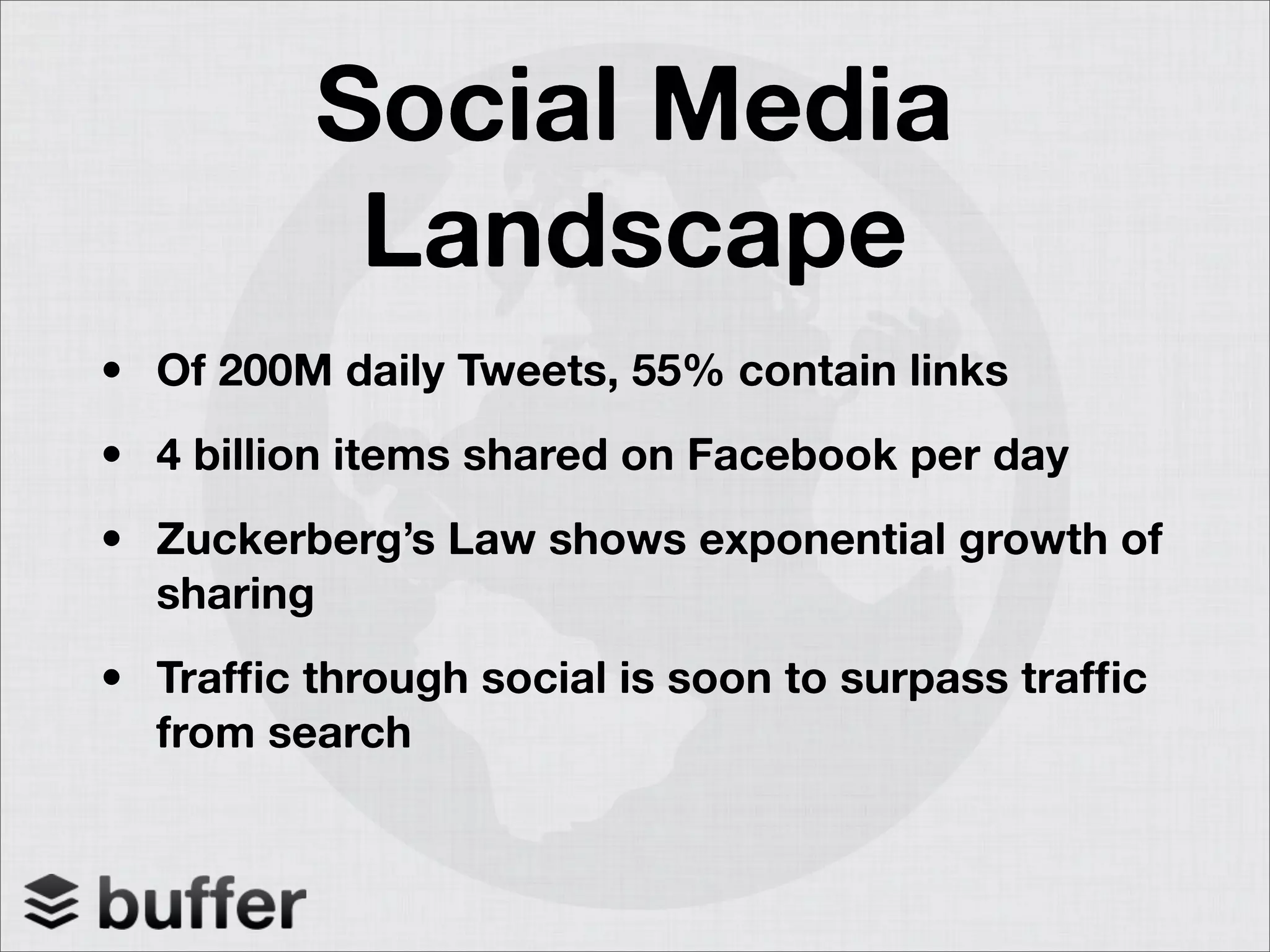
Slide 2 frames the opportunity by citing social sharing growth and a memorable rule — "the amount a user shares today is twice the amount they shared a year ago" — paired with a visual of exponential engagement. This slide connects the product to an obvious macro trend (massive growth in social sharing and link-sharing behavior), justifying why a scheduling and sharing product is strategically relevant.

The slide is effective because it blends a qualitative quote, an authoritative name, and a related visual to quickly make the market case. Founders should emulate this by using a few simple, high-impact facts or quotes that show why the market dynamics favor their product, rather than overwhelming investors with exhaustive market research at the outset.

Key Takeaway: Tie your product to a clear, data-backed trend early to justify market timing and urgency.
Product Demonstration: Show the Core Experience (Queue Your Updates)

Product Demonstration: Show the Core Experience (Queue Your Updates)

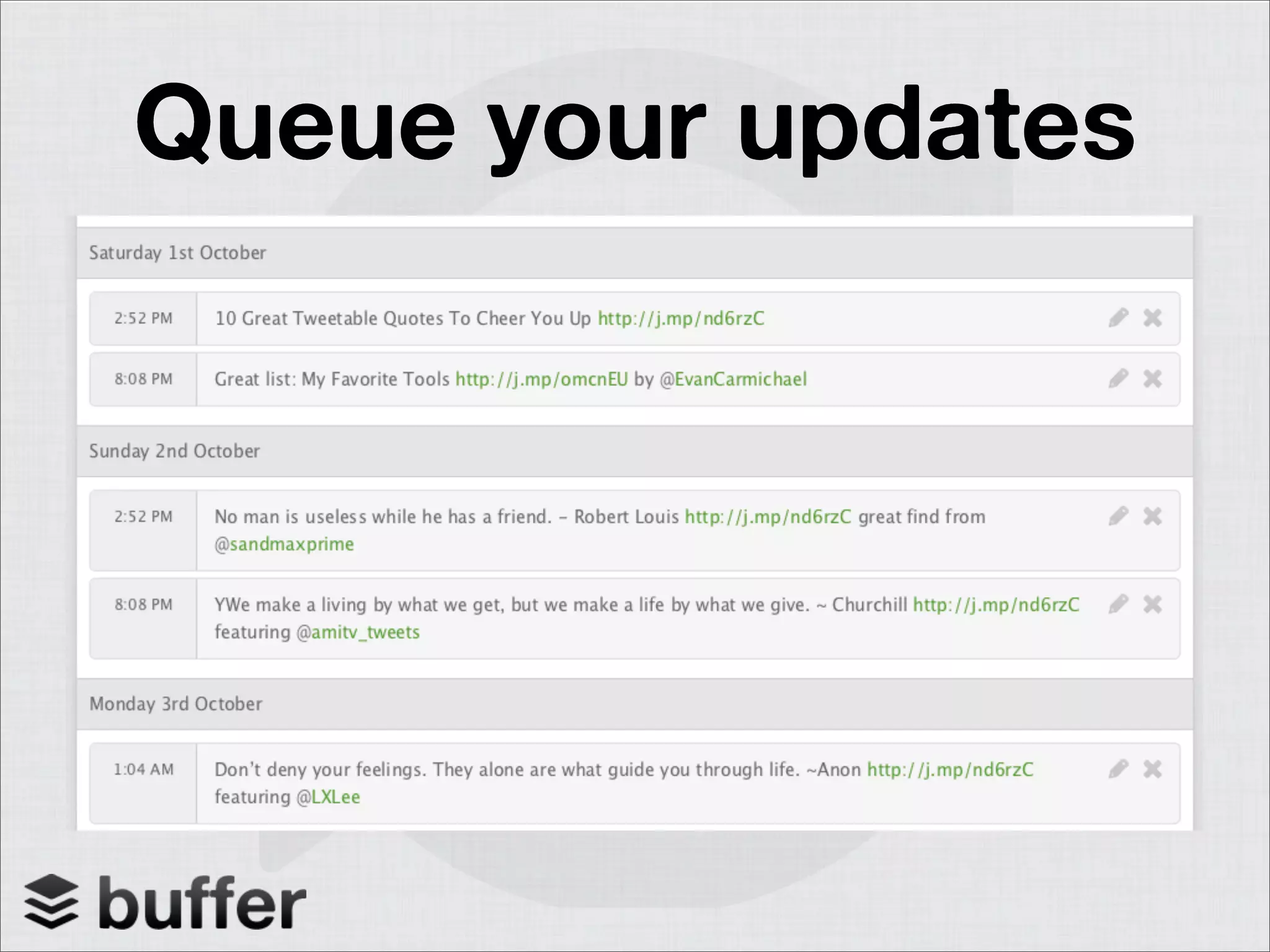
Slide 4 uses a single, large screenshot of the product queue with a succinct headline: 'Queue your updates.' It demonstrates the core value — scheduling and queuing posts — without technical jargon. The visual shows the interface and the workflow, making it obvious what users do and why it’s helpful. This approach keeps the message focused on functionality and user benefit rather than feature lists.

This slide teaches founders the power of a single, well-shot product screenshot: it communicates utility, reduces cognitive load, and lets investors imagine the user flow. If your product’s primary differentiator is UX or workflow, show it early and prominently; images beat bullet points for explaining how a product is used in practice.

Key Takeaway: Use one clear product screenshot to convey the core user workflow and value proposition instantly.
Traction: Metrics That Build Credibility

Traction: Metrics That Build Credibility

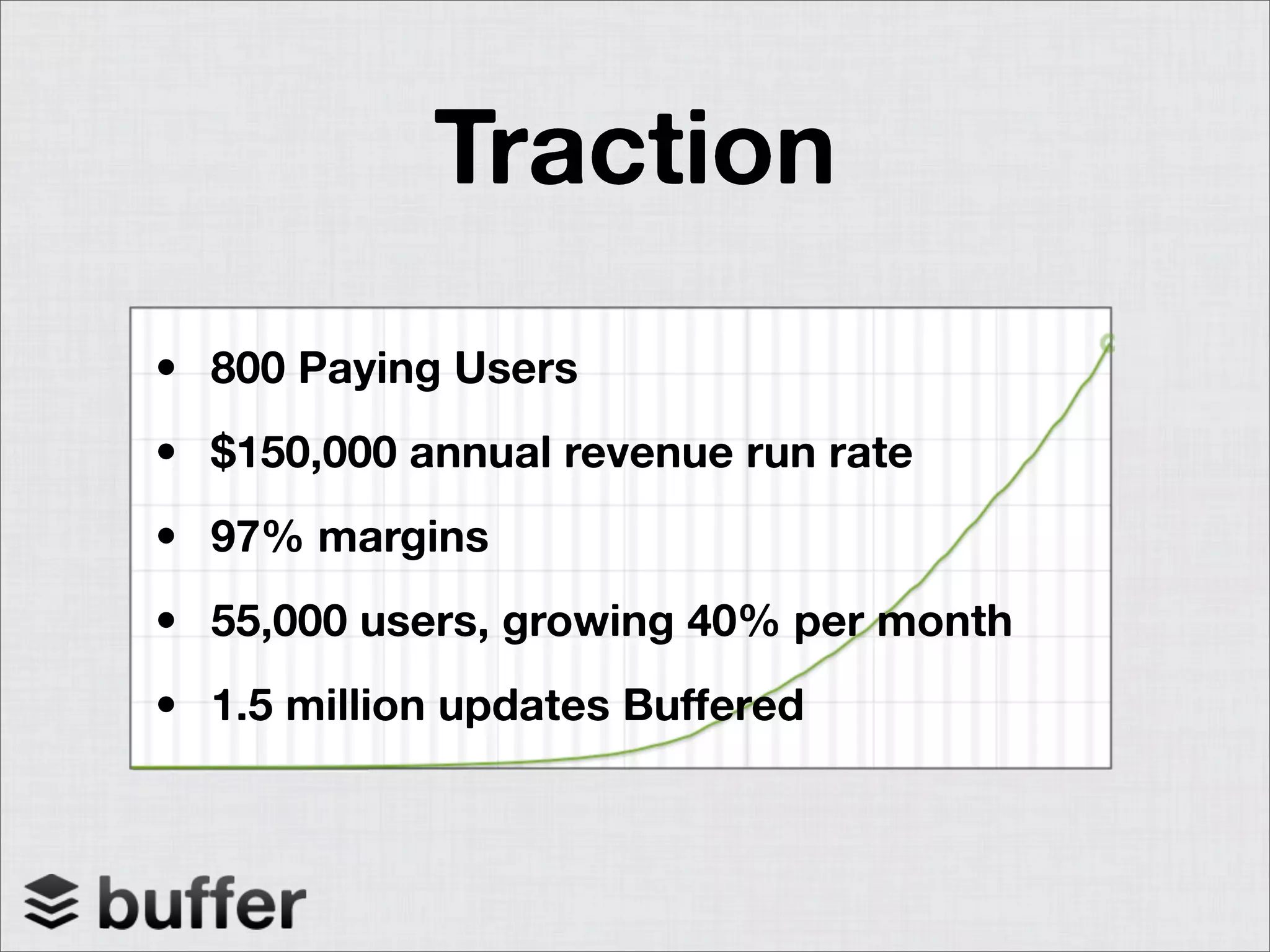
Slide 6 lists crisp, investor-oriented traction metrics: paying users, annual run rate, margins, total users and growth rate, and number of updates. These are the exact KPIs VCs want to see for a SaaS company and they’re presented plainly on top of an upward curve graphic. The slide balances revenue, user growth, and operational efficiency (margins), creating a compelling snapshot of business momentum.

Founders should note the combination of absolute numbers (55,000 users) with growth rates (40% per month) and unit economics (97% margins). Presenting both top-line and unit metrics together answers many investor questions proactively and signals that the team understands what matters to scale a SaaS business.

Key Takeaway: Lead with a handful of clear, high-leverage metrics (users, growth rate, revenue, margins) to convey product-market fit and momentum.
Roadmap & Milestones: Showing Rapid Progression

Roadmap & Milestones: Showing Rapid Progression

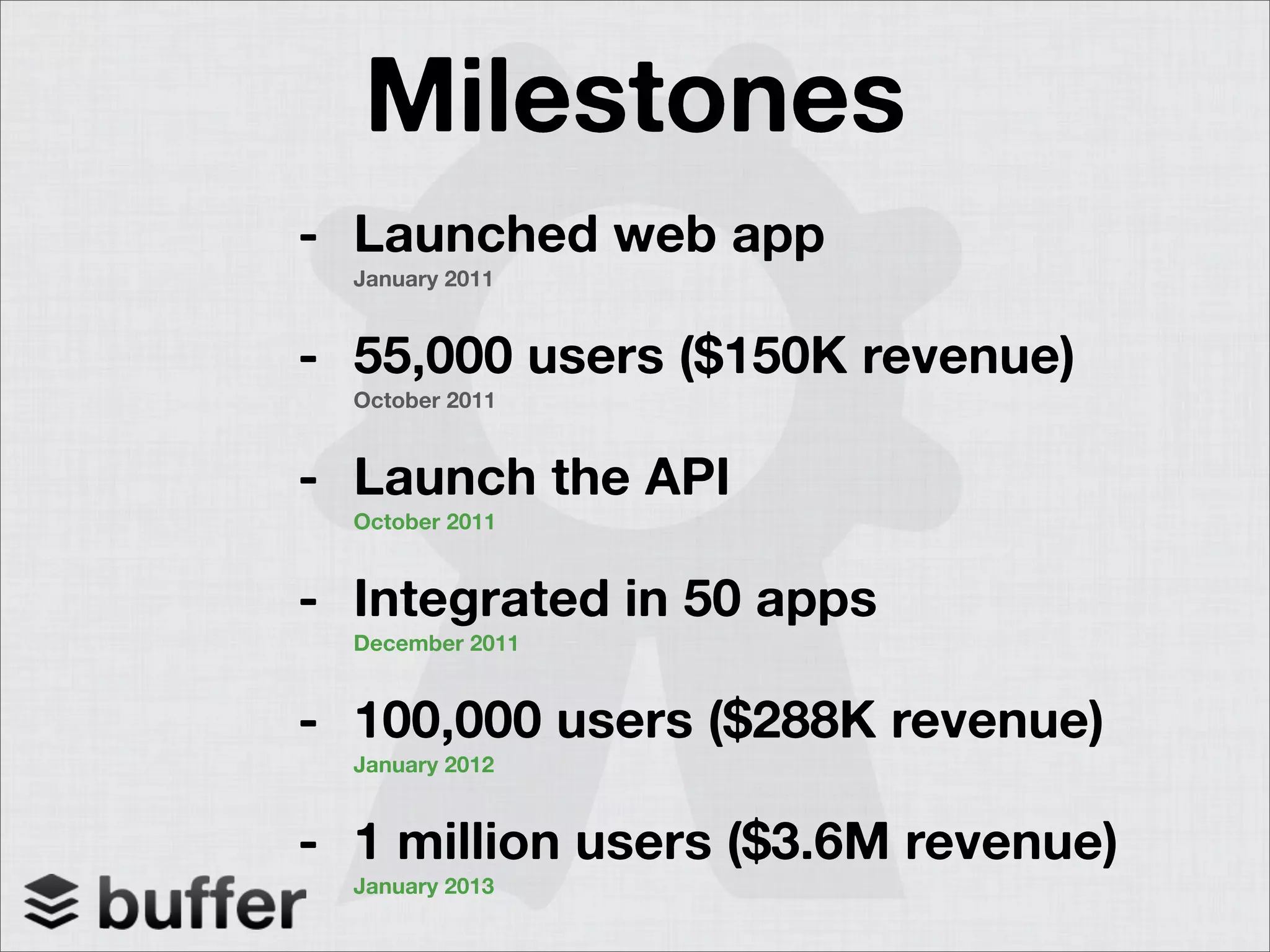
Slide 7 outlines milestones with dates: web app launch, user and revenue milestones, API launch, integrations, and long-term user projections. This timeline demonstrates a cadence of execution and product development that maps to user growth and monetization. It reassures investors that the team has delivered tangible milestones in short order and has a roadmap for continued scaling.

The lesson for founders is to present milestones that combine product launches, partnerships, and measurable outcomes. Dates and dollar figures make progress verifiable and help investors see the trajectory from idea to revenue to scaling. A clear timeline also enables a conversation about what will happen next and what resources are required to accelerate.

Key Takeaway: Use a dated milestone timeline with concrete user/revenue outcomes to show repeatable execution and near-term roadmap.
Business Model: Unit Economics and Acquisition Levers

Business Model: Unit Economics and Acquisition Levers

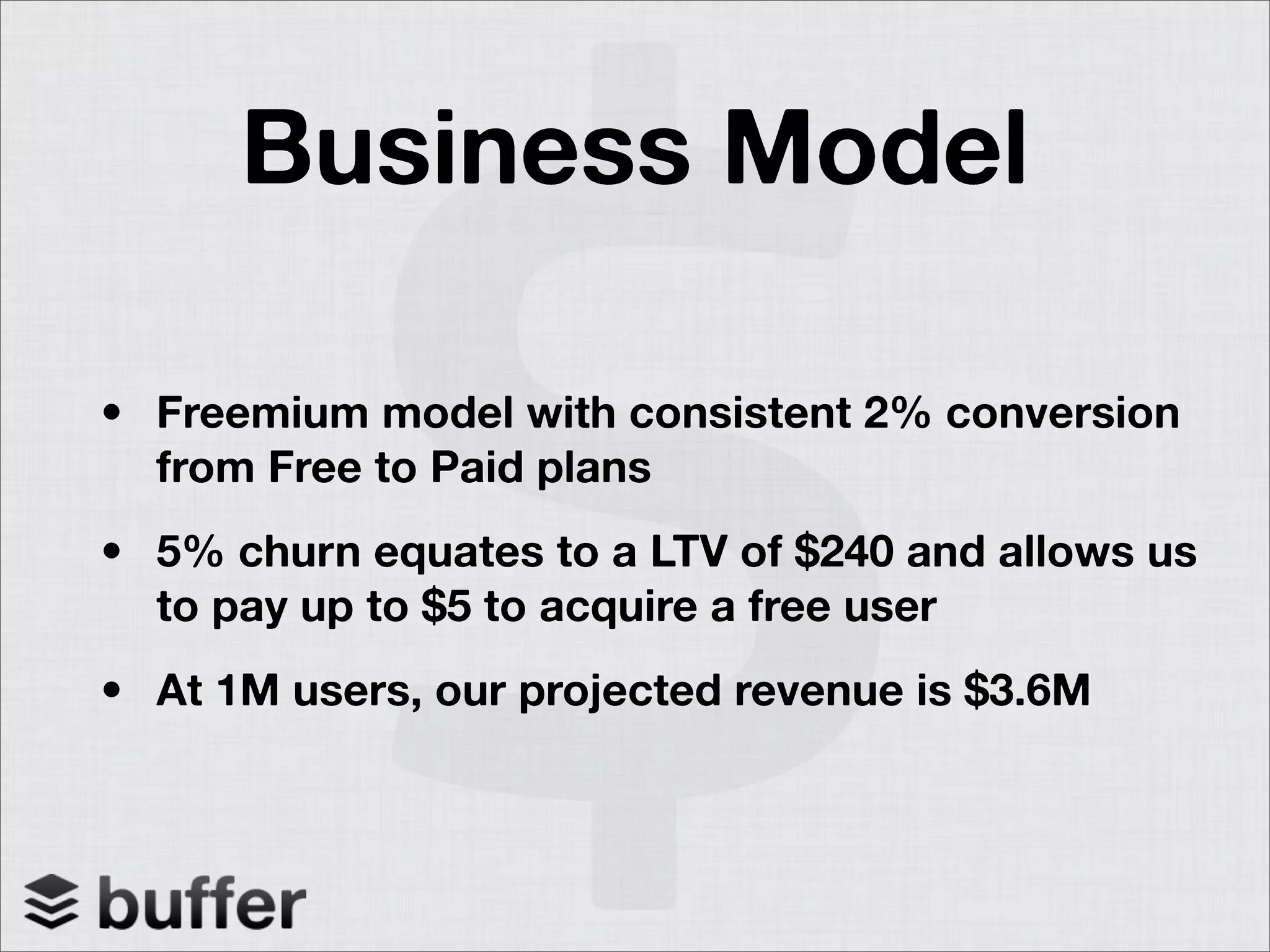
Slide 8 succinctly explains the freemium model, conversion rate, churn, LTV, and how much they can pay to acquire a free user. The slide ties product usage to a monetization model and shows the math that justifies customer acquisition investments. Presenting LTV and allowable CAC demonstrates an understanding of scalable economics and capital efficiency.

Founders should copy this clarity: spell out your pricing model, conversion assumptions, churn, LTV, and CAC. Investors want to see defensible unit economics and an explanation of how acquisition spend converts into predictable revenue. Even rough, realistic figures are better than vague claims — they enable informed follow-up questions and build credibility.

Key Takeaway: Expose your core unit economics (conversion, churn, LTV, allowable CAC) so investors understand how growth translates to revenue.
Team & Credibility: Founders, Advisors and Investors

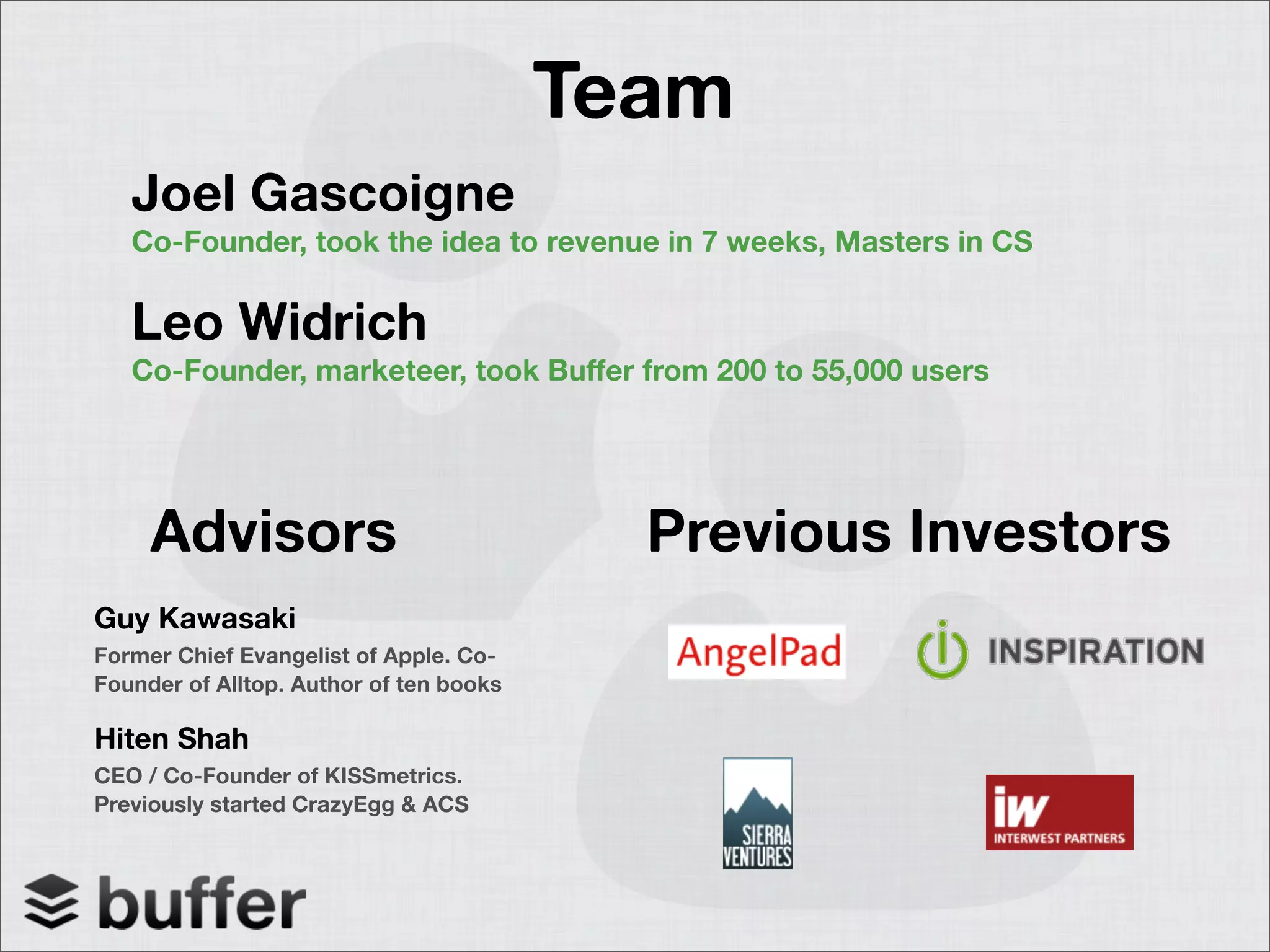
Team & Credibility: Founders, Advisors and Investors

Slide 13 presents the founding team, short bios, notable advisors, and previous investors. It highlights functional roles (technical co-founder, marketer) and early validation via well-known advisors and angel programs. This slide balances bios with social proof, which helps investors evaluate execution risk and access to networks or distribution channels.

For founders, the takeaway is to present a compact team narrative: who does what, what they’ve already achieved, and which credible advisors or investors back the effort. Strong, relevant advisors and prior investor logos can materially increase perceived credibility — but they should be presented as supplements to, not replacements for, clear founder accomplishments.

Key Takeaway: Briefly explain each founder's role and highlight a few credible advisors or investors to reduce execution risk and signal network access.

Conclusion: Key Lessons

Buffer’s seed deck is a compact example of clarity and focus: it ties a simple product to a big market trend, demonstrates real product usage, and backs claims with crisp metrics and unit economics. The visual design is clean and consistent, allowing investors to quickly absorb the core narrative without distraction. The deck prioritizes what matters early — product, traction, model, team — and leaves room for discussion.

Actionable advice for founders: keep slides minimal and visual, lead with the market trend and the core user experience, present a small set of high-impact metrics that prove momentum, and show the economics that make growth scalable. Use milestones and trusted advisors to demonstrate execution capability, and always prepare to back each claim with data or a demo during follow-up conversations.