Stack up against DoorDash

Compare Your Deck

DoorDash's 2013 Pitch Deck

Marketplace
Stage: YC
Raised: $120K
Year: 2013
Slides: 7
Outcome: IPO at $39B valuation

Pitch Deck

1 / 7
Slide 1
Click to expand

Deck Analysis

This YC pitch deck from DoorDash (2013) succinctly presents a local food logistics marketplace that pairs on-demand couriers with integrated restaurant ordering. It highlights a clear problem/solution fit (enable every restaurant to deliver), positions the company against competitors, and backs claims with early traction metrics — faster delivery times, strong week-over-week growth, and meaningful annualized restaurant sales. The deck is notable for combining simple, design-forward storytelling with metrics that demonstrate product-market fit and a defensible operational advantage.

The Opening: Clear value proposition and brand

The Opening: Clear value proposition and brand

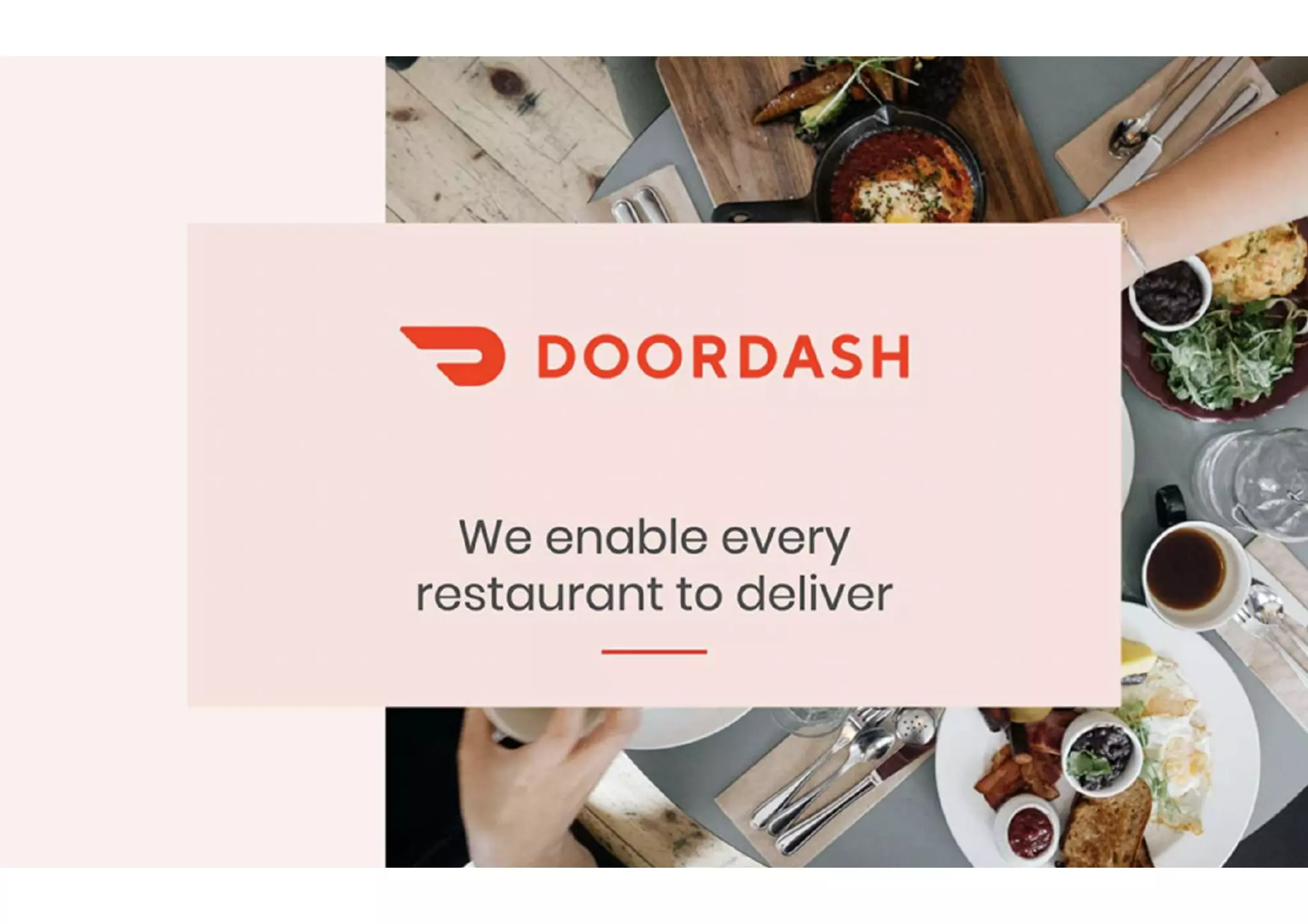
The first slide immediately states the company name and a one-line mission: "We enable every restaurant to deliver." It uses large type, minimal copy, and lifestyle photography to establish context (food, restaurants) while making the promise explicit and easy to remember. This is effective because investors instantly understand the target customer (restaurants) and the service outcome (deliveries) without having to parse jargon.

For founders, the lesson is to lead with a crisp value proposition that names who you serve and what you do. The visual treatment here supports the message — clean typography, strong logo placement, and relevant imagery help create an emotional as well as rational hook. There's no filler; the slide does the job of orienting the audience in seconds.
Key Takeaway: Start your deck with a single, unambiguous sentence that names the customer and the core outcome — reinforced by clean visuals that set context.
Competitive positioning: map the landscape simply

Competitive positioning: map the landscape simply

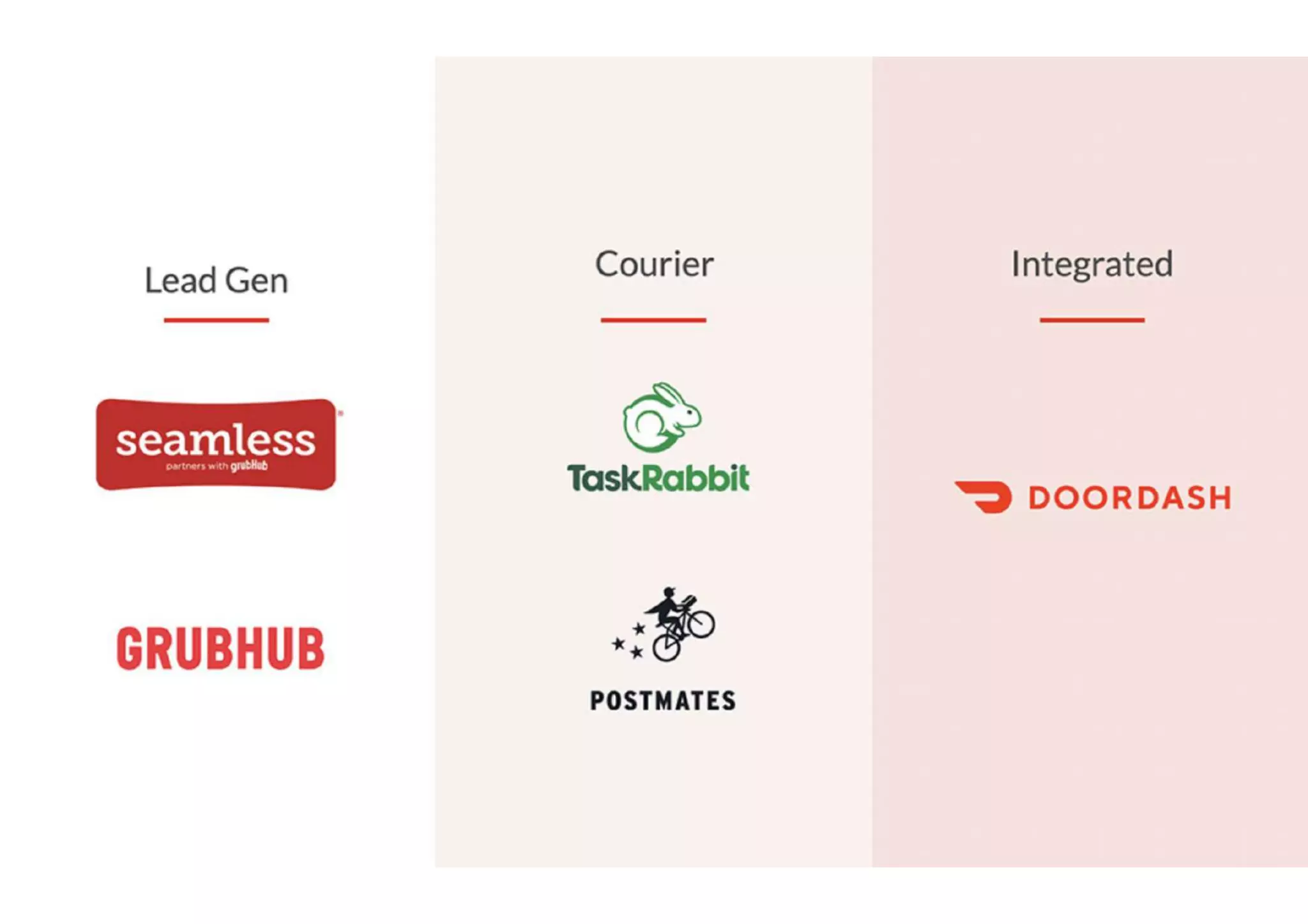
Slide 2 lays out competitors across three categories: lead generation (Seamless, Grubhub), courier marketplaces (TaskRabbit, Postmates), and an "Integrated" approach (DoorDash). This three-column framing clarifies how DoorDash differentiates: not just a listing or a courier network, but an integrated merchant-facing logistics solution. The simple logos and minimal labels make it easy for investors to grasp the landscape at a glance.

Founders should emulate this by mapping competitors in a way that highlights their unique axis of differentiation. Rather than a long list, group competitors by the specific role they play and show where your offering sits. This helps investors understand defensibility and why customers would choose you over incumbents.

Key Takeaway: Present competitors in a concise matrix or categories that directly contrast your unique approach — make the differentiation visually obvious.
Operational advantage: faster delivery times

Operational advantage: faster delivery times

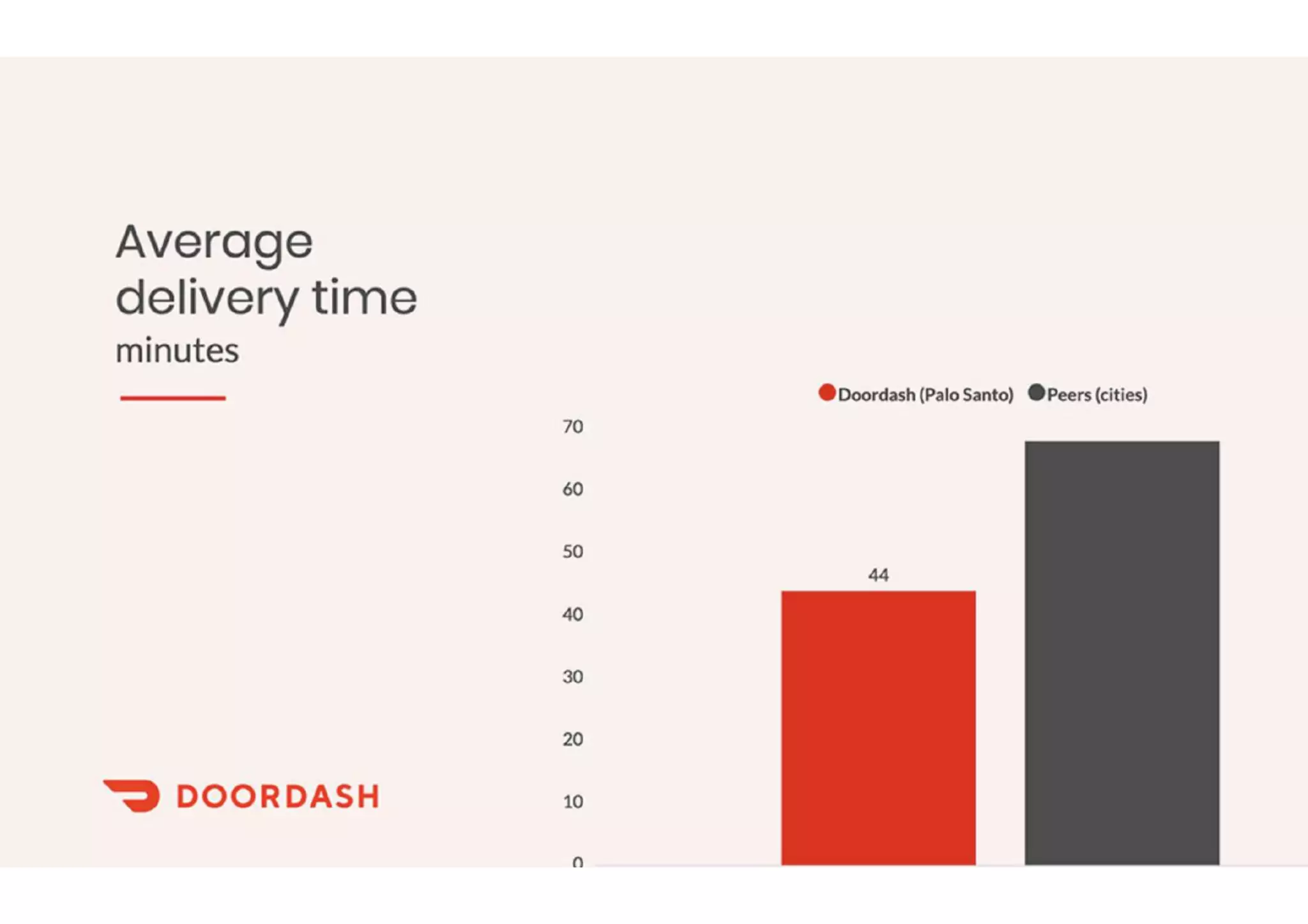
Slide 3 presents a concrete operational metric: average delivery time. DoorDash (Palo Alto) shows 44 minutes versus ~70 minutes for peers (cities). This is a strong, tangible claim of superior service that ties directly to user experience and retention. Presenting a simple bar chart with numeric labels makes the advantage obvious and credible.

For founders building marketplaces or logistics businesses, operational KPIs that affect customer satisfaction (speed, reliability, cost) are powerful evidence of early product-market fit. Use clear, comparable metrics and be prepared to explain methodology — investors will probe how you achieve the advantage and whether it scales.

Key Takeaway: Use a single, hard-to-argue metric that demonstrates your operational edge — make it visual and directly tied to customer value.
Traction: growth curve and momentum

Traction: growth curve and momentum

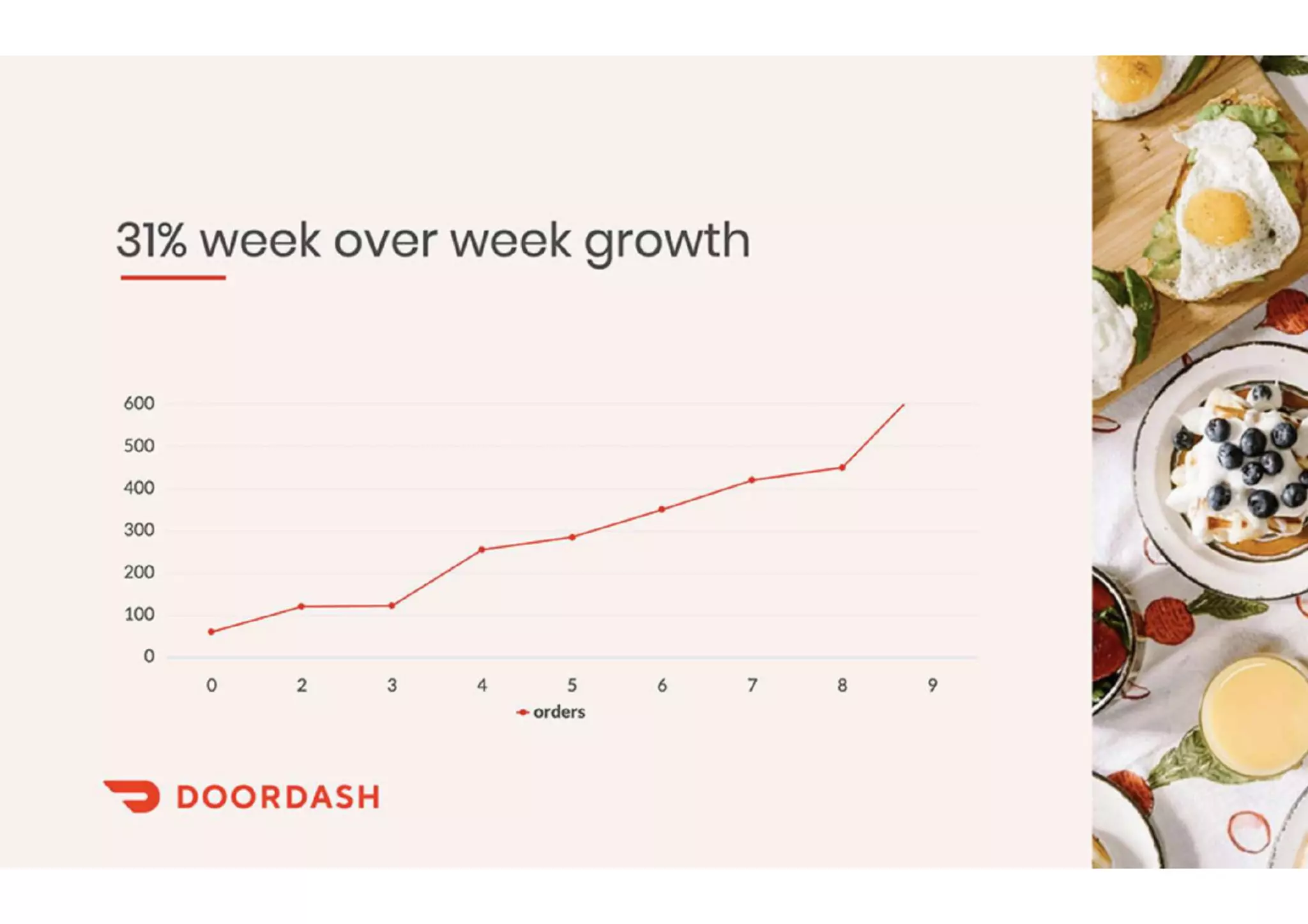
Slide 4 shows a line chart with "31% week over week growth" and a rising orders curve that accelerates late in the series. The explicit growth rate headline plus the visual trajectory communicates momentum — one of the most persuasive signals to early investors. The graph lacks complex labeling, which keeps attention on the trend rather than granular data points.

Founders should highlight compound growth and present trends that tell a clear story of adoption. Call out the growth rate prominently, and use a simple visual that avoids clutter. If growth is uneven, annotate reasons (product changes, partnerships) so investors can connect cause and effect.

Key Takeaway: Lead with a clear growth statistic and a simple visual trend that demonstrates momentum — narrative and numbers should reinforce each other.
Monetization signal: early revenue per restaurant

Monetization signal: early revenue per restaurant

Slide 5 communicates "$1.5 Million Annualized restaurant sales," which signals meaningful economic impact for merchants using the platform. By translating orders and growth into dollar figures, the deck shows that the product creates real revenue for restaurants (and potential take rate for DoorDash). This helps investors estimate marketplace GMV and revenue potential even from sparse early data.

For founders, convert user or order metrics into monetary impact as soon as possible. Investors care about the size of the economic opportunity and the platform's ability to capture value; early annualized GMV or merchant sales figures help ground projections and validate the business model.

Key Takeaway: Translate usage into economic terms (GMV, annualized merchant sales) early in the deck to show the real-world financial impact of your product.
Moat: combine logistics with merchant integration

Moat: combine logistics with merchant integration

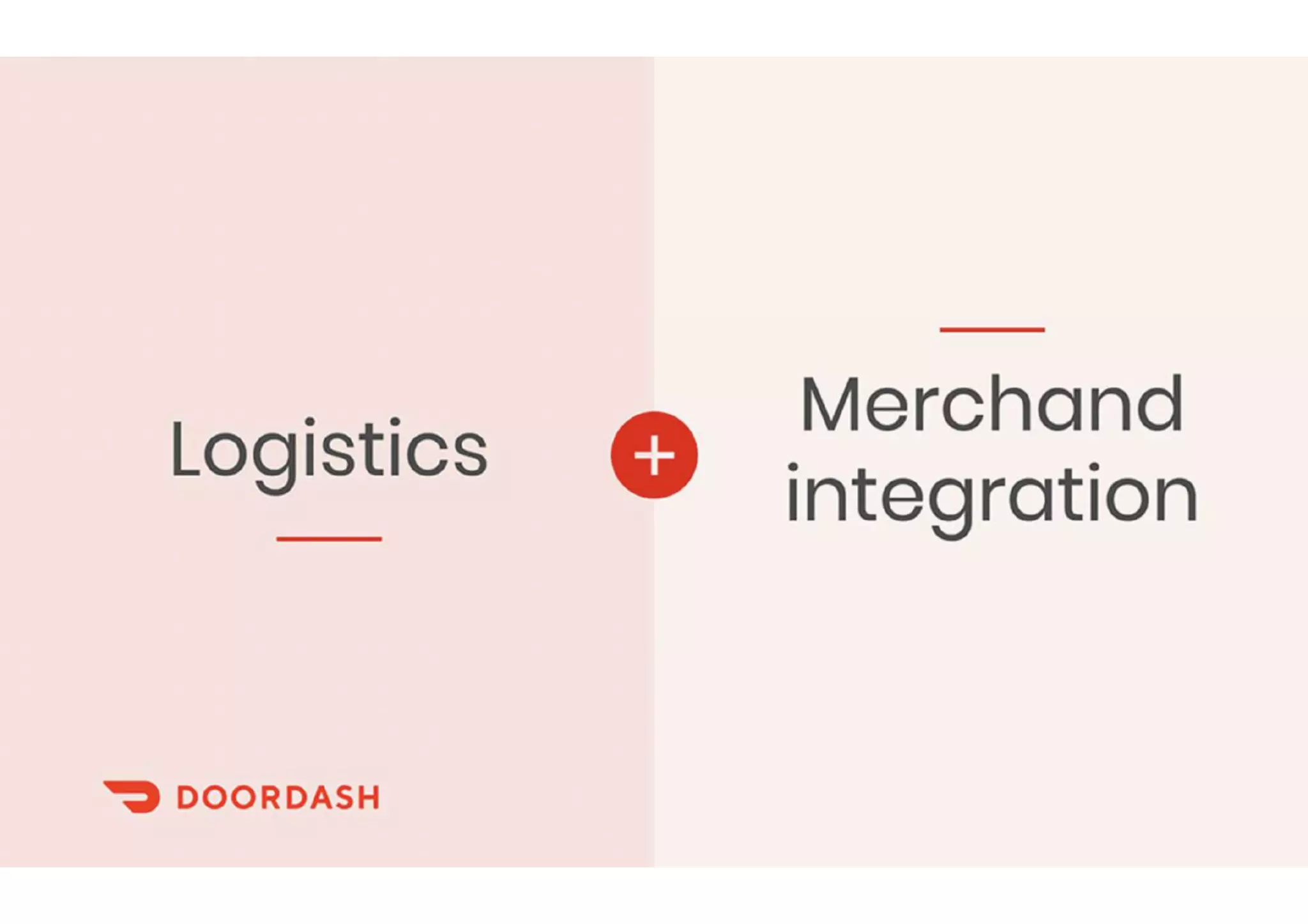
Slide 6 emphasizes the two-part thesis: "Logistics + Merchant integration." This succinctly states why DoorDash's model is defensible — logistics alone is replicable, but pairing it with deep merchant integration (ordering systems, workflows) creates stickiness. The slide uses minimal text and a split layout to make the combination feel like a strategic formula rather than an afterthought.

Founders building platform businesses should articulate the components of their moat and how they reinforce one another. Don’t just claim a competitive advantage — break it down into complementary pieces (technology, operations, partnerships) and show how they compound to raise barriers to entry.

Key Takeaway: Define your moat as a set of complementary advantages and explain how they interlock to create defensibility.
Vision: expand beyond food to local logistics

Vision: expand beyond food to local logistics

The final slide frames the long-term vision: "The Future: FedEx of Local." That analogy expands the company's scope from restaurant delivery to a broader local logistics platform. It’s aspirational but grounded — it ties the immediate restaurant-focused product to a larger, scalable market opportunity. The imagery and concise phrasing make the ambition memorable without overloading on speculative detail.

For founders, close with a bold but credible vision that connects current traction to a sizable future opportunity. Use a simple metaphor or comparison to help investors quickly grasp the endgame, but avoid overpromising — ensure the path between today's product and that vision is defensible and logical.

Key Takeaway: End with a clear, credible big-picture vision that links present traction to a larger, well-defined market opportunity.

Conclusion: Key Lessons

DoorDash’s YC deck is a model of clarity: a sharp value proposition, a compact competitor map, operational KPIs that demonstrate a real service advantage, clear growth metrics, early monetization signals, and a concise articulation of moat and vision. The deck balances design and substance — visuals that set context and numbers that prove momentum and economic potential. Founders should prioritize: (1) leading with a single sentence that explains who you serve and what you deliver, (2) using one or two hard metrics to prove operational advantage, (3) converting usage into dollar-based impact, and (4) explaining how complementary assets create a durable moat. Keep slides minimal, visual, and narrative-driven so each one advances the story investors need to believe in both traction and scale.