Stack up against Vettery

Compare Your Deck

Vettery's 2016 Pitch Deck

Marketplace
Stage: Series A
Raised: $9M
Year: 2016
Slides: 11
Outcome: Acquired by Adecco

Pitch Deck

1 / 11
Slide 1
Click to expand

Deck Analysis

This deck from Vettery (Series A, 2016) presents a concise, design-forward pitch for a two-sided hiring marketplace focused on matching tech candidates with employers. It combines simple, polished visuals with clear signals of traction (GMV, revenue growth, hiring manager activation), a large definable market, competitive positioning, and strong unit economics. What makes it notable is the balance between aspirational vision and hard metrics — the founders demonstrate both the size of the opportunity and early evidence that the marketplace mechanics and economics are working.

Cover & Brand: A clear, confident opening

Cover & Brand: A clear, confident opening

The opening slide (cover) establishes a clean, consistent brand identity — a bright, simple layout and a memorable logo set a professional tone. The slide communicates confidence and makes the deck approachable without wasting space on unnecessary text. For investors, well-executed branding signals product polish and attention to detail, which is especially important for marketplaces where trust and UX matter to both sides of the network.

Key Takeaway: Start with a strong, simple cover that reflects your product’s user-facing quality — it sets expectations and builds credibility before a single metric is shown.
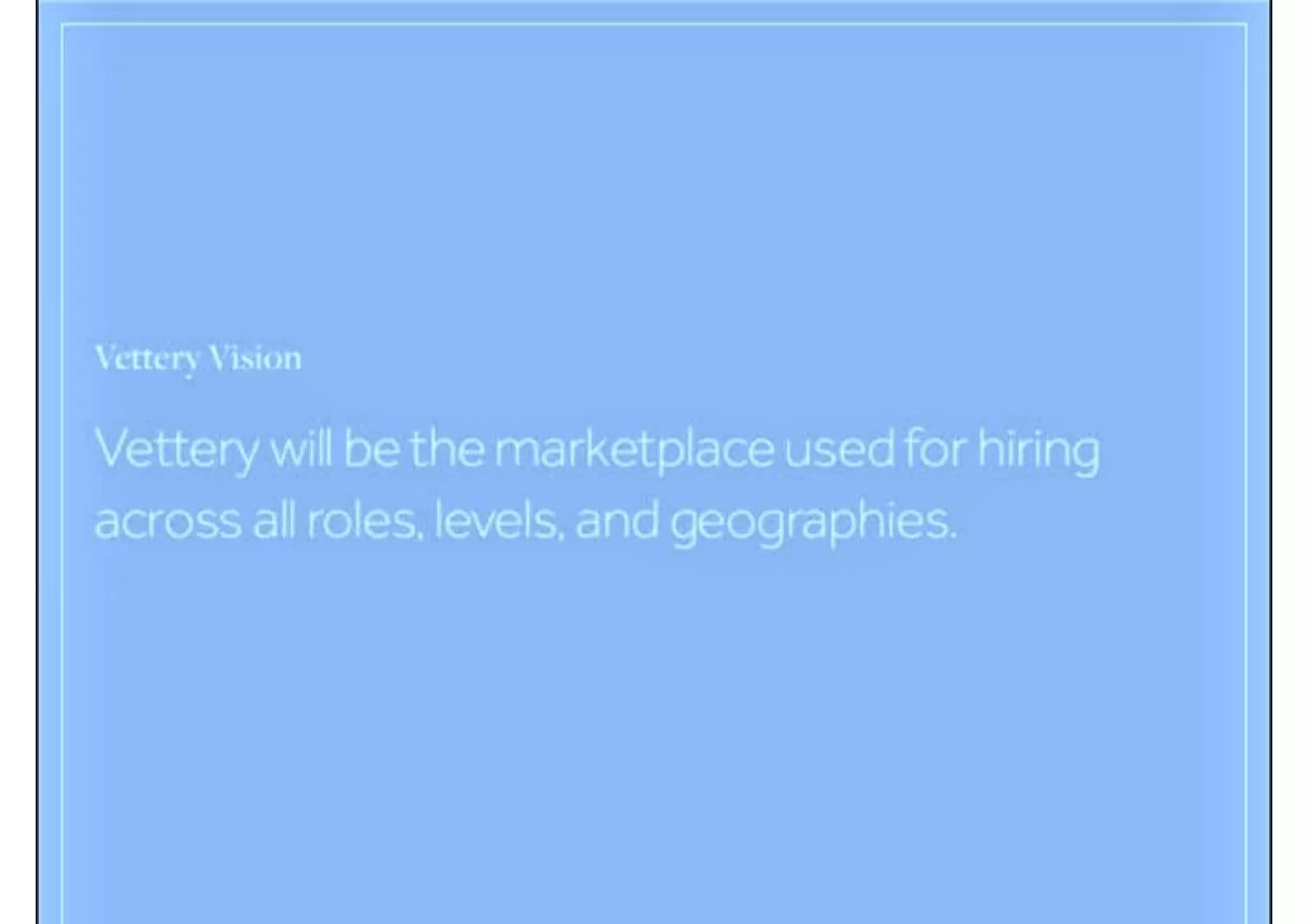
Vision: Define the end state succinctly

Vision: Define the end state succinctly

Slide 2 presents Vettery’s vision in one short sentence: to be the marketplace used for hiring across roles, levels, and geographies. This is effective because it sets a broad, ambitious target while keeping messaging tight — investors immediately know what problem the company is trying to solve and the scope of the opportunity. The minimalist treatment of the slide avoids distracting the reader with premature details and positions the product as universally applicable.

Key Takeaway: Express your long-term vision in one clear sentence so investors can quickly grasp the mission and potential scale.
Product & Marketplace Overview: Show both sides

Product & Marketplace Overview: Show both sides

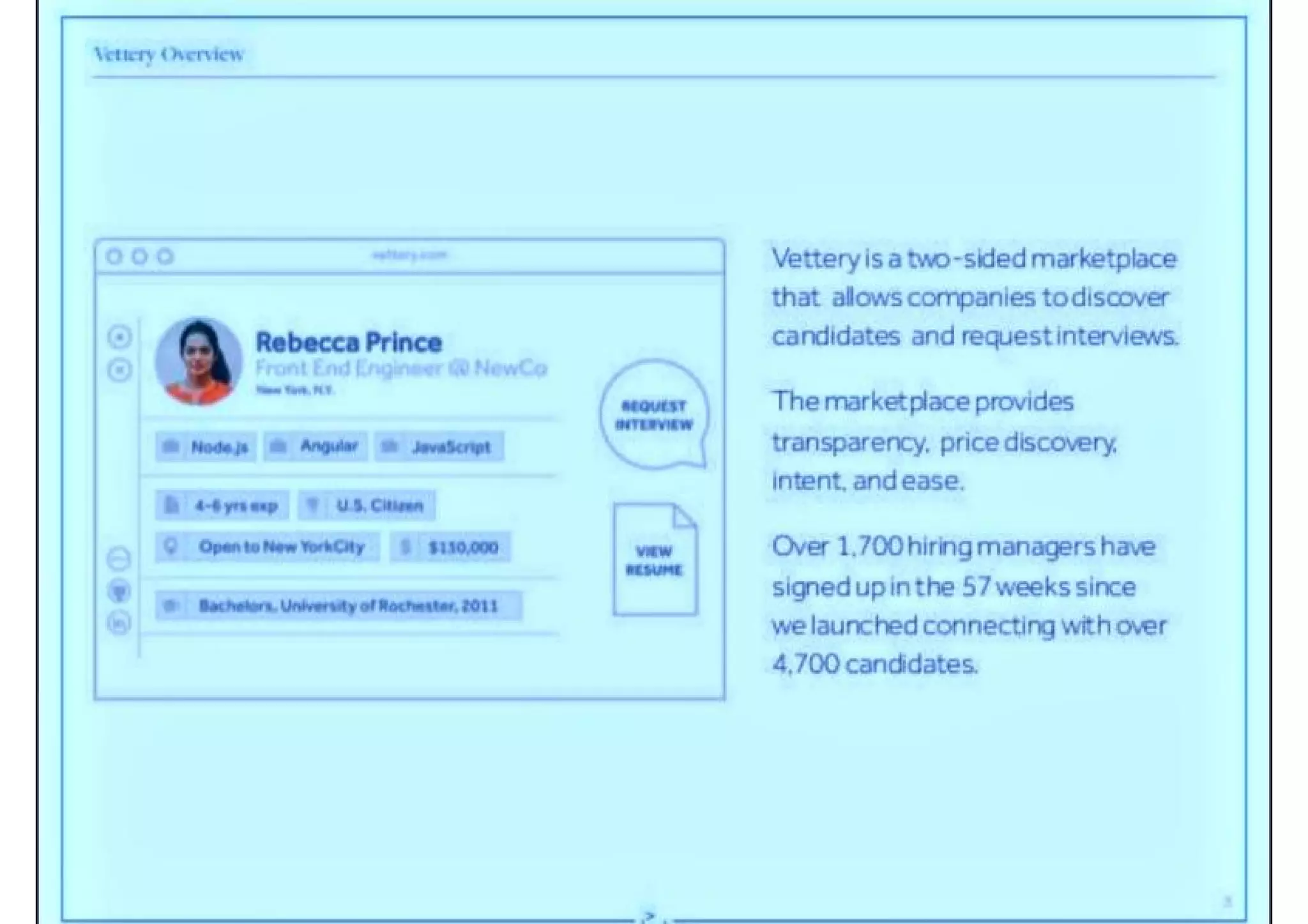
Slide 3 gives a compact visual of the product (candidate card UI) and a short description explaining that Vettery is a two-sided marketplace allowing companies to discover candidates and request interviews. Presenting a mockup of the candidate profile alongside the business description helps investors visualize the product and how value flows — it’s not just an abstract marketplace, it’s an actionable hiring interface. The text also calls out early scale metrics (1,700 hiring managers and 4,700 candidates in 57 weeks), which pairs product explanation with proof that real users are adopting the platform.

Key Takeaway: When describing a marketplace, show the interface and the user journey for both sides, and pair that with early adoption numbers to make the use case tangible.
Traction & Metrics Dashboard: Let the data tell the story

Traction & Metrics Dashboard: Let the data tell the story

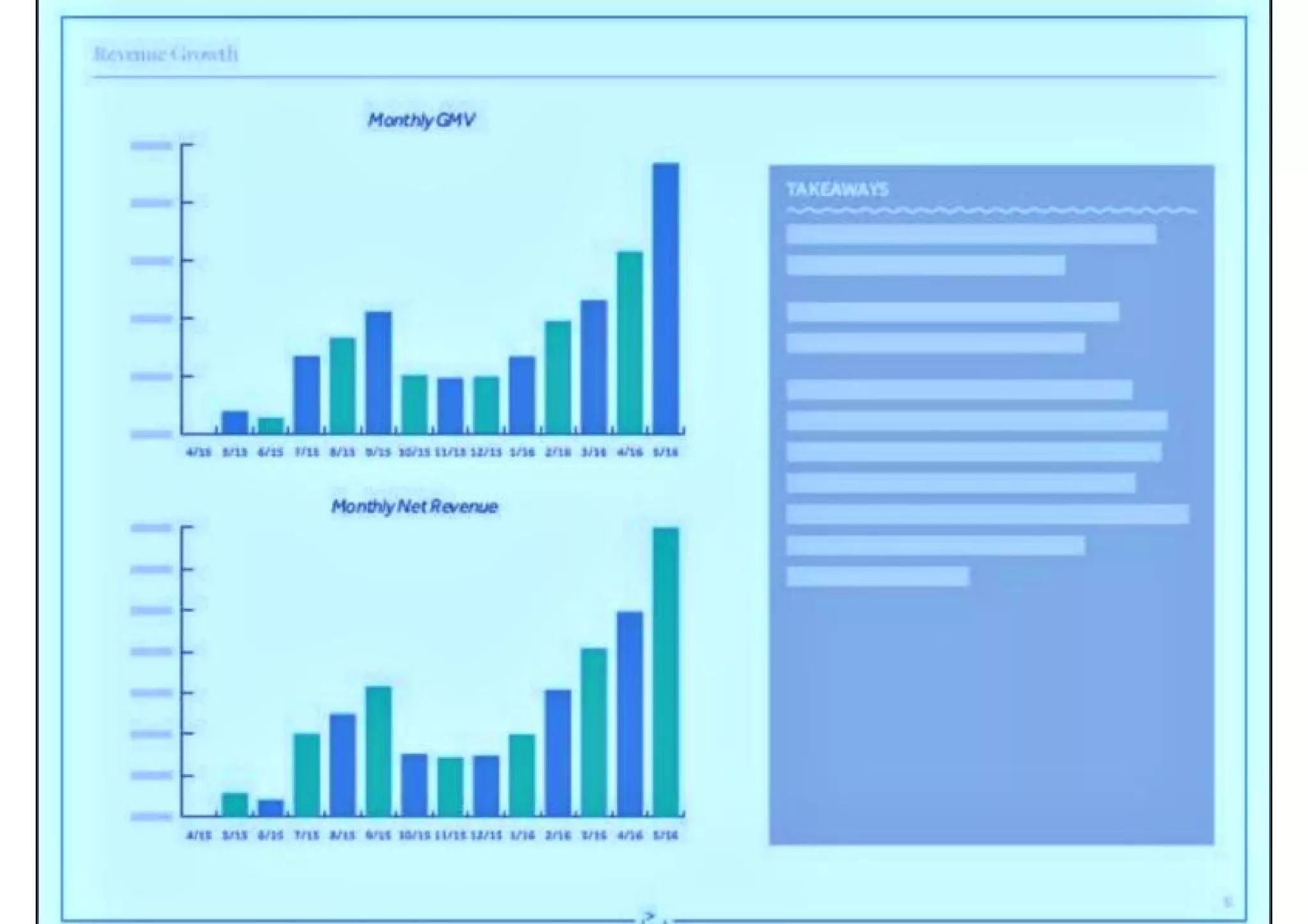
Slides like the KPI/dashboard page (slide 5) and the revenue/GMV growth page (slide 6) use charts to communicate clear month-over-month growth across interview requests, active hiring managers, average invite salary, and acceptance rates. The visuals emphasize steady, multi-dimensional traction rather than a single vanity metric. Showing both demand-side indicators (requests, active managers) and supply-side or outcome metrics (average invite salary, acceptance rates) demonstrates well-rounded progress and helps investors assess funnel health and marketplace liquidity.

Key Takeaway: Use a concise dashboard to show balanced traction across acquisition, engagement, and monetization metrics — investors want to see healthy flow on both sides of the marketplace.
Market Size: Make the opportunity unambiguous

Market Size: Make the opportunity unambiguous

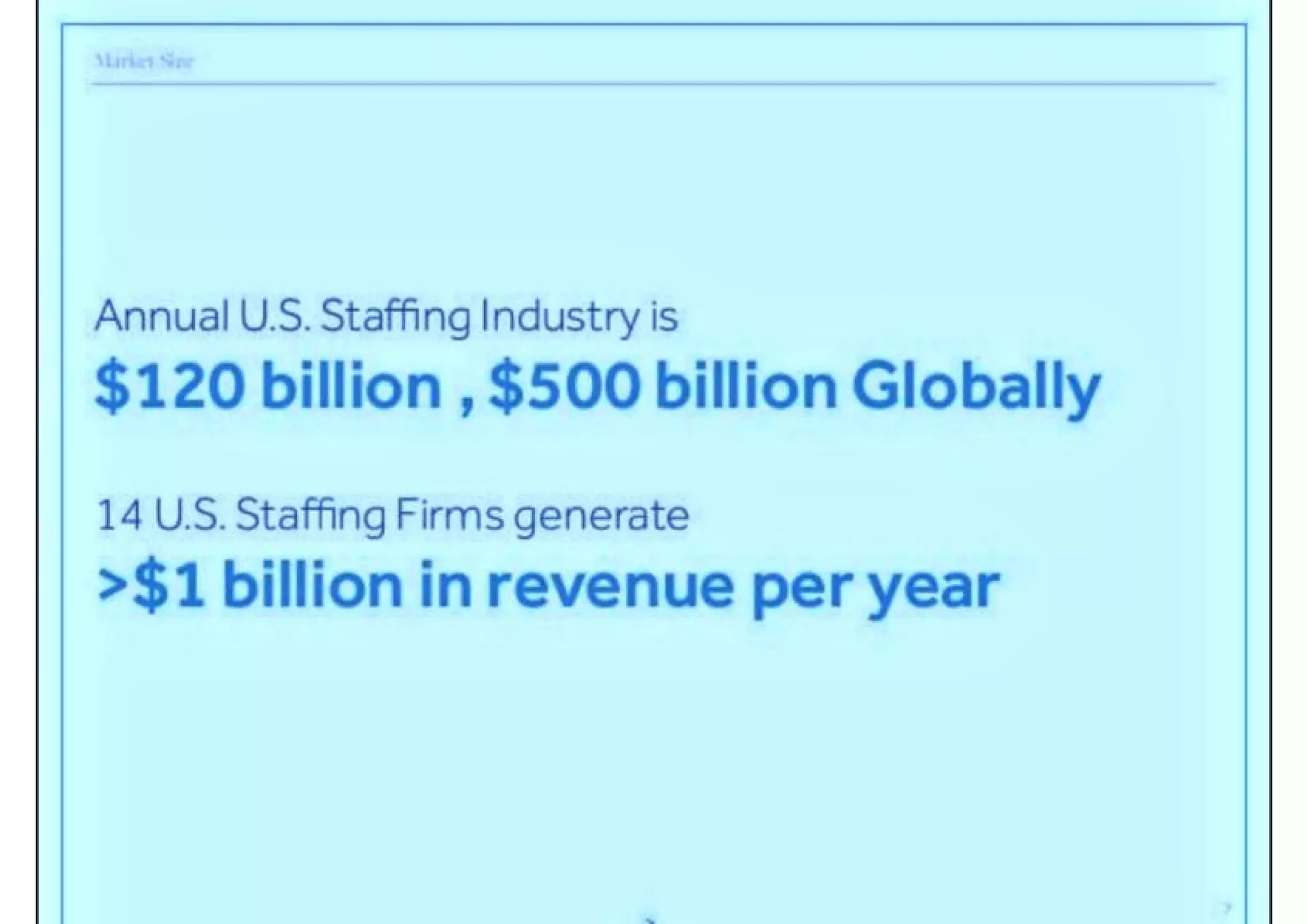
Slide 7 states the total addressable market (Annual U.S. staffing $120B; $500B globally) and highlights the concentration at the top (14 U.S. staffing firms generate >$1B). This is a classic market-sizing slide: it quantifies the opportunity and suggests room for disruption given incumbent concentration. The emphasis on an established, high-dollar market helps justify enterprise sales efforts and the long-term value of winning even small share.

Key Takeaway: Quantify the market clearly and call out incumbents and concentration — investors need both scale and a reason why the market is ripe for change.
Competitive Positioning: Where you sit on the spectrum

Competitive Positioning: Where you sit on the spectrum

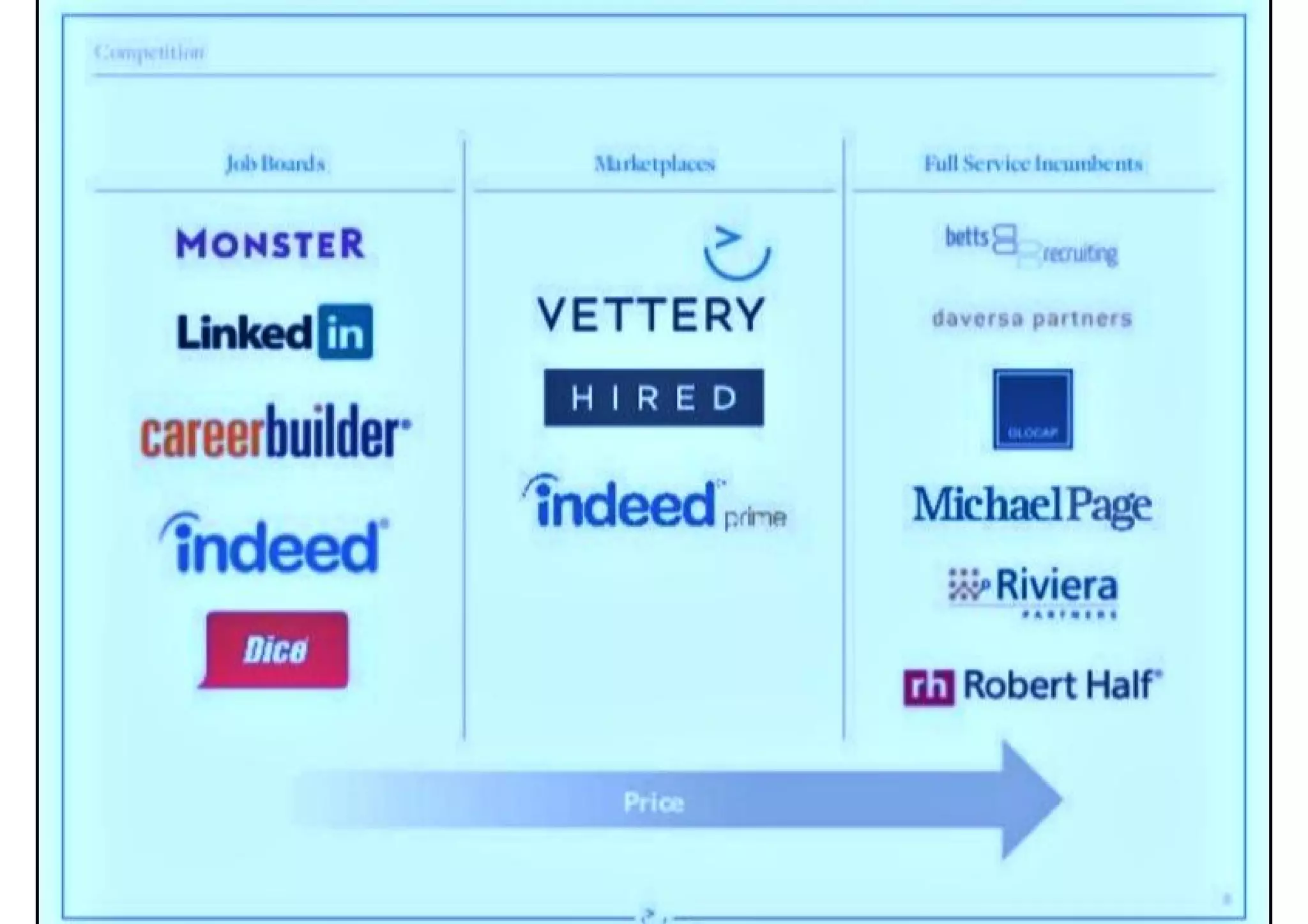
Slide 8 positions Vettery between low-cost job boards (Monster, LinkedIn, Indeed) and high-touch staffing firms (Michael Page, Robert Half), showing the company as a marketplace alternative. This three-column framing makes Vettery’s unique value prop visible — it aims to combine marketplace efficiency with hiring quality and control. By visually mapping competitors along a price/quality axis, the slide communicates differentiation without a long narrative and prepares investors for the business model and pricing rationale that follow.

Key Takeaway: Map competitors along clear dimensions (price, service, quality) so investors can instantly see your differentiation and where you can capture share.
Unit Economics & Business Model: Demonstrate profitability potential

Unit Economics & Business Model: Demonstrate profitability potential

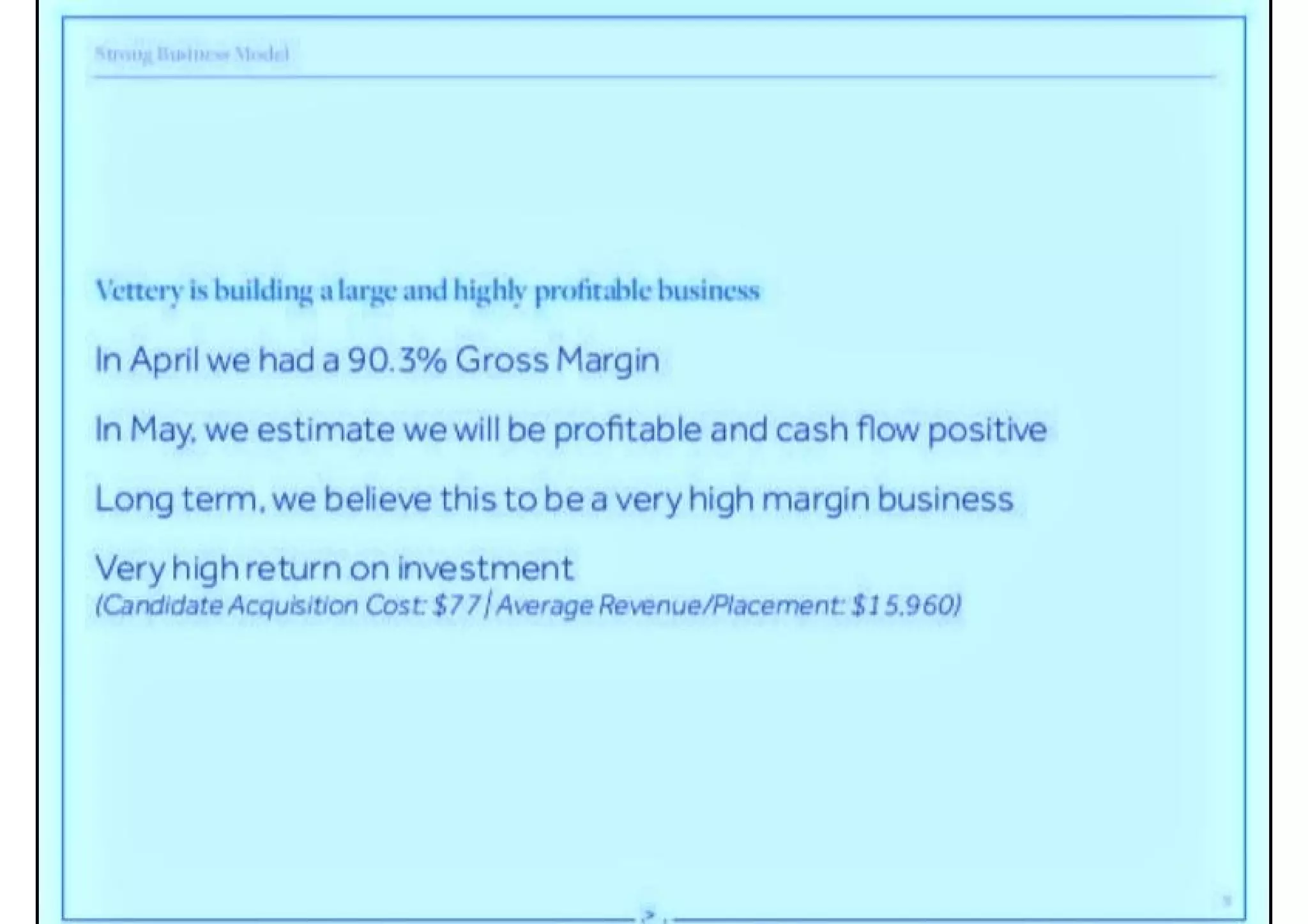
The slide labeled 'Strong Business Model' (slide 9) is particularly persuasive: it calls out a 90.3% gross margin in April and projects profitability and positive cash flow the following month. It also lists candidate acquisition cost ($77) and average revenue per placement ($15,960). These numbers are critical because they transform the marketplace story into a financially credible business. Very strong unit economics reduce investor risk — they show that growth can scale without proportional cost increases.

Key Takeaway: Lead with unit economics: show CAC, average revenue per transaction, and margin milestones to prove your model scales profitably.
Technology & Scaling Roadmap: How you'll defend and grow

Technology & Scaling Roadmap: How you'll defend and grow

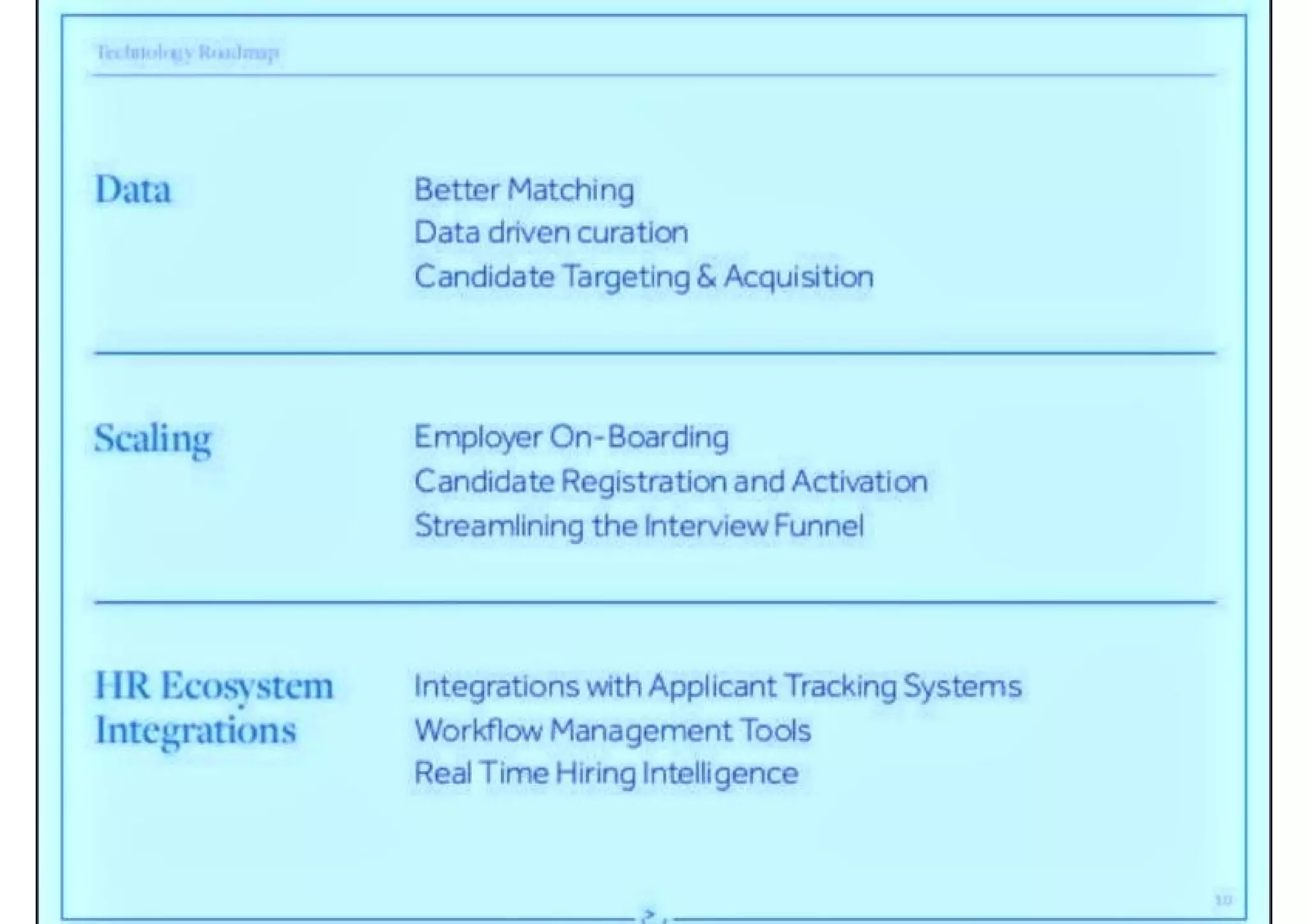
Slide 10 outlines a concrete technology roadmap focused on data, scaling, and HR ecosystem integrations: better matching, data-driven curation, employer onboarding, candidate activation, and ATS/workflow integrations. This is effective because it links product development to defensibility — data and integrations create switching costs and improve matching quality over time. It also signals a clear product plan to investors: not only have they built a working marketplace, they know which technical capabilities will drive expansion and retention.

Key Takeaway: Tie your roadmap to defensibility: prioritize data, automation, and platform integrations that increase switching costs and improve core matching metrics.

Conclusion: Key Lessons

Vettery’s Series A deck is a strong example of balancing product clarity, market sizing, competitive positioning, and hard metrics. Strengths include a tight vision, a visual product demo, multi-dimensional traction charts, explicit unit economics, and a defensible tech roadmap. For founders drafting their own decks: prioritize clarity (one-sentence vision), show the product and user flows, present balanced KPIs across both sides of a marketplace, quantify market size and incumbents, and — crucially — lead with unit economics that prove the business can scale profitably. Finally, map your competitive differentiation and spell out the technical investments that will sustain growth and create barriers to entry.