Stack up against Mixpanel

Compare Your Deck

Mixpanel's 2014 Pitch Deck

SaaS
Stage: Series B
Raised: $65M
Year: 2014
Slides: 12
Outcome: Valued at $865M

Pitch Deck

1 / 12
Slide 1
Click to expand

Deck Analysis

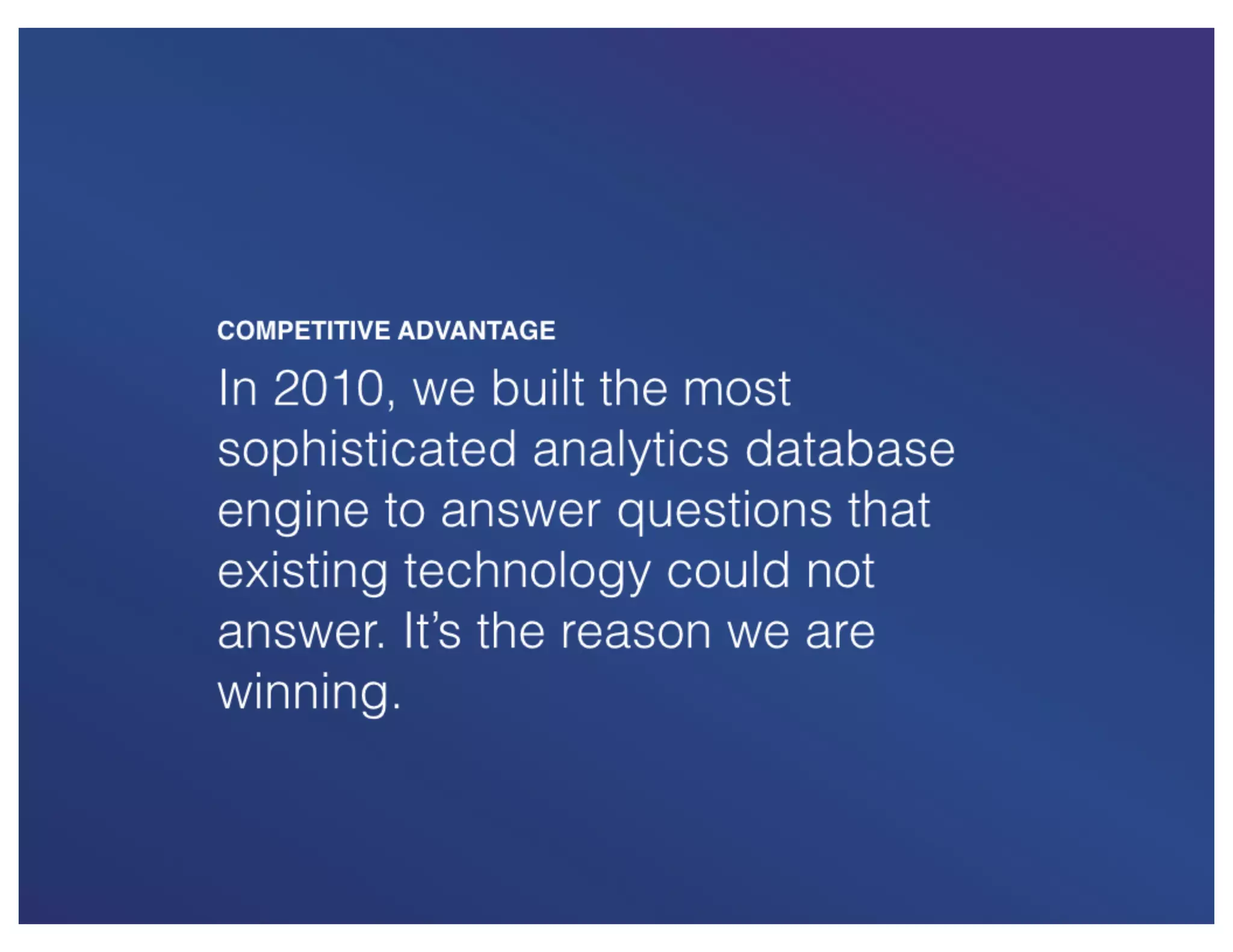
This Series B pitch deck from Mixpanel (2014) presents a concise, design-forward case for scaling a product analytics platform. The deck pairs stark, high-contrast slides with clear problem statements, a defensible technology advantage, and traction data (MRR growth and sales KPIs) to persuade investors that Mixpanel had product-market fit and a repeatable go-to-market. What makes it notable is the disciplined focus: the narrative moves quickly from why traditional metrics are broken to Mixpanel's differentiated database and revenue momentum, backed by operational metrics and fundraising history.

Opening: Strong brand and visual focus

Opening: Strong brand and visual focus

Slide 1 is a minimalist title slide that foregrounds the Mixpanel brand with a simple logo on a deep blue background. The lack of clutter and the consistent visual treatment set a professional tone and implicitly communicate confidence and maturity. For investors, a clear, polished cover signals attention to detail — an important trait for analytics companies that sell precision.

The lesson here is not just aesthetics: the opening slide primes the audience for a narrative that is concise and product-centric. Founders should use the cover to set expectations about the style and rigor of the presentation — a messy or overly busy opener undermines credibility before a single data point is shown.

Key Takeaway: Use a clean, on-brand opener to set tone and signal professionalism and focus.

Problem: Vividly framing the decision-making gap

Problem: Vividly framing the decision-making gap

Slide 2 states Problem 1: most people make decisions by guessing or using their gut, and will be either lucky or wrong. This is an effective early move because it defines a universal pain point — poor decision-making — and positions the product as a remedy. The phrasing is evocative and memorable, which helps anchor the rest of the narrative: it's not merely a technical feature request, it's a mission to change behavior.

By stating a broad human problem rather than a niche technical issue, Mixpanel creates empathy and urgency. Founders should emulate this by articulating the emotional or business fallout of the problem they solve (lost revenue, wasted time, wrong bets) before diving into product mechanics. A crisp, human-focused problem makes the solution feel consequential.

Key Takeaway: Start with a clear, human-centered problem statement that communicates why resolving it matters at scale.
Problem (continued): Calling out weak incumbent metrics

Problem (continued): Calling out weak incumbent metrics

Slide 3 doubles down with Problem 2: companies measure weak metrics (page views, installs) and struggle to be sophisticated. This slide sharpens the competitive landscape by explaining why incumbent metrics are insufficient for modern product teams. It prepares investors to see analytics as a strategic, product-facing capability rather than a vanity tracking tool.

This two-slide problem articulation (human behavior + broken status quo) is pedagogically strong: it moves from abstract pain to specific operational failures. Founders should aim to define both the emotional and the technical dimensions of the problem so investors can connect product design decisions to real market demand.

Key Takeaway: Explain both the human cost and the technical shortcomings of current solutions to make your product’s value obvious.
Solution & Mission: Clear product positioning and ambition

Solution & Mission: Clear product positioning and ambition

Slide 4 (Solution) and Slide 5 (Mission) together position Mixpanel as analytics built for product and marketing, with a mission to help the world learn from its data. The solution slide is explicit about current focus (product and marketing) and intelligent about roadmap (sales and finance next), showing thoughtful expansion without overpromising. The mission slide succinctly elevates the company beyond a product to a broader purpose, which helps with storytelling and talent/partner attraction.

This structure — specific immediate value plus an aspirational mission — balances realism and ambition. Founders should state the current product boundary clearly and sketch the next markets in a way that suggests scalability. Combining a tactical solution slide with a one-line mission helps investors see both near-term monetization and long-term vision.

Key Takeaway: Pair a concrete product focus and go-to-market plan with a one-line mission that signals long-term ambition.
Traction: Monthly recurring revenue growth chart

Traction: Monthly recurring revenue growth chart

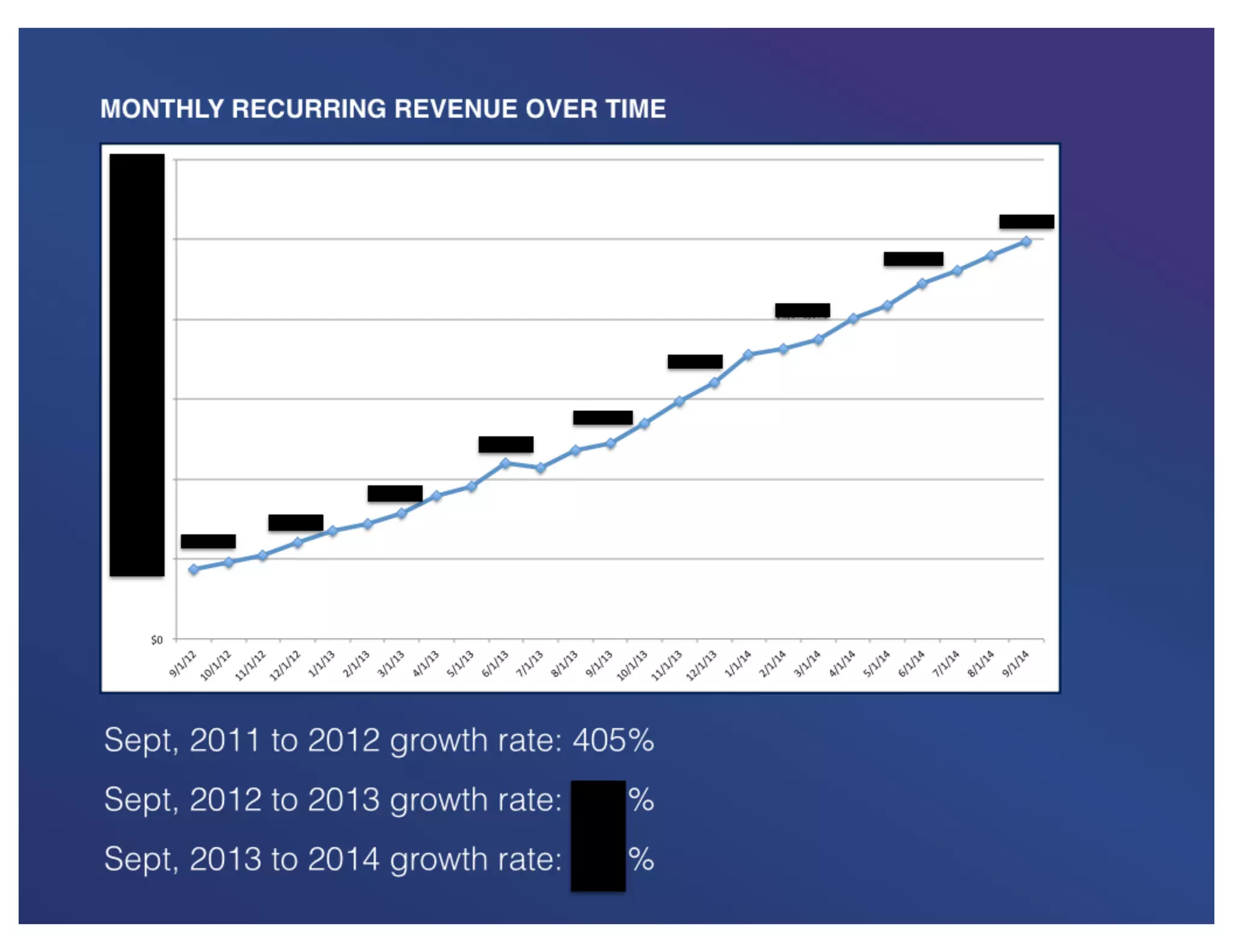
Slide 7 presents an MRR chart showing steady, steep growth from 2012 to 2014 and lists year-over-year growth rates (one shown: 405% from Sept 2011 to 2012). The visual of a rising line combined with explicit growth percentages is highly persuasive: it quantifies momentum and demonstrates that demand translates into revenue. The chart’s timeline and annotations indicate consistent progress rather than a single spike, which reduces investor concern about one-off wins.

This slide is a classic example of letting metrics tell the story: clean visuals + a few highlighted growth figures make traction indisputable. Founders should prioritize credible, chart-based evidence of user and revenue growth in early slides — graphs are often more convincing than long lists of customers because they show repeatability and scale.

Key Takeaway: Present clear, time-based revenue charts and a few key growth rates to prove sustained traction and repeatability.
GT Maturity: Sales KPIs and go-to-market metrics

GT Maturity: Sales KPIs and go-to-market metrics

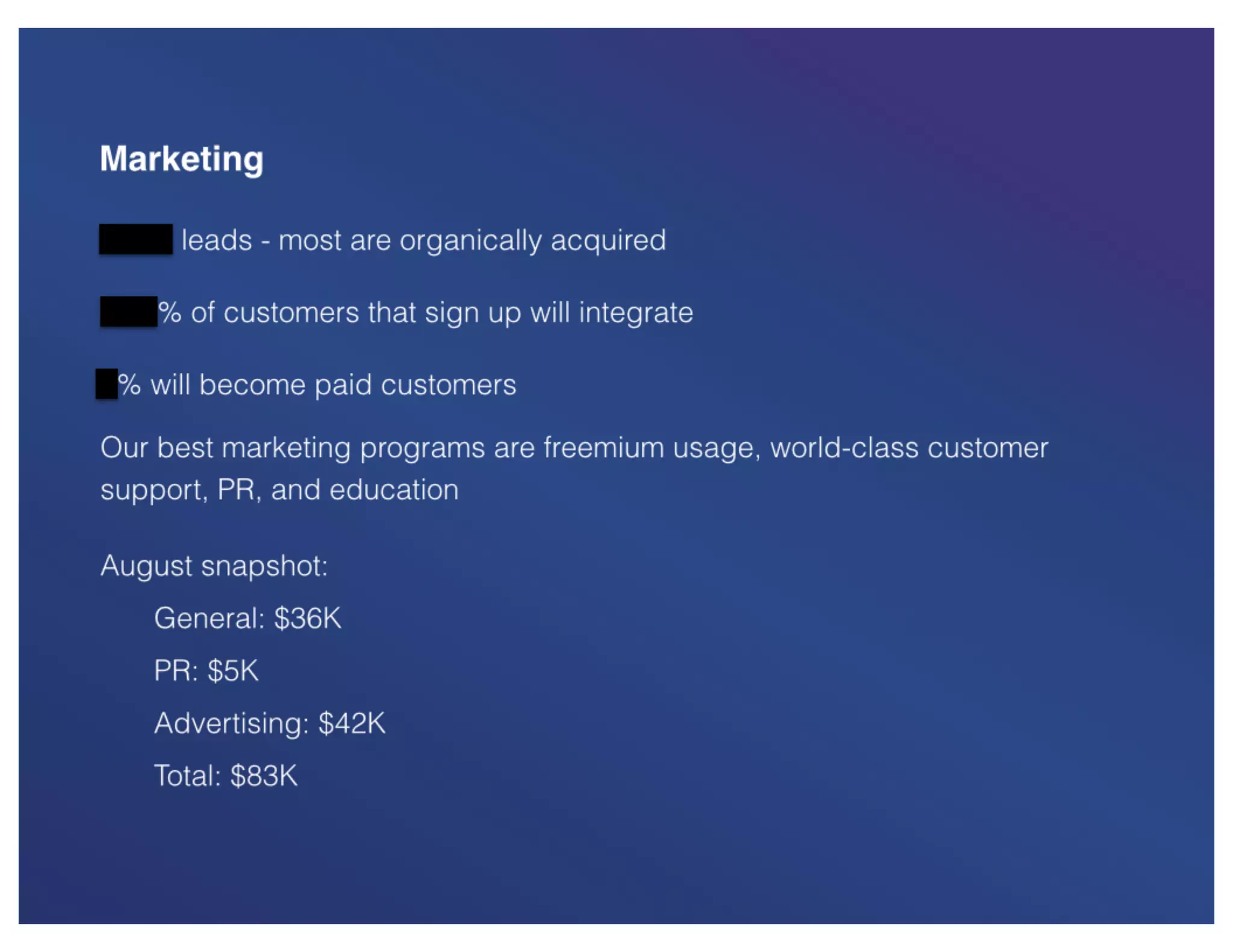
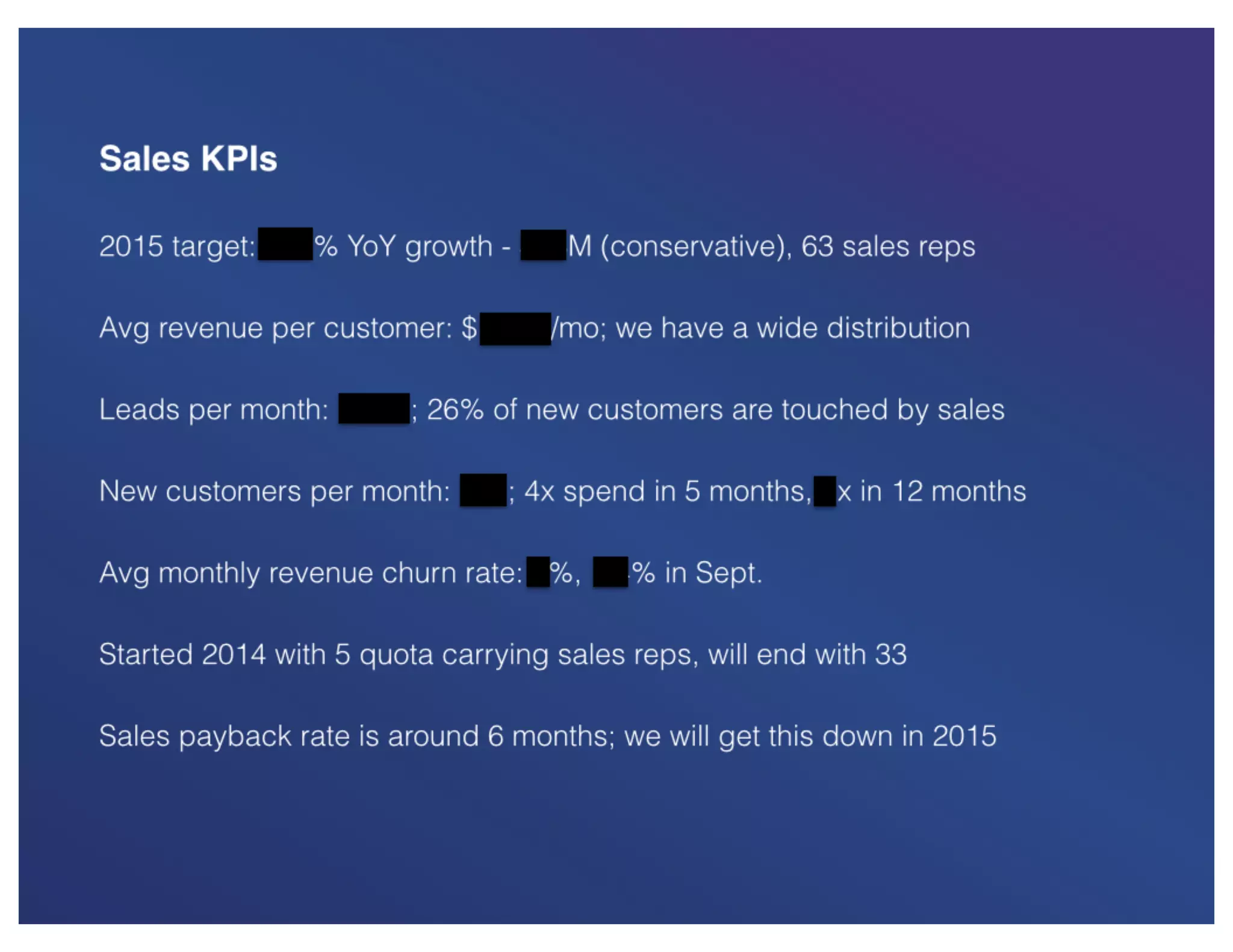
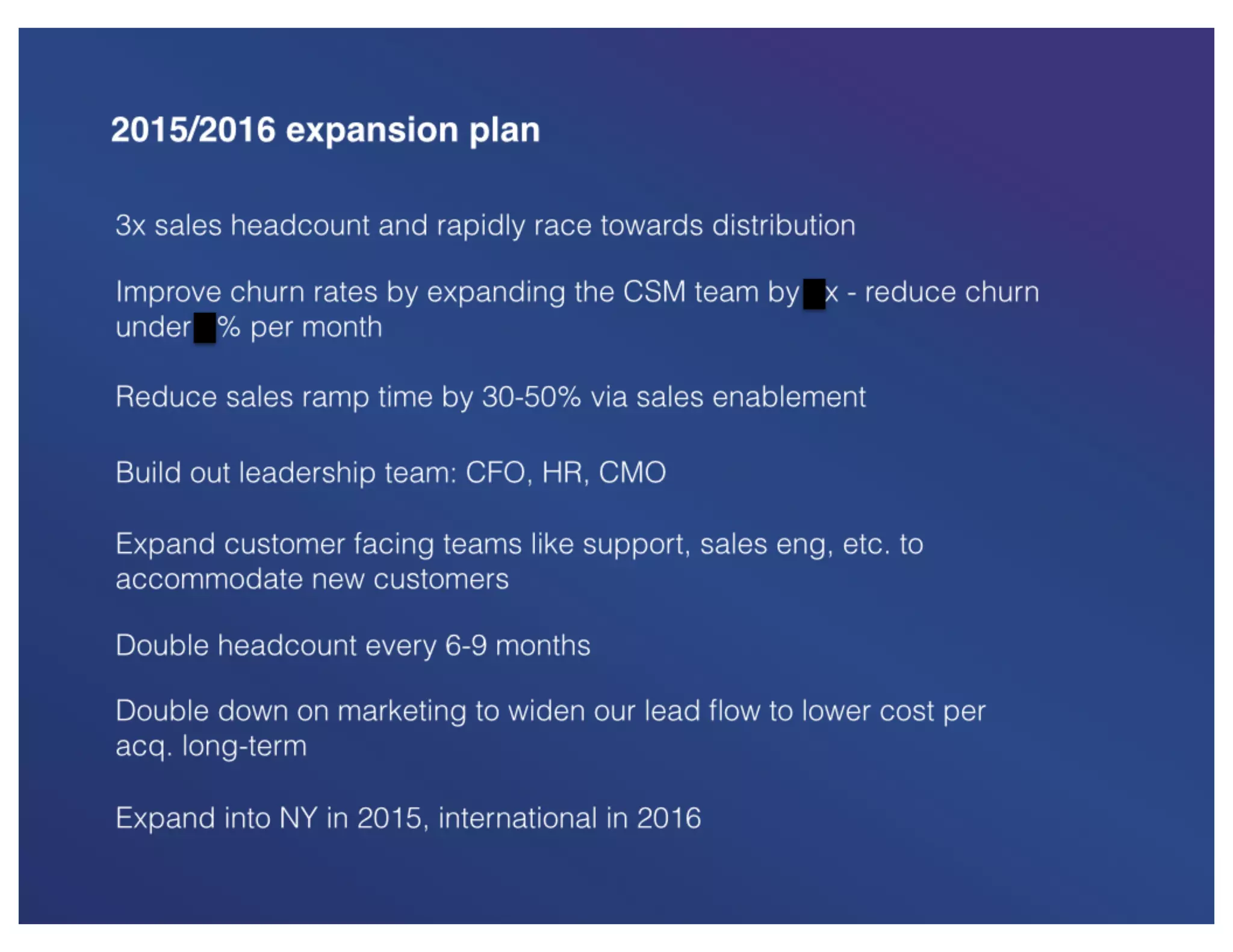
Slide 9 (Sales KPIs) provides granular operational metrics: targets, average revenue per customer, leads and new customers per month, churn rates, and sales headcount evolution. This level of detail signals that Mixpanel has moved beyond product-market fit into a metrics-driven commercial operation. Including payback period and hiring plans shows unit-economics awareness and an actionable plan for scaling the sales organization.

For investors, these are the slides that move the conversation from product to business — demonstrating CAC, churn, sales productivity, and scalability. Founders raising growth rounds should mirror this: show the engine driving current revenue, efficiency levers, and how incremental investment will change the math (e.g., shorter payback, higher ARPU). Operational transparency builds confidence.

Key Takeaway: Include concrete GTM metrics (ARPU, churn, payback, lead flow, hiring plans) to demonstrate you understand how to scale revenue efficiently.
Financing & credibility: Funding history and investor roster

Financing & credibility: Funding history and investor roster

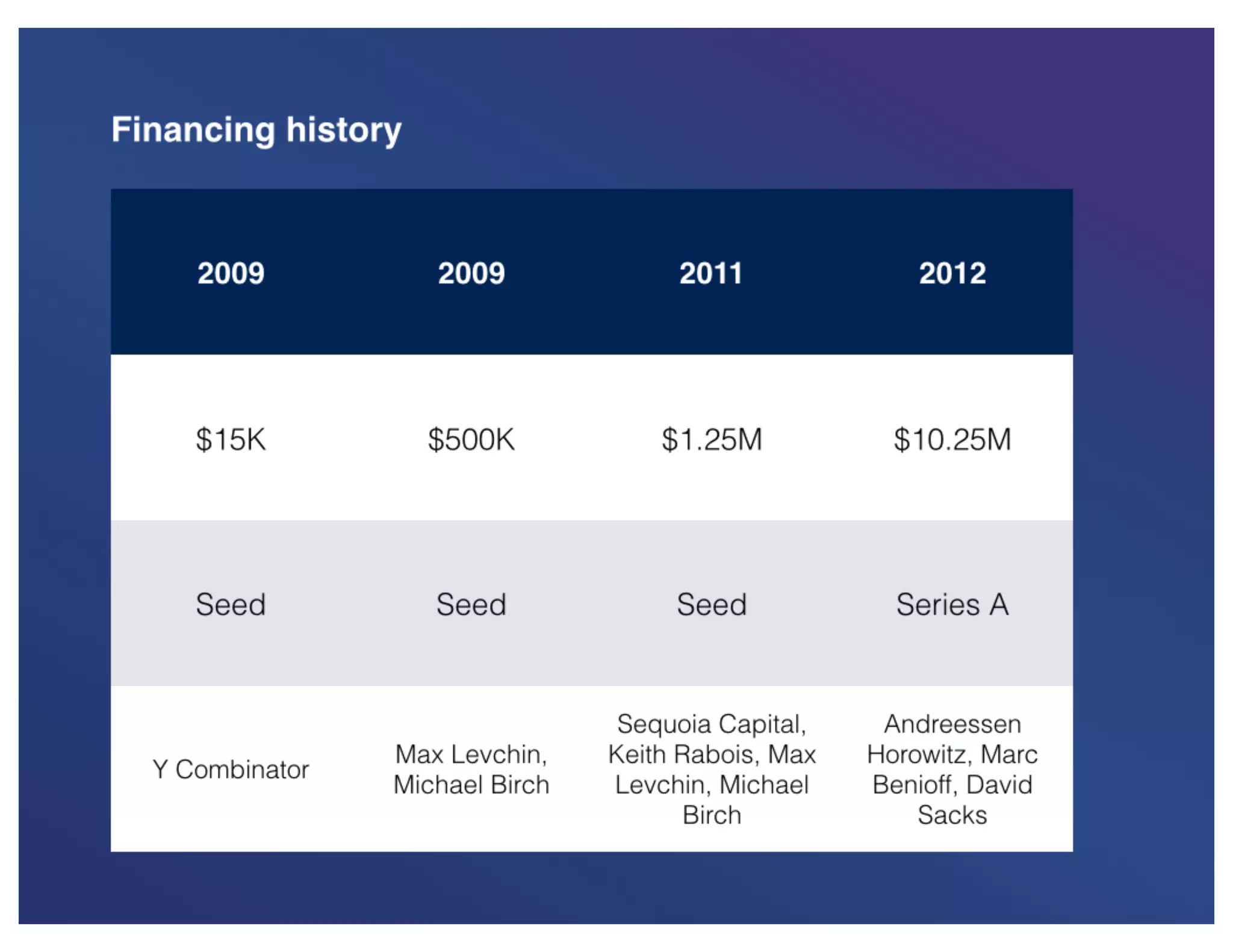
Slide 12 summarizes Mixpanel’s financing history (seed rounds and a Series A) and highlights notable backers including Y Combinator, Sequoia, and Andreessen Horowitz, with amounts from $15K up to $10.25M. This slide serves two purposes: it shows capital sufficiency to date and, importantly, social proof through respected investors. A well-known investor list reduces perceived risk and signals validation by experienced firms.

Including precise fundraising history helps investors contextualize the ask and the company’s runway progression. Founders should clearly document prior capital, lead investors, and how prior rounds were deployed — but avoid overloading the slide with minutiae. The combination of dollar amounts, round types, and credible names is efficient and persuasive.

Key Takeaway: Present a concise financing timeline with amounts and reputable investors to show validation and capital strategy clarity.

Conclusion: Key Lessons

Mixpanel’s Series B deck succeeds by combining a sharp problem narrative, a focused product/missions statement, clear traction visuals, and operational sales metrics — all wrapped in consistent, high-quality design. The deck moves quickly from why the market needs a better analytics solution to how Mixpanel has built defensible technology and is scaling revenue. For founders, the actionable takeaways are: (1) frame the problem in human and technical terms, (2) show repeatable revenue with simple charts and a few growth rates, (3) present GTM metrics that prove unit economics and scalability, and (4) use a clean visual identity to project professionalism.

When building your own deck, prioritize clarity over quantity: pick the handful of slides that prove market need, product differentiation, traction, and the plan to scale. Use concise language, one strong graph for momentum, and operational KPIs that tie spending to revenue outcomes. That combination persuades investors that you understand both the product and the business of scaling it.