Stack up against Foursquare

Compare Your Deck

Foursquare's 2009 Pitch Deck

Social
Stage: Seed
Raised: $1.3M
Year: 2009
Slides: 15
Outcome: Pivoted to B2B, valued at $400M

Pitch Deck

1 / 15
Slide 1
Click to expand

Deck Analysis

This seed deck from Foursquare (2009) presents a clear product-first pitch for a location-based social app that gamifies real-world exploration. It combines concise product descriptions, screenshots of the mobile UX, early traction use-cases (mayors, merchant tweets), and a credible monetization path focused on lead generation and sponsored badges. The deck is notable because it demonstrates how a simple, well-scoped consumer product combined with strong network effects and measurable local intent can appeal to investors and later evolve into substantial B2B opportunities.

The Opening: What Foursquare Is

The Opening: What Foursquare Is

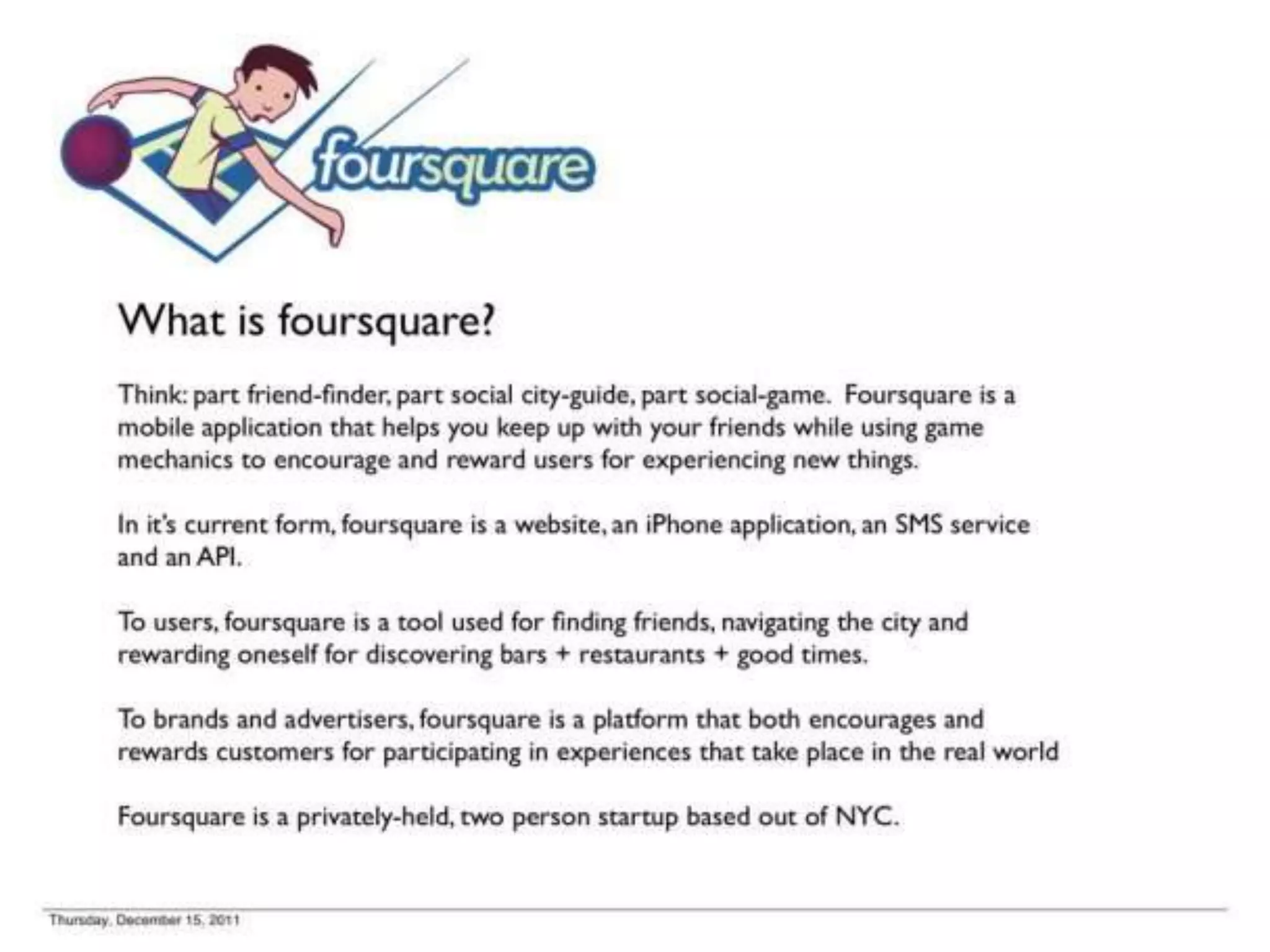
Slide 2 (What is foursquare?) functions as a compact positioning statement that immediately establishes the product as a hybrid: friend-finder, social city guide, and social game. The language is simple and benefit-focused — it tells users what the app does and tells brands how it could serve them. For investors, this kind of clarity reduces cognitive load and frames every subsequent slide against a clear value proposition.

Founders can learn from the discipline here: open with a one-line synthesis that communicates who the product is for, what it does, and why it matters to two audiences (users and brands). This slide also hints at the multi-channel product strategy (website, iPhone app, SMS, API) which signals technical breadth without getting bogged down in engineering detail.
Key Takeaway: Start with a single, tight positioning sentence that states the product, core user value, and who else benefits (e.g., brands) to orient investors quickly.
Core UX: Friend Finder (Onboarding & Immediate Value)

Core UX: Friend Finder (Onboarding & Immediate Value)

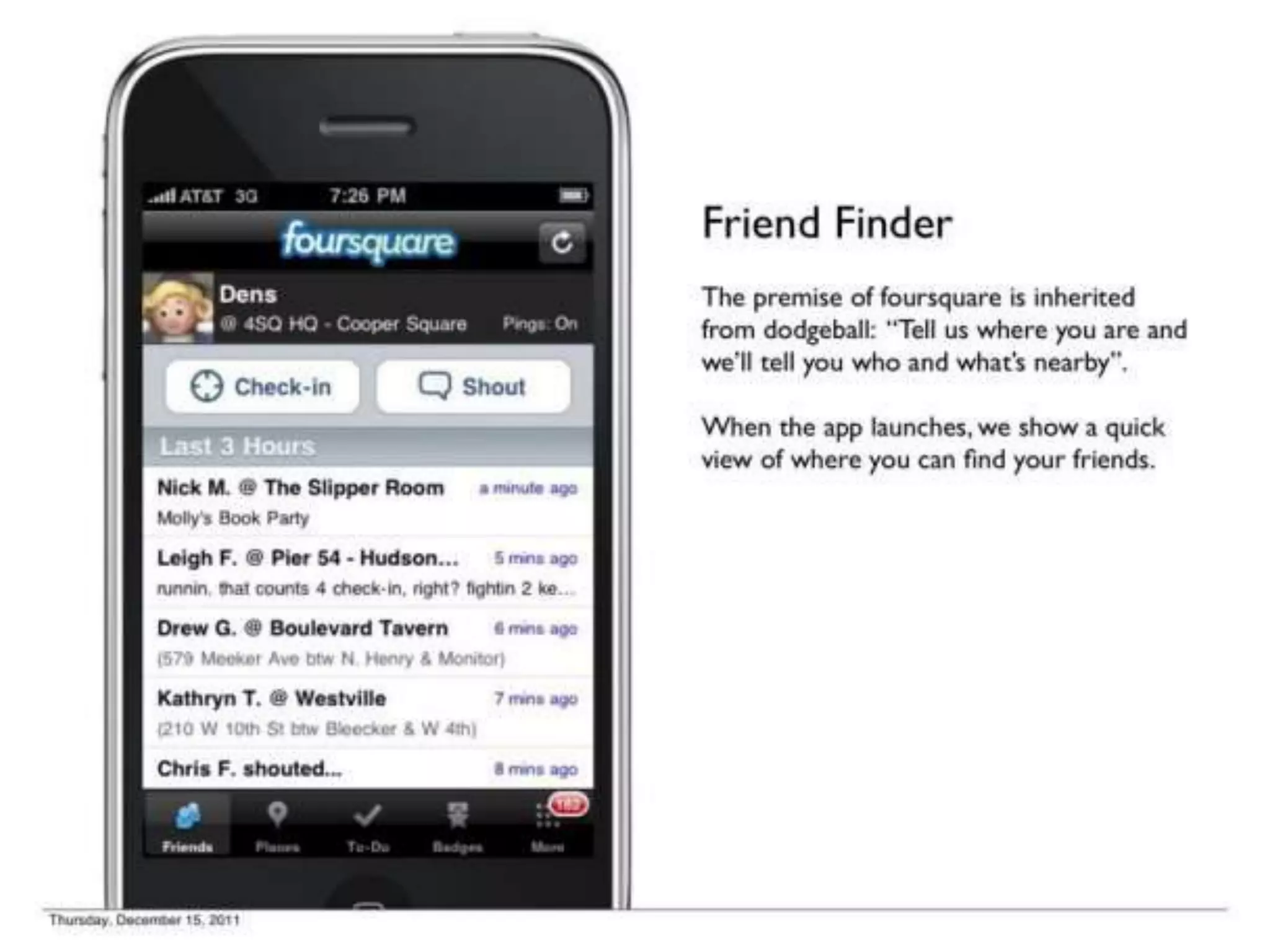
Slide 3 demonstrates the core interaction: check-ins and a near-real-time feed of where friends are. The screenshot plus a short paragraph showing the dodgeball-inspired premise ('tell us where you are and we'll tell you who's nearby') makes the immediate value palpable — users open the app and get actionable social information. Showing the live feed gives investors a feel for habitual usage and retention drivers (knowing where friends are creates recurring utility).

This slide is effective because it pairs product UI with a simple behavioral hook. Founders should mimic this: show a real UI screenshot that illustrates the simplest moment of value (what the user sees and does in the first 10 seconds) and explain the behavioral logic that drives repeat use.

Key Takeaway: Use a real product screenshot and one-line behavioral thesis to show how your app becomes habit-forming from the first interaction.
Product Differentiation: Social City Guide

Product Differentiation: Social City Guide

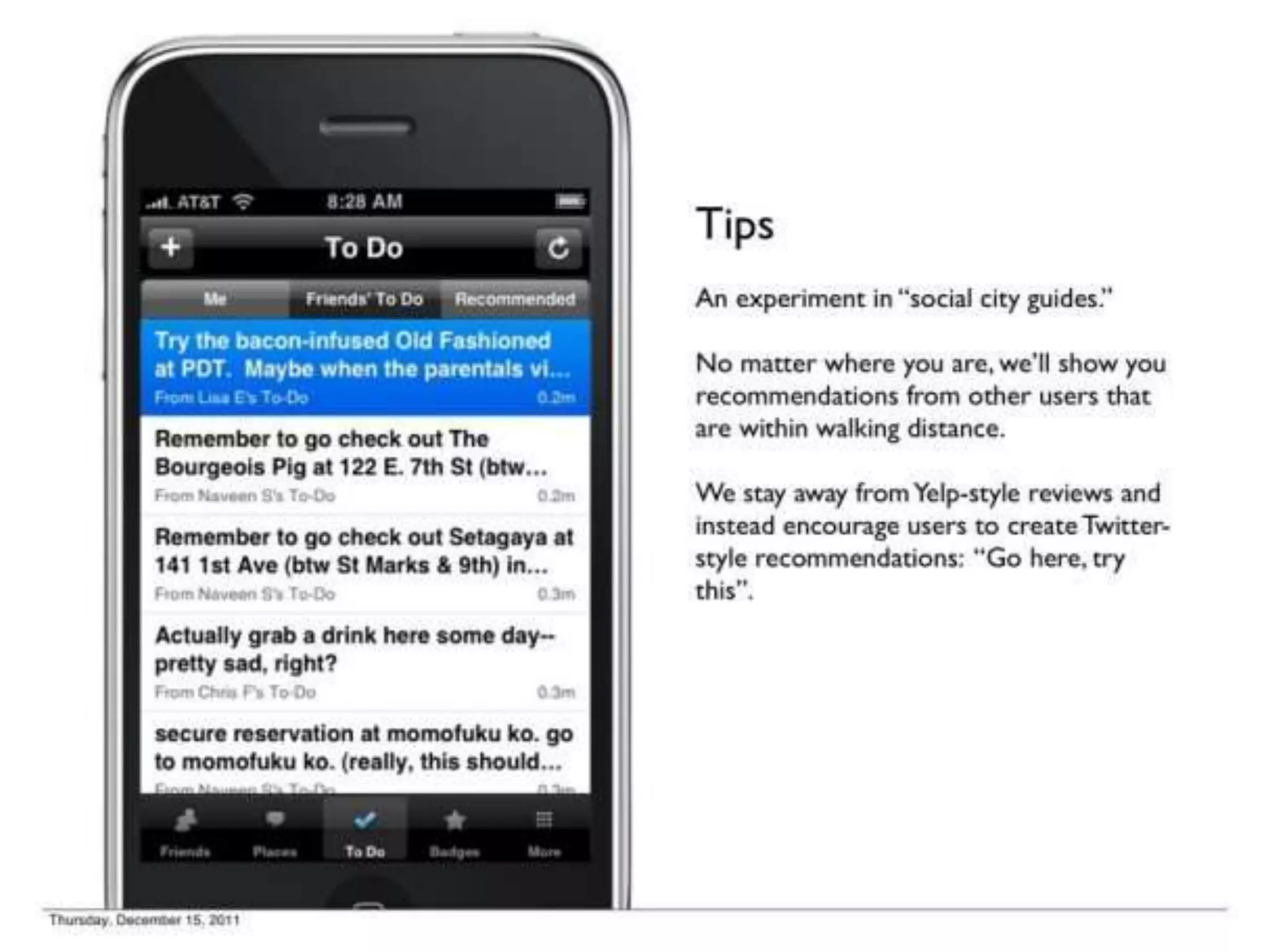
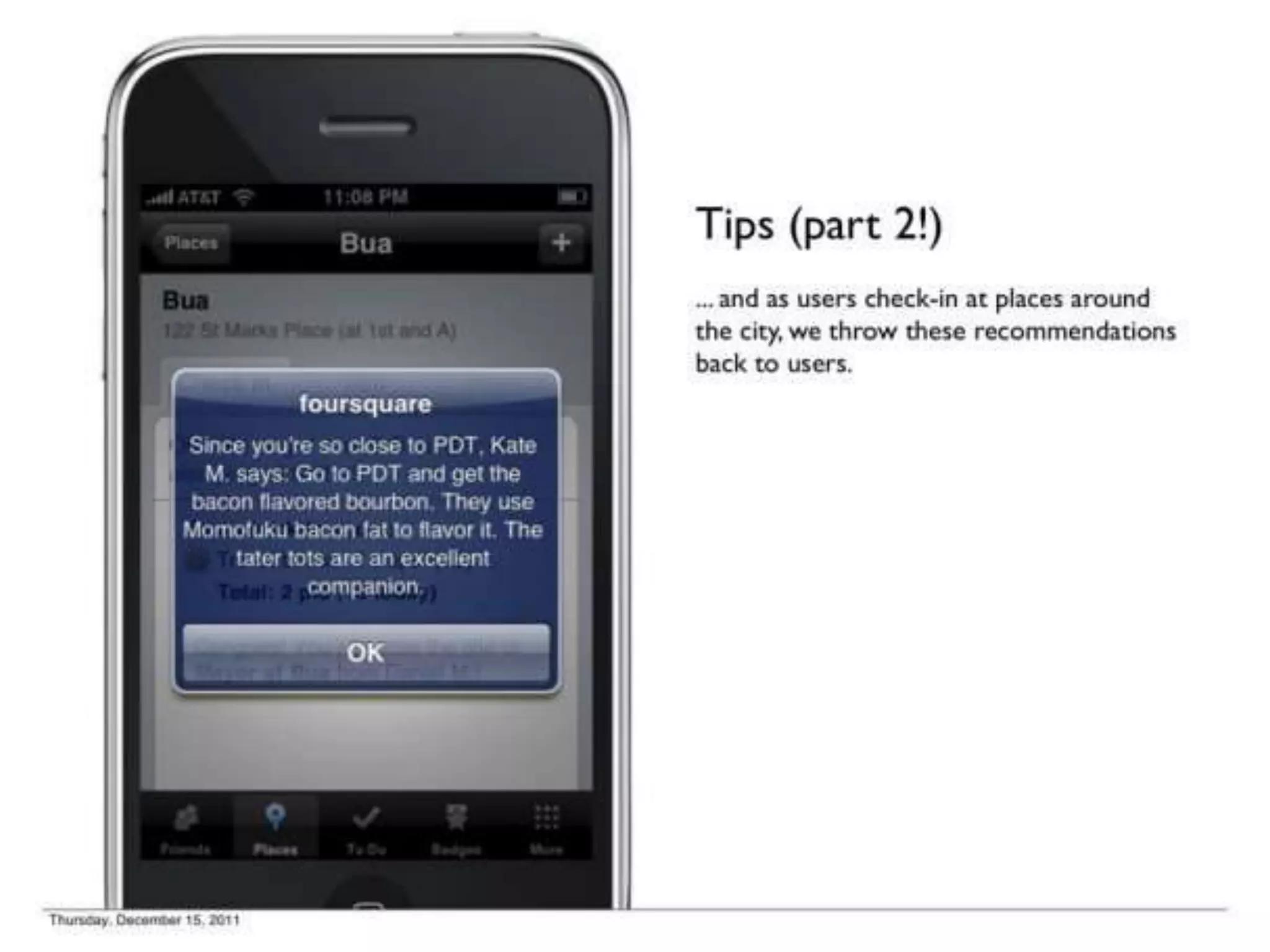
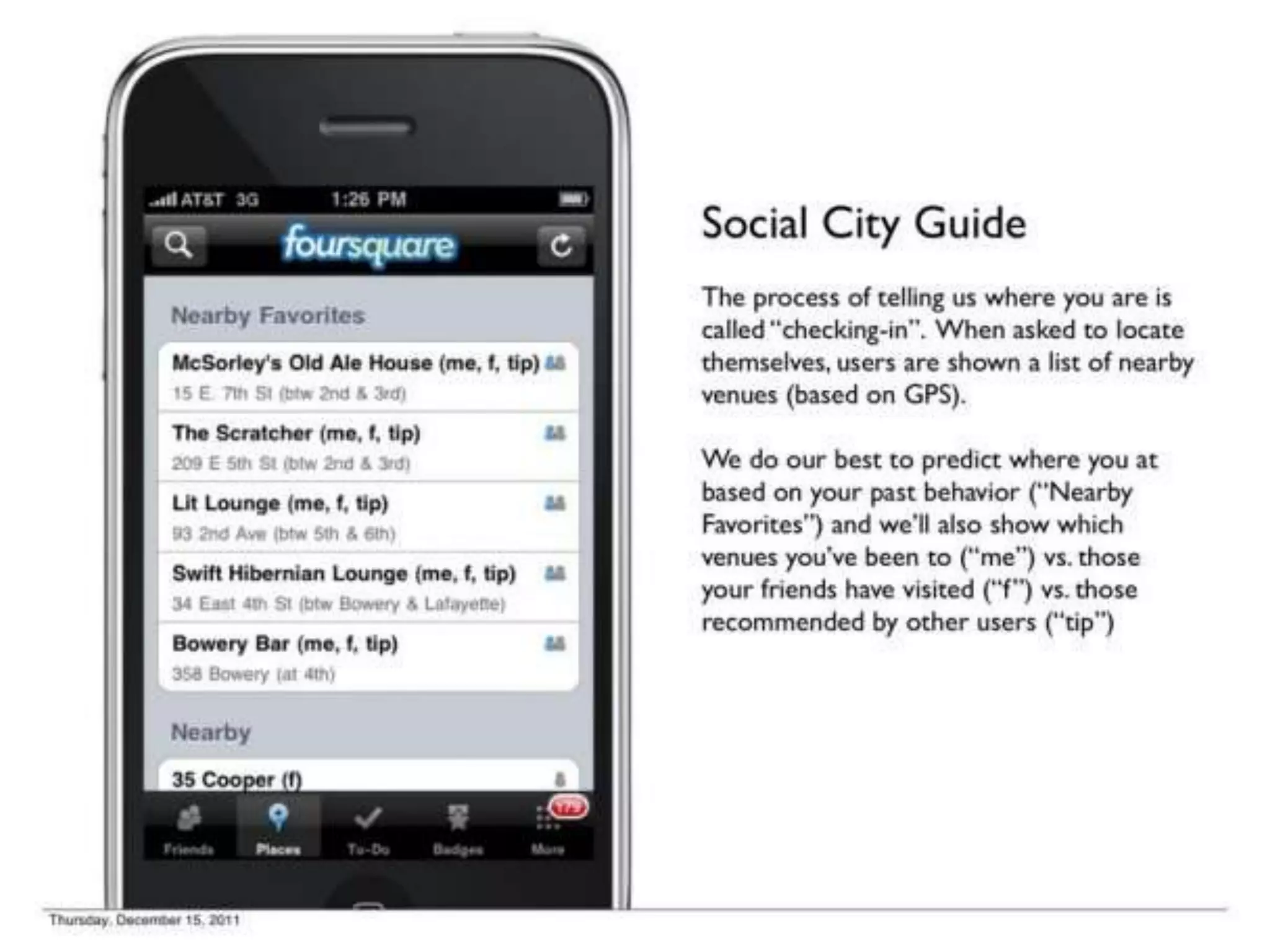
Slide 4 expands the narrative from friend-finding to discovery — how check-ins become context-aware venue suggestions and social signals ('me', 'f', 'tip'). This is where the product shifts from pure social utility to content and discovery, an important expansion of use cases that increases user engagement and session length. The slide explains predictive features (‘Nearby Favorites’) which hints at personalization and data-driven recommendations.

Founders should note how the deck layers features: after showing the core hook, it explains complementary features that broaden use and create defensibility (personalization, social proof). Explaining how signals are surfaced (past behavior, friends' visits, public tips) helps investors see pathways to differentiated product experiences.

Key Takeaway: After establishing the core hook, show adjacent features that increase engagement and build defensibility through personalization and social signals.
Game Mechanics: Check-ins, Points and Mayorships

Game Mechanics: Check-ins, Points and Mayorships

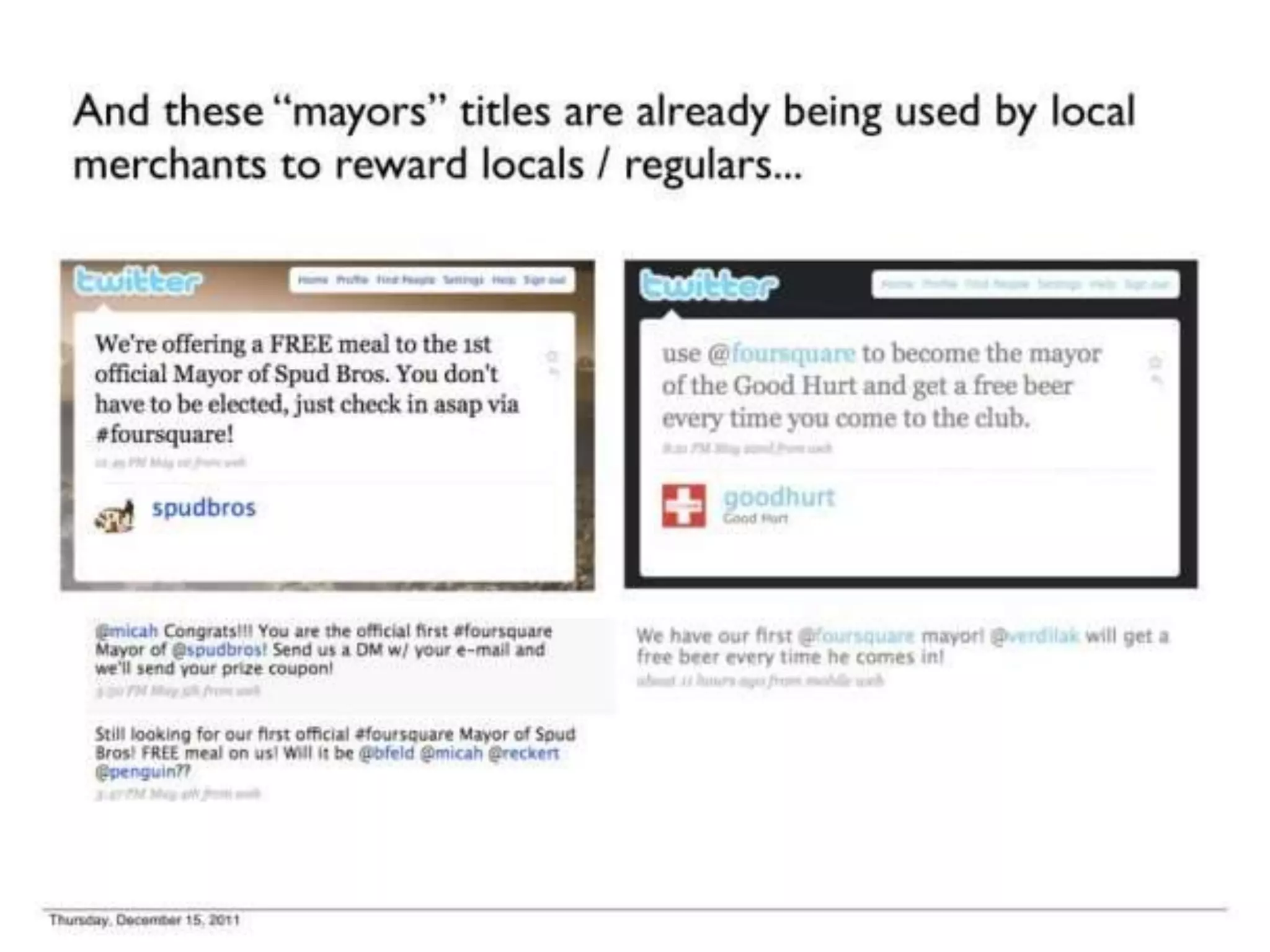
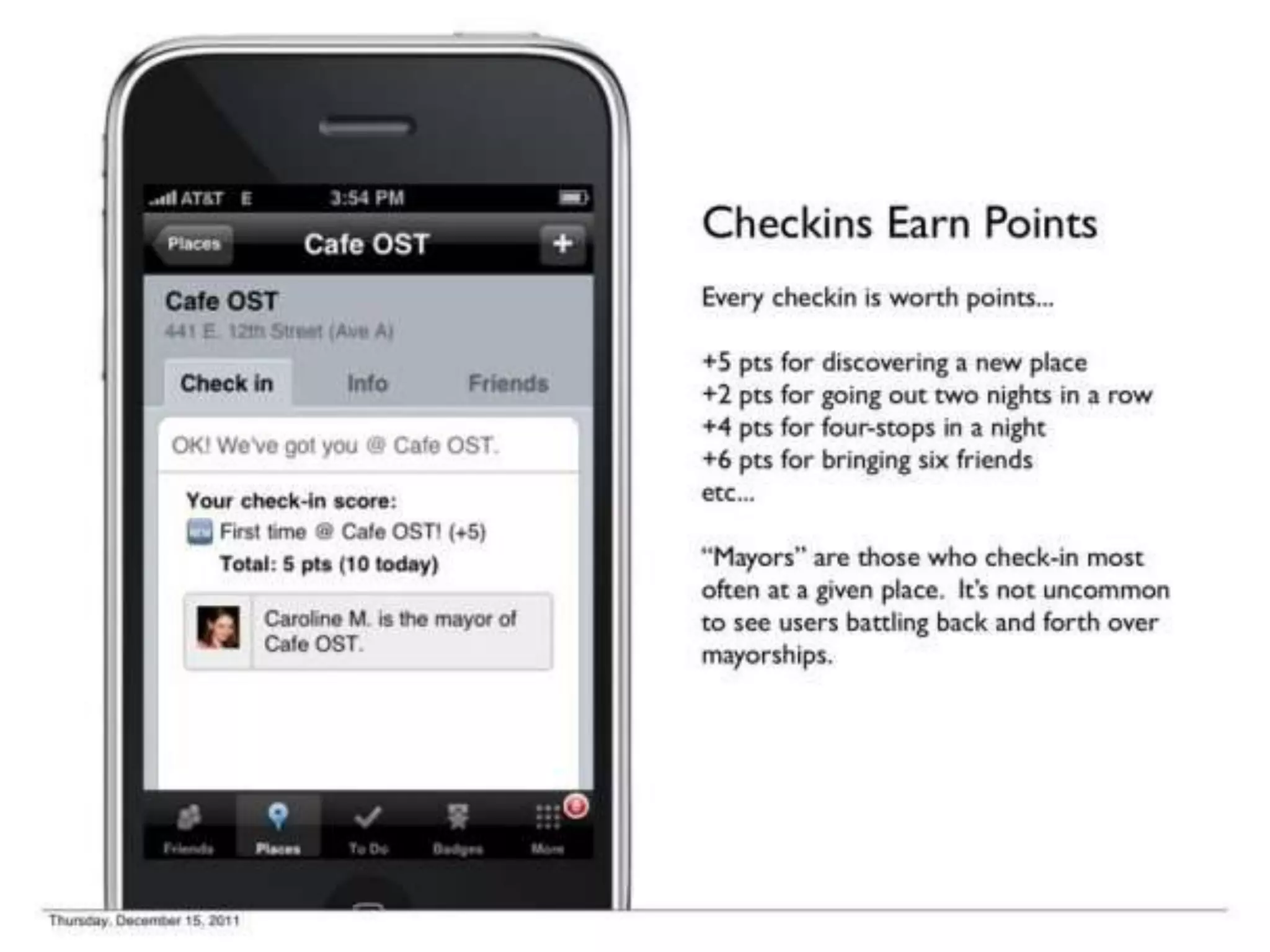
Slide 5 (Checkins Earn Points) and Slide 6 (merchant tweets about mayors) illustrate how gamification and social status drive behavior and create local incentives. The deck lists concrete point values for behaviors and describes the mayor mechanic — a simple, visible status that users compete for. Slide 6 provides immediate social proof that merchants were already rewarding mayors, turning a product mechanic into offline value for users.

These slides are compelling because they combine product mechanics with evidence of ecosystem adoption: merchants are already using mayorships as promotional hooks. Founders should emulate this by designing simple, measurable reward mechanics and showing any early third-party adoption that validates the mechanism beyond the app itself.

Key Takeaway: Design simple reward mechanics that are visible in-app and show any real-world adoption to prove the mechanic creates measurable offline value.
Retention & Social Proof: Leaderboards and Competition

Retention & Social Proof: Leaderboards and Competition

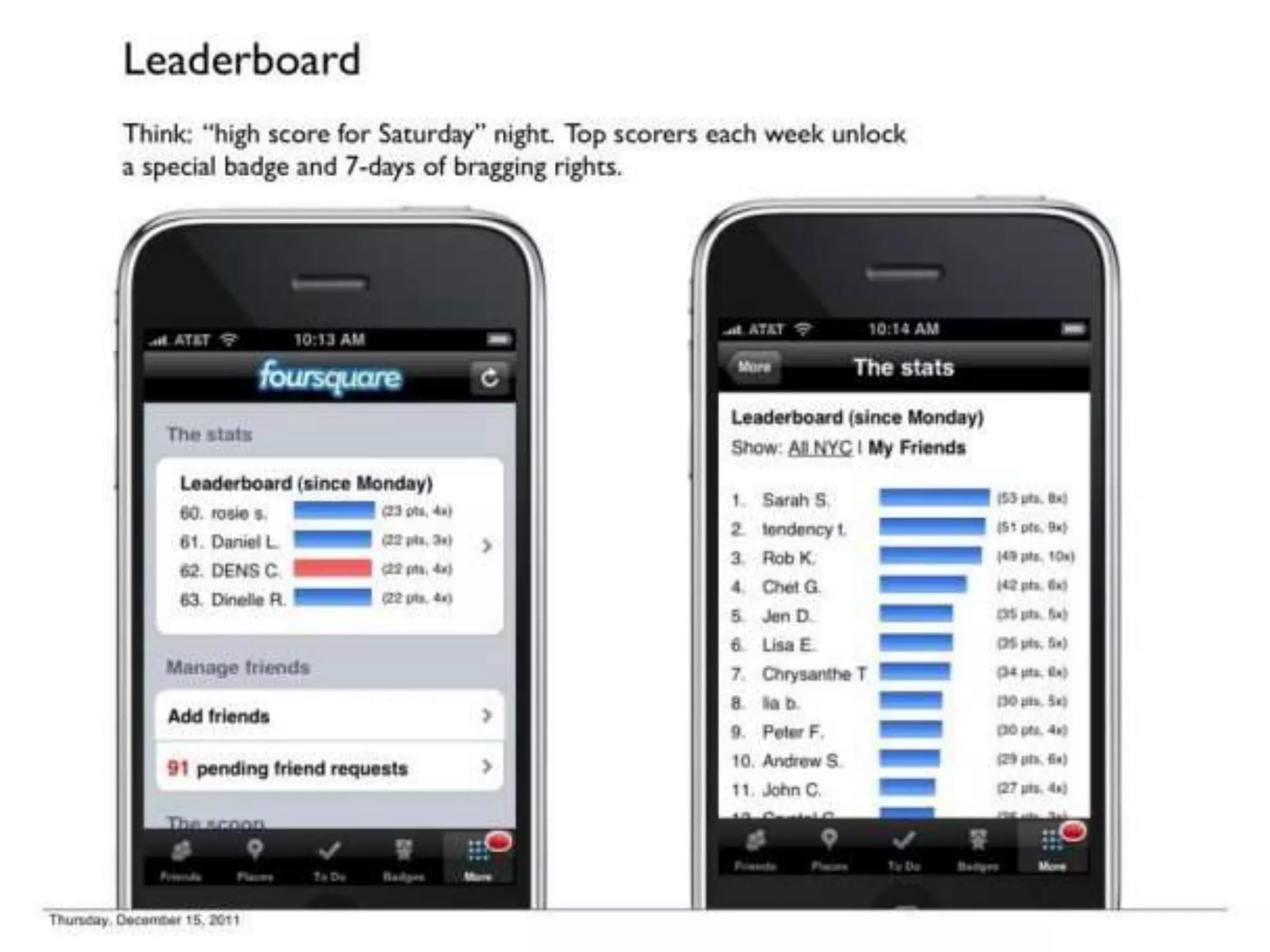
Slide 7 (Leaderboard) highlights competitive elements and social comparators — weekly leaderboards, badges, and top-scorer incentives. The slide shows both compact and full leaderboard UIs, which implies thoughtfulness about social visibility and virality (people share scores, brag, invite friends). Leaderboards and weekly competitions give users reasons to keep checking in and maintain activity rhythms.

For founders, this is a lesson in designing for social proof and repeat engagement: gamified leaderboards create recurring events (weekly competitions) and discrete goals that keep users returning. When possible, include UI examples that show how social comparisons are surfaced and how they encourage network-driven growth.

Key Takeaway: Use time-boxed competitions and visible leaderboards to create recurring engagement cycles that encourage social sharing and retention.
Monetization Strategy: Lead Generation & Sponsored Badges

Monetization Strategy: Lead Generation & Sponsored Badges

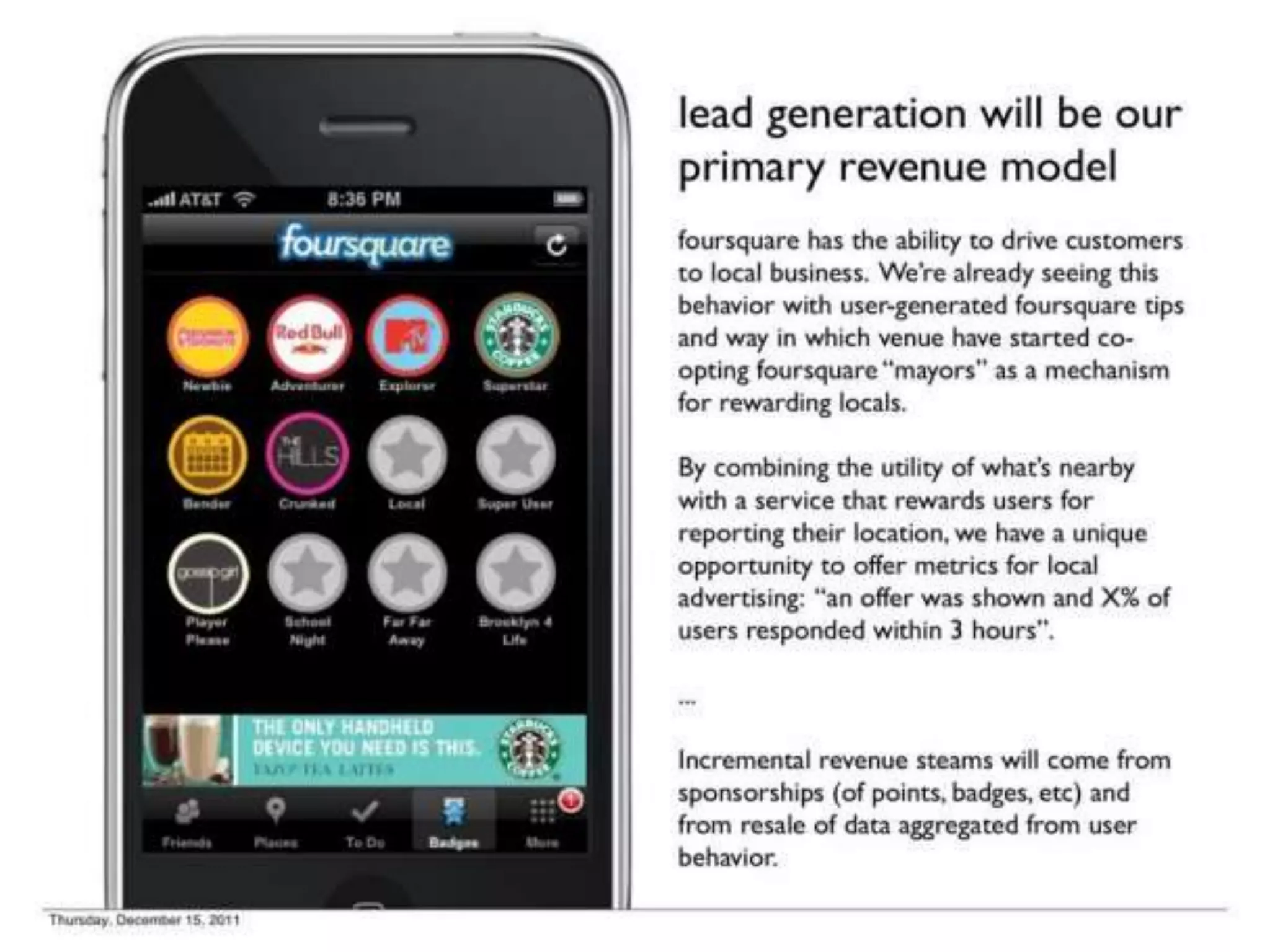
Slide 11 lays out the primary revenue hypothesis: converting ephemeral check-in intent into measurable leads for local businesses. It argues that by combining 'what's nearby' utility with reward mechanics, Foursquare can offer advertisers tight response metrics (e.g., shown an offer and X% responded). This positions the product as an advertising and local-commerce channel rather than a pure social network ad play.

This is a strong example of aligning monetization with core product behavior. Founders should align revenue with an action that users already take (in this case, check-ins) and propose measurable KPIs that matter to advertisers (impressions => responses within a timeframe). That alignment makes the revenue path credible rather than speculative.

Key Takeaway: Tie monetization directly to a core user action and present clear, measurable KPIs that demonstrate value for advertisers or partners.
Incremental Revenue: Sponsored Badges, Redeemable Points, Banners

Incremental Revenue: Sponsored Badges, Redeemable Points, Banners

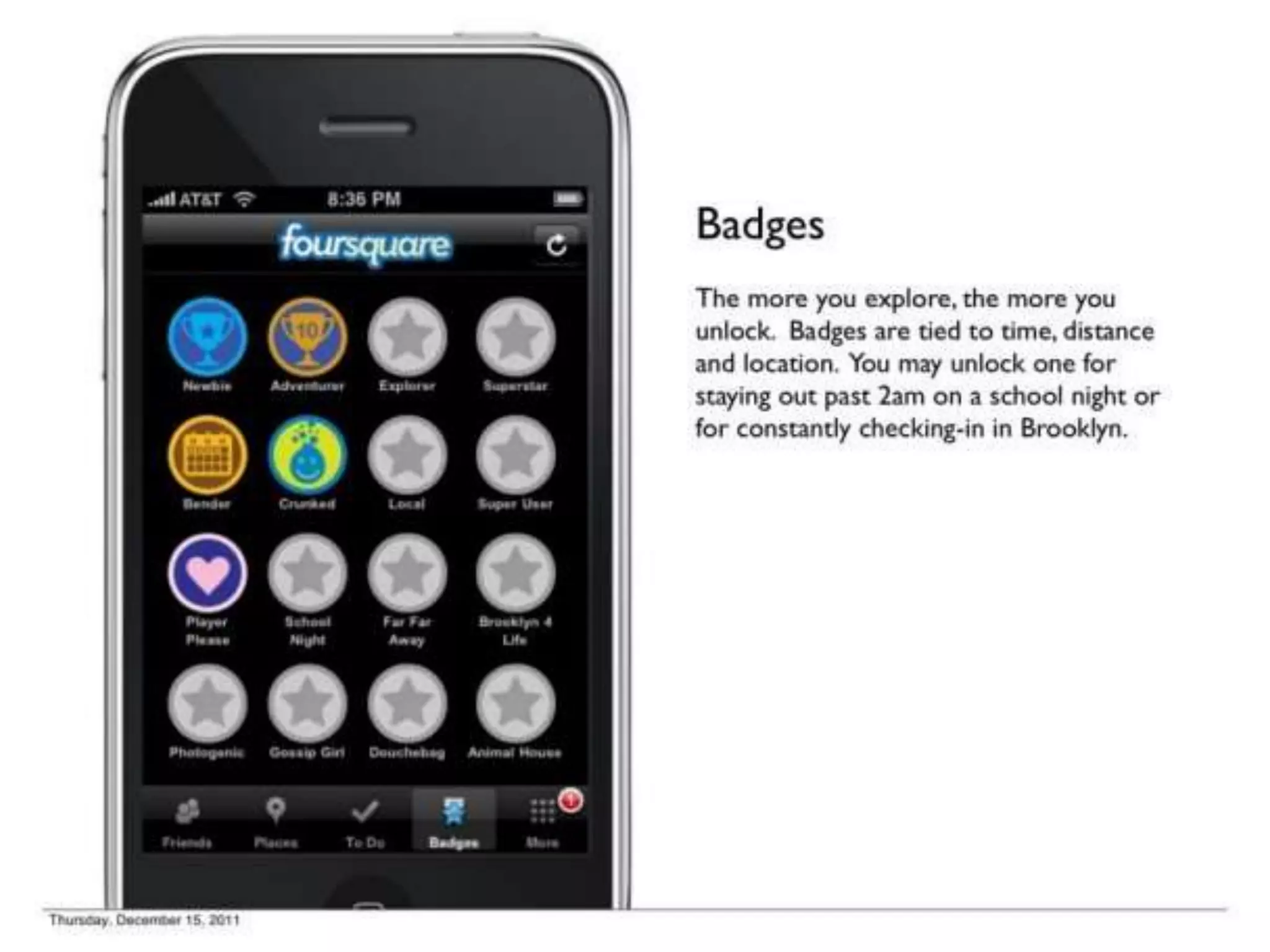
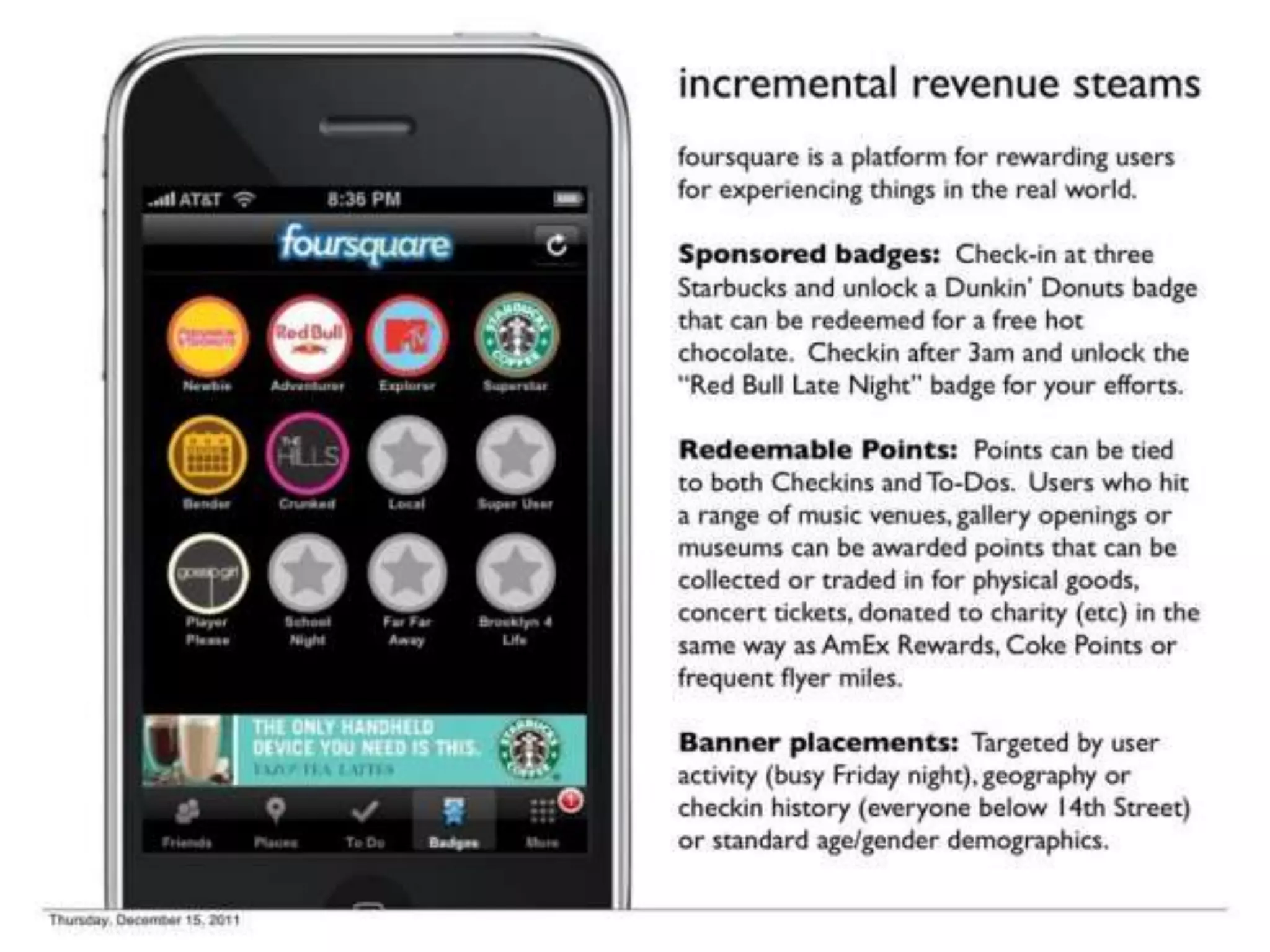
Slide 13 drills into incremental revenue streams: sponsored badges, redeemable points, and targeted banner placements. Each concept maps to product behaviors — badges for visits, points for collections, banners for targeted times/locations — and suggests potential sponsor relationships (brands, local businesses). The slide shows an early understanding of productized ad units that respect user behavior while offering measurable outcomes for sponsors.

Founders should take from this the importance of multiple, complementary monetization experiments that fit naturally into the product experience. Present several non-invasive, testable revenue ideas with examples of how they'd be tied to product events and measurement. This reduces risk and gives a roadmap for early partnerships and A/B tests.

Key Takeaway: Propose multiple monetization experiments that align with natural product events and are easy to measure and test with partners.

Conclusion: Key Lessons

Foursquare's seed deck is an exemplar of product-led storytelling: it opens with crisp positioning, shows the simplest user moment of value with real UI, layers gamification and social mechanics to drive retention, and ties monetization directly to the core behavior (check-ins). The deck balances user-focused narrative with credible business models and early evidence of third-party adoption (merchants rewarding mayors), which together reduce investor risk.

Actionable advice for founders: lead with clear positioning and a screenshot that shows the 'a-ha' moment; design and present product mechanics that create habitual behavior; show any third-party validation early; and propose monetization that maps directly to user actions with measurable KPIs. Finally, include a few incremental, low-friction revenue experiments — sponsors, redeemable points, targeted placements — so investors can see both immediate and scalable paths to revenue.